I want to review Lafferty's short story 'For All Poor Folks At Picketwire' (1975) next, but I feel compelled to try to get this off my chest first. It's probably completely unnecessary for a lot of readers, but it's something that puzzles and intrigues me. Feel free to demur from or expand on the view expressed below.
Since I first started publicly writing about Lafferty in 2009, I've claimed that Lafferty is weird, odd, strange, experimental, and bizarre in a way that the first-time reader is just not going to expect. Nothing will have prepared you for how Lafferty goes about being offbeat, even 'crazy'. I know that people often hear about 'the Lafferty madness' (as the likes of Harlan Ellison and Samuel Delany called it when Lafferty's fiction emerged on the scene in the 1960s) and they understandably think of the experimentations of the likes of Captain Beefheart perhaps, or the paranoid but fascinating open and subversive universe of the likes of Philip K. Dick perhaps. Or you name it. Whatever your background makes you think of when you hear the claim that someone is utterly original and 'insane' and the like, that thing you're thinking of, it's almost guaranteed to not be an apt comparison or preparation for Lafferty.
Even as I say all this - that no one is like Lafferty, nothing can prepare you for his brand of weirdness - you're getting the wrong idea! Why? Because when we hear such encomiums we generally think of one of two things (or both). We think either of something crazy in a really cool and 'hip' sort of way, something experimentally-minded college students might get into maybe, or something a well-(if-defiantly-)dressed 'alternative' crowd of one variety or another might champion. I get that. I was a teenage punk rocker and never grew out of it. When I think of crazy and original, I think of bands like The Birthday Party or The Fall (or in an alterna-metal direction, Mike Patton and his projects Mr. Bungle and Fantomas). If you're thinking speculative literature, you might think Neil Gaiman or China Mieville. If film, maybe David Lynch or the wackier and wilder aspects of the Coen brothers or Tarantino. But Lafferty's work is not (or not immediately) like all this, not soaked in these kinds of aesthetic assumptions and expressions.
On the other hand, the 'crazy-original' claims might make us think of really 'out there' bizarro examples like maybe Daniel Johnston or the aforementioned Captain Beefheart. If film, then maybe the likes of Terry Gilliam or John Waters. This impression is closer to the mark. But in most of these cases there can still be an aura of (usually countercultural) 'coolness' about the weirdness.
Now don't get me wrong. I often exclaim 'Cool!' in response to what I read in Lafferty. But I mean it the way I meant it as a kid in the 80s - an expression of sheer enthusiasm for something that strikes me as in some way excellent. Not as a confirmation of something's 'hipness', something's trendy now-ness, even by 'alternative' or 'indie' standards. Nor do I mean to deny that Lafferty is deeply countercultural in his own way (indeed, he's probably better called counter-ontological so reality-bending is his work and perspective). Lafferty was indeed what he called a 'queer fish', swimming crankily but joyously against the mainstream.
I also don't want my denial that Lafferty is 'cool' to give the impression that his weirdness is 'geeky'. Lafferty isn't comic-con weird either. Lafferty can, in certain respects, fit in both worlds - the geeks and the hipsters. Yet he is a misfit in both as well. That was seen to be the case when the 1960s/70s New Wavers of U.S. science fiction - Harlan Ellison, Roger Zelazny, Samuel Delany, and the like - championed Lafferty. They never lost their love of Lafferty's work, but they eventually didn't know how to categorise him as he was clearly not of or in the fold. All in all, Lafferty is by turns too literary, too genre, too experimental, too dark, too comic, or too difficult for various groups. That's why his work has tended to generate its own category of literature (what Theodore Sturgeon called 'lafferties') and its own following of Laffertyans or Laffertians, a diverse fan base comprised of all schools and allegiances, the unifying commonality being that they are struck and captured by Lafferty's unique genius.
So what should you think of when you hear that Lafferty is 'a genius, an oddball, a madman' and 'a genre in himself' (Neil Gaiman) or that 'Lafferty has the power which sets fires behind your eyeballs' (Zelazny) or that Lafferty 'bends or breaks normal story restrictions apparently at will' and has 'the most unfettered imagination' (Terry Carr) or that 'Lafferty is fun, sophisticated, and utterly insane', 'a madman, a wild talent' (Reader's Guide to SF)?
Well, maybe start by thinking of the likes of Amos Tutuola or Black Elk. Like them, Lafferty is a native primal force, an individual that grows out of the fecund soil of an ancient communal worldview and speaks the cosmic magical vision of a people, stamped with his own idiosyncrasy, sure, but overflowing with more than what one individual could ever imagine or convey. Yet Lafferty had more than one soil to grow out of - not only his family's Irish-Catholic soil, but also the Southwestern American Frontier and the lives and lore of his Native American neighbours. If you cut Lafferty, he bleeds all three.
Further complicating this possible resonance, Lafferty was classically educated in Augustinian and Thomist traditions, well-read in history and theology and philosophy, knowledgable of the hard and soft sciences, abreast of some major 20th-century developments in thought such as Jungian psychology and Teilhardian cosmology. Lafferty was a largely self-taught but impressive polymath. So his weirdness is going to be not only primally visionary like Tutuola and Black Elk, but also inevitably book-learned (albeit inclusive of some cranks and conspiracy theorists). So maybe when you hear about Lafferty's mad experimentation you should be thinking also of Joyce's Ulysses and Finnegans Wake. Or in a slightly different register, the wildnesses of Chesterton's buoyant dialectics and carnivalisations. (The weirdest parts of Kafka might be appropriate here too, but minus the unmitigated bleakness.)
Yet Lafferty is even more than the above hybridity of Mystic and Man-of-Letters (+ a pinch of crackpot) suggests, for he also embodies regional and class (Oklahoma and blue-collar) dialects, dictions, and perspectives that liberally salt his visions and sophistications with homespun wit and wisdom. And these perspectives puncture a whole helluva lot of pomposity and intelligentsia-speak along the way (though they don't foreclose Lafferty's own arcane and sesquipedalian theorisings, which are frequently embedded into his stories). I suppose Lafferty might be a bit of a Mark Twain in his knowing and humorous use of colloquialism, except that he comes across as more thoroughly from these classes, child of an extended frontier family as he was. This sincere rusticism is one crucial way in which Lafferty will surprise many a reader expecting The Cool Weird from him.
Now, all that said, once you've encountered and immersed yourself in Lafferty a while, it's not altogether unlikely that you will indeed end up thinking of him as a literary-yet-rustic Beefheart or Lynch, an 'outsider artist' and auteur in one. And dammit, Lafferty's weirdness is cool! So utterly cool, what would've made us 80s kids exclaim with approbation: 'Bad!' And it does get crazy weird and beautifully bizarre and sometimes disturbing. And its weirdness is deep, because Lafferty, like Lovecraft, is playing for keeps. This is a cosmic view of things that gets beneath the surface into the ontic architecture of existence.
All right, let's get back to reading these stories one by one.
Showing posts with label weird. Show all posts
Showing posts with label weird. Show all posts
Monday, September 7, 2015


Thursday, January 15, 2015
Again, Buffalopunk - Lafferty and Weird West
Okay, I'm going to try to keep more 'notes' here on my long-term project of interpreting Lafferty through the nexus-lens of:
* Monster Theory,
* Southwest Regional Writing,
* Environmental Writing,
* Ecocriticism (especially Dark Ecology),
* Theology (especially Ecotheology, Theology of Monsters, and Thomism),
* Metaphysics (especially Object-Oriented Ontology, Speculative Realism, Weird Realism, et. al.),
* and my own emerging (puling to be precise) theory of an 'Ecomonstrous' aesthetic.
Today I just want to scratch a few thoughts about Lafferty's fiction in relation to the Weird West subgenre. Roughly, a 'weird west' tale tends to mix classic western genre motifs with the monsters and horror of Weird Fiction (ala Lovecraft if you're Old School and Vandermeer if you're New School [and Miss Jackson if you're Nasty]).
It's kind of like Cowboys & Cthulhu.
Or Lovecraft meets L'Amour.

To me, it's a plenty stretchy genre that can also include things like Space Westerns and Future Westerns (e.g. android gunslingers) and other such genre-blending permutations (in the far reaches there are comic books series such as Cowboy Ninja Viking and Six-Gun Gorilla). And it can draw not only on roots of classic westerns but also American Indian lore and Weird Mexicana (e.g. Día de los Muertos). It overlaps a little with Spaghetti Westerns and Gonzo Westerns and Anti-Westerns (Cormac McCarthy's Blood Meridian being the quintessential specimen of this last type) and even the Southern Gothic literature of the likes of Faulkner and Flannery O'Connor. For me, it's a loose and suggestive conglomeration of tangentially related imagery and concepts.
Enter Lafferty. He's never going to truly fit any genre. He mutates everything he touches. Such is the case here. He overlaps with some of the territory of westerns because his settings are frequently those of his own lifelong Southwestern environs, mainly his native Oklahoma. Though many of his Oklohaman settings, in both novels and short stories, are urban, many also feature the wider non-urban landscape. (And even the tales set in a city - frequently Tulsa - tend to have an eye for regional features.) Since Lafferty's fiction tends to have a hefty dose of American Indian influence as well as stylistic innovations that made him at home in 1960s/70s New Wave science fiction for a while, I call his excursions into western-y territory 'buffalopunk' (think 'cyberpunk', 'steampunk', etc.).
Indeed, buffalos themselves sometimes feature in his yarns (e.g. 'Days of Grass, Days of Straw', 'Inventions Bright and New') as well as their 'byproducts' (hides, horns, meat, etc.). And just think of all the instances where some character, instead of crying bullshit, cries 'Oh, Buffalo Hokey!' And so it is with all the other fauna, flora, landscape, and general ephemera of the Southwestern region, which show up in equal doses of focused attention, background assumption, offhanded asides, and enmeshed textural detail. You may not have even noticed it, but once you're paying attention, you'll see it often: mesquite, coyotes, mesas, cattle, mountains, mountain lions, plains, 'bottoms', 'flats', crayfish, kit foxes, bears, and much, much more.
Of course, all these regional elements are either themselves 'weirded' in some way or are attendant upon the joyfully bizarre Laffertian carnival we've all come to expect from his tales: the weirdness may be in the form of magic, horror (both visceral and ghostly), mad science, aliens, monsters, extreme violence or gore, dystopia, and general metaphysical antics (doubled people, landscapes that won't behave properly, skies raining everything but cats and dogs, talking fauna, persons filled with sawdust or confetti, etc.). Hence the '-punk' suffix.
You can think of your own list of stories that feature strains of Lafferty's buffalopunk, but some that spring to my mind are (in addition to the few named above) 'Boomer Flats', 'Happening at Chosky Bottoms', 'Narrow Valley', 'And Walk Now Gently Through the Fire', 'Sodom and Gomorrah, Texas' and 'Oh Tell Me Will It Freeze Tonight'. These all take place in the Southwest, but even in Lafferty's offworld stories there is often a noticeable element of buffalopunk: e.g. 'Pig in a Pokey', 'Snuffles', 'Golden Trabant', 'Smoe and the Implicit Clay', etc. (Also, a number of his earliest stories, which are only recently beginning to come to light to a wider audience, are quite regional, though some are perhaps a little lighter on overtly freakish 'punk' elements: e.g. 'The Wagons', 'Rain Mountain', 'Ghost in the Corn Crib', etc.)
His novel most relevant to this theme is obviously his historical epic of the Choctaws Okla Hannali (1972), but The Reefs of Earth (1968) comes a close second as a science fiction novel in full Southwestern Gothic-Weird mode, with its backwoods setting, murderous alien children, lively Indian mounds and so on.
But what provoked this whole meditation for me was that I ran smack into a whole chapter of buffalopunk (IV: 'Liar on the Mountain') in my now third re-reading of Fourth Mansions (1969). I'd remembered that the landscape behaved strangely in this passage, but I didn't remember how repletely Weird West this chapter was, complete with a Texas-Mexico setting (the same territory as McCarthy's Blood Meridian). There is a very western 'mesquite and sagebrush' landscape described, which is rolling like the sea (an image of western plains I've seen in sources as diverse as McCarthy and Zane Grey, but here rather more literalised) and taking on impossible dimensions the further into it they go. There's a preternatural guardian, a short bloody boar hunt, a cave-cooked meal, and even a many-tentacled black monster in a fountain in this chapter. A delightful excursion into weird western!
The rest of the novel is very Tulsa urban, and still evinces not a little of buffalopunk, but that Lafferty just went full western in this chapter kind of freshly hit me and reminded me how frequently recurring is his element of buffalopunk. Now I'm going to be trying to catalogue all its appearances and allusions. (What, me obsessive? Pshh.)
* Monster Theory,
* Southwest Regional Writing,
* Environmental Writing,
* Ecocriticism (especially Dark Ecology),
* Theology (especially Ecotheology, Theology of Monsters, and Thomism),
* Metaphysics (especially Object-Oriented Ontology, Speculative Realism, Weird Realism, et. al.),
* and my own emerging (puling to be precise) theory of an 'Ecomonstrous' aesthetic.
Today I just want to scratch a few thoughts about Lafferty's fiction in relation to the Weird West subgenre. Roughly, a 'weird west' tale tends to mix classic western genre motifs with the monsters and horror of Weird Fiction (ala Lovecraft if you're Old School and Vandermeer if you're New School [and Miss Jackson if you're Nasty]).
It's kind of like Cowboys & Cthulhu.
Or Lovecraft meets L'Amour.
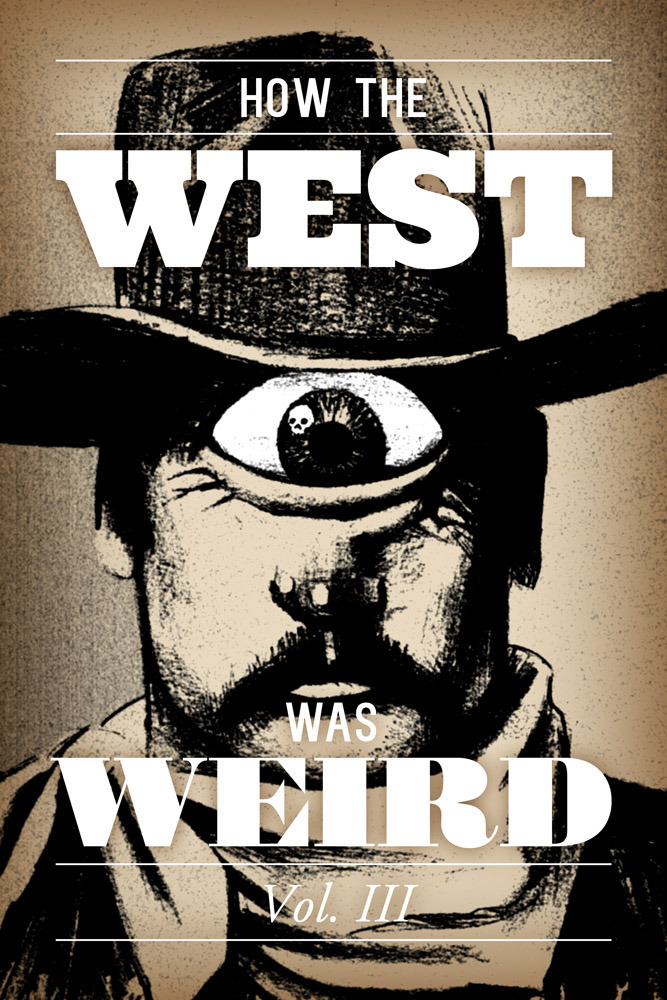
(art by Jim Rugg)
To me, it's a plenty stretchy genre that can also include things like Space Westerns and Future Westerns (e.g. android gunslingers) and other such genre-blending permutations (in the far reaches there are comic books series such as Cowboy Ninja Viking and Six-Gun Gorilla). And it can draw not only on roots of classic westerns but also American Indian lore and Weird Mexicana (e.g. Día de los Muertos). It overlaps a little with Spaghetti Westerns and Gonzo Westerns and Anti-Westerns (Cormac McCarthy's Blood Meridian being the quintessential specimen of this last type) and even the Southern Gothic literature of the likes of Faulkner and Flannery O'Connor. For me, it's a loose and suggestive conglomeration of tangentially related imagery and concepts.
Enter Lafferty. He's never going to truly fit any genre. He mutates everything he touches. Such is the case here. He overlaps with some of the territory of westerns because his settings are frequently those of his own lifelong Southwestern environs, mainly his native Oklahoma. Though many of his Oklohaman settings, in both novels and short stories, are urban, many also feature the wider non-urban landscape. (And even the tales set in a city - frequently Tulsa - tend to have an eye for regional features.) Since Lafferty's fiction tends to have a hefty dose of American Indian influence as well as stylistic innovations that made him at home in 1960s/70s New Wave science fiction for a while, I call his excursions into western-y territory 'buffalopunk' (think 'cyberpunk', 'steampunk', etc.).
Indeed, buffalos themselves sometimes feature in his yarns (e.g. 'Days of Grass, Days of Straw', 'Inventions Bright and New') as well as their 'byproducts' (hides, horns, meat, etc.). And just think of all the instances where some character, instead of crying bullshit, cries 'Oh, Buffalo Hokey!' And so it is with all the other fauna, flora, landscape, and general ephemera of the Southwestern region, which show up in equal doses of focused attention, background assumption, offhanded asides, and enmeshed textural detail. You may not have even noticed it, but once you're paying attention, you'll see it often: mesquite, coyotes, mesas, cattle, mountains, mountain lions, plains, 'bottoms', 'flats', crayfish, kit foxes, bears, and much, much more.
Of course, all these regional elements are either themselves 'weirded' in some way or are attendant upon the joyfully bizarre Laffertian carnival we've all come to expect from his tales: the weirdness may be in the form of magic, horror (both visceral and ghostly), mad science, aliens, monsters, extreme violence or gore, dystopia, and general metaphysical antics (doubled people, landscapes that won't behave properly, skies raining everything but cats and dogs, talking fauna, persons filled with sawdust or confetti, etc.). Hence the '-punk' suffix.
You can think of your own list of stories that feature strains of Lafferty's buffalopunk, but some that spring to my mind are (in addition to the few named above) 'Boomer Flats', 'Happening at Chosky Bottoms', 'Narrow Valley', 'And Walk Now Gently Through the Fire', 'Sodom and Gomorrah, Texas' and 'Oh Tell Me Will It Freeze Tonight'. These all take place in the Southwest, but even in Lafferty's offworld stories there is often a noticeable element of buffalopunk: e.g. 'Pig in a Pokey', 'Snuffles', 'Golden Trabant', 'Smoe and the Implicit Clay', etc. (Also, a number of his earliest stories, which are only recently beginning to come to light to a wider audience, are quite regional, though some are perhaps a little lighter on overtly freakish 'punk' elements: e.g. 'The Wagons', 'Rain Mountain', 'Ghost in the Corn Crib', etc.)
His novel most relevant to this theme is obviously his historical epic of the Choctaws Okla Hannali (1972), but The Reefs of Earth (1968) comes a close second as a science fiction novel in full Southwestern Gothic-Weird mode, with its backwoods setting, murderous alien children, lively Indian mounds and so on.
But what provoked this whole meditation for me was that I ran smack into a whole chapter of buffalopunk (IV: 'Liar on the Mountain') in my now third re-reading of Fourth Mansions (1969). I'd remembered that the landscape behaved strangely in this passage, but I didn't remember how repletely Weird West this chapter was, complete with a Texas-Mexico setting (the same territory as McCarthy's Blood Meridian). There is a very western 'mesquite and sagebrush' landscape described, which is rolling like the sea (an image of western plains I've seen in sources as diverse as McCarthy and Zane Grey, but here rather more literalised) and taking on impossible dimensions the further into it they go. There's a preternatural guardian, a short bloody boar hunt, a cave-cooked meal, and even a many-tentacled black monster in a fountain in this chapter. A delightful excursion into weird western!
The rest of the novel is very Tulsa urban, and still evinces not a little of buffalopunk, but that Lafferty just went full western in this chapter kind of freshly hit me and reminded me how frequently recurring is his element of buffalopunk. Now I'm going to be trying to catalogue all its appearances and allusions. (What, me obsessive? Pshh.)
Saturday, November 5, 2011
'There is nobody, there has never been anybody, who writes like Lafferty' - Theodore Sturgeon introduces R. A. Lafferty
It's an easy thing to sit down and slosh sweet sugar to coat everything that comes out of the box the editor sends you; do that once, however, and the reader, having found one single cascara in his candy, isn't going to bite another piece of it nor buy another box... Okay: no candy. Let me first say honestly and freely which stories pushed my joy-button, and a little of why...

The two Lafferty stories, like virtually all Lafferty stories, sting and tickle at the same time. There is nobody, there has never been anybody, who writes like Lafferty. Under the puckishness, the color-bursts, the wild, weird and wonderful characterizations, the tumble and sparkle of language, is an undercoat of sharp and serious observation - observation of human motivations, of human institutions (universities, for example, or rituals which have lost their reason-for-being) so that, like Gulliver's Travels, almost all of Lafferty can be read as enchanting entertainments, or as sharply-etched political cartoonery, or as analogs of a superbly thought-out philosophy concerning human nature and human conduct. In other words, you get out of Lafferty, as out of Swift, whatever you're equipped to bring in.
-Theodore Sturgeon, referring to Lafferty's stories 'Bright Flightways' and 'The Man Who Walked Through Cracks' in Chrysalis 3 (1978), edited by Roy Torgeson
Friday, July 8, 2011
Some Initial Thoughts on R. A. Lafferty's Fourth Mansions
It's usually agreed that Lafferty is stronger at his short stories than his novels. The wonderful weirdness that is usually a strength at the short story length can sometimes threaten to become overwhelming, or even unreadable incoherence, at novel length. Nevertheless, besotted fans of Lafferty's short stories are impelled by sheer addiction to his prose--the sweaty, shaky need for more Laffertian lore, from any source whatever--to wade into the novels and grapple with Lafferty's uber potent strangeness in depth, for one long sustained narrative. And though Lafferty fanatics are often not a little baffled by the novels, we tend to go back for more!
Besides Fourth Mansions, I've read the following novels by Lafferty: Past Master, Reefs of Earth, Space Chantey, Arrive At Easterwine, The Devil Is Dead, Annals of Klepsis, Where Have You Been Sandaliotis, and The Three Armageddons of Enniscorthy Sweeney. That's nine novels in total (over a period of about as many years), so it's not as if they're unreadable. Indeed, you get the hang of them. You start to love some of them, or parts of them, as much as the short stories. In fact, I've read the afforementioned Past Master, Annals of Klepsis, and Space Chantey at least twice-over each (the latter two I even read out loud to my children!) for sheer pleasure--just delighting to savour again the prose and the narrated events.
The bottom line is that I've found, basically, however Lafferty's novels may compare to the short stories, however much they may or may not 'succeed' as cohesive versions of that particular art form - they usually ALL contain some amount (usually quite a lot) of solid Laffertian gold.
Interestingly, despite the sometimes overwhelming concentration (or diffusion) of weirdness in Lafferty's novels, I have usually found them quite 'easy' reads. I can usually get through them in fairly short order. Despite the wonkiness, they still manage, oddly, to have a fairly page-turning flow. The novels sometimes reel, roil, and riot, but they seem to be eminently finishable.
But this is where Fourth Mansions was the exception to the rule for me. When I first tried to read it some 8 or 9 years ago, I just couldn't finish it. I had finished all the ones I had read before that and have subsequently finished all the ones I've read after abandoning it. I knew that a number of fans and critics considered Fourth Mansions Lafferty's best (and some even said it was possibly his most coherent plot), but this just baffled me as I found that its story just didn't pull me in beyond a few chapters and the strangeness wasn't cohering into anything inviting for me. I gave up half way through. I knew also that some fans found Fourth Mansions to be one of Lafferty's 'worst' novels. (The R. A. Lafferty Devotional Page categorises it as 'lame'--below even 'OK'--then again, how LAME is it that a site 'devoted' to Lafferty even has the category 'lame' for his works! Honestly, I admit I've read what comes close to 'average' from Lafferty, but 'lame'? Never.)
Anyway, I assumed that since I had more or less easily downed all the other novels I'd tried, this one was just truly flawed. Still, I had always intended to go back and get through it. I recently read a 1975 paper by Sheryl Smith on Arrive At Easterwine that mentioned Lafferty had written three 'end-of-the-world comedies'--Past Master (1968), Fourth Mansions (1969), and Easterwine (1971)--which she recommended reading in that order if possible. I found this to be a fresh way of labelling and grouping some of his works. Having recently re-read Past Master and planning to re-read Easterwine soon, I decided now was the time to finally muscle through to the end of Mansions.

Basic result? I totally missed it on my first reading. This is an amazing book. Definitely one of Lafferty's very best and most important. It is packed with tons of the finest of Lafferty's prose on a lot of levels. It is also packed with fantastic marvels and action-adventure (of an utterly bizarre variety, of course) as well as Lafferty's usual long and creative portions of exposition - ranging from various types of conversations to college lecture Q&A sessions to prophets preaching on the streets. It is bristling with a wonderful cast of weird and well-sketched characters of various ethnicities and powers and beings. The pedestrian protagonist, newspaper reporter Freddy Foley, is a bumbling favourite for me alongside Past Master's Thomas More.
The novel is still very, very strange and hard to follow and even hard to finish toward the latter half (though all the later chapters are as good as the early chapters - it's just that mere mortals flag in trying to quaff one of Lafferty's most potent brews). Yet it is full of joys and thrills and pleasures.
In one sense it is a sustained meditation on a theology of monsters (which is very exciting for one of my lifelong study projects). But even more centrally, it is another crucial piece in the puzzle that Lafferty's body of work constructs: a profound, pungent, tenacious argument that we need to wake up and rebuild intellectual and spiritual DIMENSION in an intellectually and spiritually FLAT modern/postmodern world.
'Somehow there is the belief that people in the Dark Ages believed that the world was flat. They didn't. But it is the contemptuous ones of today who have made a really flat world that is the sad answer to everything. What is wrong with the world and why is it not worth living in? It's flat, that's what.' (Fourth Mansions, p. 59)
This novel, as all of Lafferty's work, joyously and rambunctiously attempts to diagnose this problem and proffers a beautiful and scary cure: unleash all the metaphorical, metaphysical, and material monsters inside us and outside us, reintegrated under the good rule of God again, freed to gleefully destroy a fake world that has been foisted on us and gruesomely rebirth a real one again.
That diagnosis and cure is no doubt unpalatable to many, but Lafferty is cooking and seasoning a musky rump roast according to his own recipe (yet one he claims is not at all his own) and he has a disarming and seductive way of wafting wonderfully inviting aromas our way, inciting our salivating mouths and rumbling bellies.
Besides Fourth Mansions, I've read the following novels by Lafferty: Past Master, Reefs of Earth, Space Chantey, Arrive At Easterwine, The Devil Is Dead, Annals of Klepsis, Where Have You Been Sandaliotis, and The Three Armageddons of Enniscorthy Sweeney. That's nine novels in total (over a period of about as many years), so it's not as if they're unreadable. Indeed, you get the hang of them. You start to love some of them, or parts of them, as much as the short stories. In fact, I've read the afforementioned Past Master, Annals of Klepsis, and Space Chantey at least twice-over each (the latter two I even read out loud to my children!) for sheer pleasure--just delighting to savour again the prose and the narrated events.
The bottom line is that I've found, basically, however Lafferty's novels may compare to the short stories, however much they may or may not 'succeed' as cohesive versions of that particular art form - they usually ALL contain some amount (usually quite a lot) of solid Laffertian gold.
Interestingly, despite the sometimes overwhelming concentration (or diffusion) of weirdness in Lafferty's novels, I have usually found them quite 'easy' reads. I can usually get through them in fairly short order. Despite the wonkiness, they still manage, oddly, to have a fairly page-turning flow. The novels sometimes reel, roil, and riot, but they seem to be eminently finishable.
But this is where Fourth Mansions was the exception to the rule for me. When I first tried to read it some 8 or 9 years ago, I just couldn't finish it. I had finished all the ones I had read before that and have subsequently finished all the ones I've read after abandoning it. I knew that a number of fans and critics considered Fourth Mansions Lafferty's best (and some even said it was possibly his most coherent plot), but this just baffled me as I found that its story just didn't pull me in beyond a few chapters and the strangeness wasn't cohering into anything inviting for me. I gave up half way through. I knew also that some fans found Fourth Mansions to be one of Lafferty's 'worst' novels. (The R. A. Lafferty Devotional Page categorises it as 'lame'--below even 'OK'--then again, how LAME is it that a site 'devoted' to Lafferty even has the category 'lame' for his works! Honestly, I admit I've read what comes close to 'average' from Lafferty, but 'lame'? Never.)
Anyway, I assumed that since I had more or less easily downed all the other novels I'd tried, this one was just truly flawed. Still, I had always intended to go back and get through it. I recently read a 1975 paper by Sheryl Smith on Arrive At Easterwine that mentioned Lafferty had written three 'end-of-the-world comedies'--Past Master (1968), Fourth Mansions (1969), and Easterwine (1971)--which she recommended reading in that order if possible. I found this to be a fresh way of labelling and grouping some of his works. Having recently re-read Past Master and planning to re-read Easterwine soon, I decided now was the time to finally muscle through to the end of Mansions.
Basic result? I totally missed it on my first reading. This is an amazing book. Definitely one of Lafferty's very best and most important. It is packed with tons of the finest of Lafferty's prose on a lot of levels. It is also packed with fantastic marvels and action-adventure (of an utterly bizarre variety, of course) as well as Lafferty's usual long and creative portions of exposition - ranging from various types of conversations to college lecture Q&A sessions to prophets preaching on the streets. It is bristling with a wonderful cast of weird and well-sketched characters of various ethnicities and powers and beings. The pedestrian protagonist, newspaper reporter Freddy Foley, is a bumbling favourite for me alongside Past Master's Thomas More.
The novel is still very, very strange and hard to follow and even hard to finish toward the latter half (though all the later chapters are as good as the early chapters - it's just that mere mortals flag in trying to quaff one of Lafferty's most potent brews). Yet it is full of joys and thrills and pleasures.
In one sense it is a sustained meditation on a theology of monsters (which is very exciting for one of my lifelong study projects). But even more centrally, it is another crucial piece in the puzzle that Lafferty's body of work constructs: a profound, pungent, tenacious argument that we need to wake up and rebuild intellectual and spiritual DIMENSION in an intellectually and spiritually FLAT modern/postmodern world.
'Somehow there is the belief that people in the Dark Ages believed that the world was flat. They didn't. But it is the contemptuous ones of today who have made a really flat world that is the sad answer to everything. What is wrong with the world and why is it not worth living in? It's flat, that's what.' (Fourth Mansions, p. 59)
This novel, as all of Lafferty's work, joyously and rambunctiously attempts to diagnose this problem and proffers a beautiful and scary cure: unleash all the metaphorical, metaphysical, and material monsters inside us and outside us, reintegrated under the good rule of God again, freed to gleefully destroy a fake world that has been foisted on us and gruesomely rebirth a real one again.
That diagnosis and cure is no doubt unpalatable to many, but Lafferty is cooking and seasoning a musky rump roast according to his own recipe (yet one he claims is not at all his own) and he has a disarming and seductive way of wafting wonderfully inviting aromas our way, inciting our salivating mouths and rumbling bellies.
Subscribe to:
Posts (Atom)