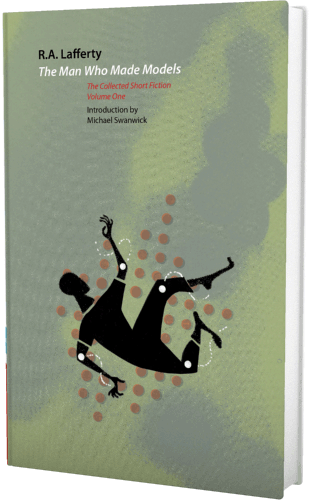
Showing posts with label short stories. Show all posts

Saturday, November 22, 2014

'The world turns in its sleep, and parts of the world have moments of wakefulness' (brief review of the short story 'And Walk Now Gently Through the Fire')

Well, I tried to post the following as a comment on the short story section of the R. A. Lafferty Devotional Page (where all of Lafferty's stories are listed out with the webmaster's rating & opinion of the story and the option for you to comment).  But though I'm registered, it refuses to work for me.  So here's a brief off-the-top-of-my-head review of one of my fave stories by Laff (from which this blog gets its name).

UPDATE (23 Nov 2014):  Well, looky here!  http://www.ralafferty.org/works/stories/  A whole new place to discuss each and every one of Lafferty's 200+ short stories!  Nice!  (The creator of this new Lafferty website is working very hard to make an exhaustive, interwoven, interactive, one-stop, poly-crosslinked site of Laffertian lore and treasure - show him your support and make use of the site!)


The story 'review':
"To you who are scattered and broken, gather again and mend. Rebuild always, and again I say rebuild. Renew the face of the earth. It is a loved face, but now it is covered with the webs of tired spiders."

Lafferty's short story "And Walk Now Gently Through the Fire" (1972) is funny, wise, nicely styled; a well-imagined philosophical post-apocalypse (in a Laffertian folklorish tone, of course).  It's written in Lafferty's Oklahoma regional mode, what I call 'buffalopunk' (which infuses most everything he writes to one degree or another). 

I rate the story 'excellent'.  [The RAL Devotional Page has only the three ratings:  lame, ok, excellent.]

This story was one of the earliest I read by Laff that got me searching out all his stuff.  Some of his fans don't like it when he gets explicitly theological, but I tend to love it.  Some will only barely notice that this story is theological and some will find it too glaring.  I think it's beautifully done.  It's kind of like a Chestertonian Screwtape Letters written by Mark Twain. (That description should alert you to the presence of biting satire.  But the tone of the story is still very warm and invitational and hopeful, even humble, and not merely acerbic.)

If more 'religious believers' in the modern world had the kind of life-affirming, ecologically rich (pay attention to the cattle, landscape, birds, and bees), constructive, beautiful, creatively countercultural, and good-humoured worldview this story exhibits, there wouldn't be so much 'secular' or 'pagan' overreaction to religion, with its own oppressive and reductive counter-fundamentalisms.    

"There was, of course, the acre of fire, the field of fire.  This acre was large enough to contain all that needed to be contained:  it is always there, wherever reality is.  There are tides that come and go; but even the lowest ebbing may not mean the end of the world.  And then there are the times and tides of clarity, the jubilees, the sabbaticals.  There is reassurance given.  The world turns in its sleep, and parts of the world have moments of wakefulness."

Monday, December 2, 2013

Complete Lafferty Library Volume 1!

It's finally gonna happen!  I'd heard about this, but I just now found out about a lovely page over at Centipede Press that outlines the project to publish all 200 of Lafferty's short stories (12 volumes' worth!) over the coming years.
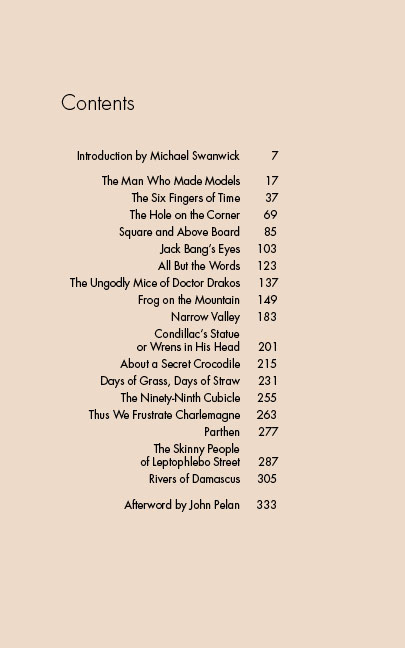
Each volume, they inform us, will include 'a guest introduction by a notable author in the field of fantastic fiction' (the first being Michael Swanwick - you can see an excerpt of the opening paragraph over on the page linked to above).  They even give us the table of contents for the first volume:
I have all of these stories in one format or another besides 'The Ninety-Ninth Cubicle', a rare story only appearing in the Weird Tales Fall 1984 issue or the 1991 collection Mischief Malicious (And Murder Most Strange) from United Mythologies Press, both now all but impossible to obtain.

I'm very happy to see that some of the more obscure stories are already showing up, even those collected only in the Chris Drumm paper chapbook format from the early 80s (these are like little zines really - quite a cool DIY 'punk rock' sort of format in my opinion, but the typewriter lettering is a little hard to get into as a reader, to really feel like you're reading a genuinely published story and not just someone's unpublished manuscript).  The story 'Jack Bang's Eyes' is one of my favourites, especially because of the wonderful chimpanzee character Flip O'Grady.  It's the first story in Drumm Booklet # 13: Snake in His Bosom and other stories.
I'm a little surprised, however, that they're kicking the whole book off with the story 'The Man Who Made Models', the titular story of Drumm Booklet # 18, a story I found rather difficult and not as gob-smacking or exquisitely crafted as many other stories by Lafferty.
It just shows me once again that Lafferty fans differ so very widely as to what is his best work, or where to start with his work.  But I'll have to go back and re-read 'Models' thinking of it as the first story in this volume and see how it hits me.  I'm glad they go on to 'The Six Fingers of Time' right after that.  It's a story I've used to introduce and hook quite a few people to Lafferty.  Straightforwardly written and packing a vivid imaginative punch with its well-imagined slow-down of time and movement, with characteristic playfulness and mischief and, of course, rather diabolical consequences (and a poignant little love story too). 'The Hole on the Corner', next in line, is a classic and well-loved tale, which really shows off some of the outrageously weird lengths Lafferty can go to in two seconds flat.  Very funny, uproariously gruesome, wildly imaginative, unsettling. Both 'Six Fingers' and 'Hole' are from the ever popular first collection of Lafferty's short stories Nine-Hundred Grandmothers (1969) and unsurprisingly, they're not the only ones on the list. 'Square and Above Board' was not a story that particularly struck me when I read it (I have it in the 1983 anthology The Year's Best Fantasy Stories: 9), but I'd love to see it again in this new context.  I have a feeling most of his stories are going to take on a fresh shine in these new formats and constellations.

I could wish they had at least one more story from Lafferty's 1971 collection Strange Doings besides 'All But the Words', and also at least one more story from his 1974 collection Does Anyone Else Have Something Further to Add? besides 'About a Secret Crocodile', and perhaps also one more from the 1991 collection Lafferty In Orbit besides 'The Skinny People from Leptophlebo Street' (and these are probably not the stories I'd have chosen from those collections if it was only going to be one).  But I am happy to see a number of stories that I first encountered in the under-appreciated 1984 collection Ringing Changes:  'The Ungodly Mice of Doctor Drakos', 'Days of Grass, Days of Straw', 'Parthen', and 'Rivers of Damascus' (two of them being ones I'd definitely have picked).  As I said Nine-Hundred Grandmothers provides the lion's share of the collection with three more stories in addition to the two I've already mentioned:  'Frog On the Mountain', 'Narrow Valley', and 'Thus We Frustrate Charlemagne', the latter two consistently considered classics and 'Frog' being another very worthy choice in my opinion.
Inline image 1
That just leaves 'Condillac's Statue or Wrens In His Head' from the 1982 collection Golden Gate and Other Stories (a book which also first collected 'Days of Grass').  It's a great story, but it continues with the trend of this first volume to collect stories that are heavy on philosophy and complex ideas and narrations.  I think this first volume could do with a few less hefty numbers and a few more that are slam-bang fun - otherwise people might get the wrong idea about what all Lafferty accomplishes across the spectrum of his storytelling.

Then again, I guess this series is really only for those who are already dedicated fans, since it's gonna cost a pretty penny per volume and run into five or six hundred dollars to collect all twelve books.  To be perfectly honest, huge fan that I am, I'm going to have to really scrape pennies (and maybe auction off a few children) to keep up and collect each one as it comes out.  And that's the only way to be sure of being in on it apparently.  This first run is limited to 300!  Presumably the subsequent volumes will be similarly limited in number.  (If any rich readers want to sponsor my collection, I can promise the Lafferty Library in my hands will go to very good use and be thoroughly reviewed and publicised to the further fame of Lafferty!  The rest of you, stop judging my beggarly kowtowing to the wealthy!)

I'm gratified to see 'Parthen' and 'Six Fingers of Time' on this opening list as I've championed them as good starting points over the years and most of my fellow Lafferty fans have demurred.  Also, I'm very happy to see 'Days of Grass, Days of Straw' as it deserves to be widely known as one of Lafferty's very, very best.

Looking over the list again, it's also good to note that Lafferty's inimitable bending of space, time, and persons are all represented in these stories - the way he goes sideways and ultraviolet with the classic science fiction and fantasy tropes of time travel and multiple worlds and alien contact and planetary expeditions.  There are also several of his Native American-centric tales and those featuring animals to pleasantly odd effect.  Also included are tales showcasing how he can stretch and shrink both people and places at will.

All in all it's very exciting!  'This is beginning, this is happening!  Let no least part of it ever forget the primordial tumble that is the beginning!'

I'll conclude with the photo of Lafferty the first volume includes, which I've never seen before and I find just lovely.

Friday, March 30, 2012

"Good increase to you!" (On finishing an unhurried re-read of Nine Hundred Grandmothers)

"We have enjoyed every minute of our short visit.  Do not despair!  We will not abandon you to your emptiness.  Our token force will return home and report.  In another week we will visit you in substantial numbers.  We will teach you the full happiness of human proximity, the glory of fruitfulness, the blessing of adequate population.  We will teach you to fill up the horrible empty places of your planet."

The Skandia were thinning out.  The last of them were taking cheering farewells of disconsolate Earth friends.

"We will be back," they said as they passed their last fertility charms into avid hands.  "We'll be back and teach you everything so you can be as happy as we are.  Good increase to you!"

"Good increase to you!" cried the Earth people to the disappearing Skandia.  Oh, it would be a lonesome world without all those nice people!  With them you had the feeling that they were really close to you.

"We'll be back!" said the Skandia leader, and disappeared from the monument.  "We'll be back next week and a lot more of us," and then they were gone.

"--And next time we'll bring the kids!" came the last fading Skandia voice from the sky.


-R. A. Lafferty, 'Guesting Time' (1965)


These are the very last words of the very last short story in Lafferty's seminal and celebrated collection Nine Hundred Grandmothers (1970).  I have just finished a slow and intermittent re-reading of this collection and am left feeling 'mellow' (to use one of Lafferty's terms for someone 'in his cups' and feeling 'high' from the buzz).  I'm left feeling mellow, and also open-ended, quite thoughtful, and frankly rather preternatural, as if some gateway onto another world (a woolly and wily one, not a misty and ephemeral one) had winked open and shut before my vision and left my mind wondering if it had glimpsed what it had seemed to glimpse:  were those titanic yet easy-earthy characters real?  Did those burly and burlesque feats of time and space and personage occur?  One chuckles.  And one shudders.  (And one wonders.)

This closing scene seems so fitting somehow, with its emphasis on fruitful increase and promised return.  It provides a wryly jokey and poignantly hopeful ending to a book full of tensions dark and bright, hilarious and horrific.  The endpiece of the collection, fittingly, does not provide closure, but rather prophecy and invitation.  (It also evokes for me the very last words of the last book of Gene Wolfe's monumental, twelve-volume Solar Cycle and a similar feeling they left me with at the end of that epic journey:  'Good fishing!  Good fishing!  Good fishing!  Good fishing!')

Though I have read a handful of favourites from this collection over and over again, many of the stories had remained at a first-read level for me from the time of my initial obtaining of this volume some eight years ago.  My memories of the stories had become vague, even for the ones I thought were quite good.  Not a single one failed to surprise and delight me afresh on this re-read.  I admit I was actually surprised by that.  This collection really holds up.  

There had been no stories I outright disliked on my first read years ago, but there were a number of them I mistook for lesser specimens.  There is at least one story that has gone from my 'pretty good' to 'very best' category:  the much-anthologised 'Narrow Valley'.  But every single story opened up totally fresh to me:  there was tons more depth of theme than I had realised, loads more complexity, lots more wonder and humour and a whole lot more downright writerly mastery of skill and craft than I had really taken in on the first go.  (That's a common reaction - aside from a few clear favourites, first-time readers of a collection of Laff's yarns are usually left with an indescribable feeling that something very deep, dark, and delightful just swam past them, leaving them in a strange wake, strangely wakeful.)

Well, I hope to write a brief description and reflection on each of the twenty-one tales in the near future.  Until then, 'Good increase to you!'


(There are no triple-breasted women in this collection, but it's still a nice cover.)

Saturday, February 18, 2012

Question: Where should I start with reading Lafferty? Answer: Er, well...

I keep getting asked where to start with reading Lafferty, so an 'official' post suggesting starter points is long overdue.  This is pretty much the best I can do just now and is based in part on what appears to me to be fairly readily obtainable.  (If you can't be bothered to read through all this, I'd recommend scrolling down to the last section entitled:  'THE GIFT BASKET APPROACH'.)


Some stories available online:
I suppose we ought to start here.  At the very bottom of the the Lafferty wikipedia page are listed 'Works available online' with links to each of the six stories.  Most Lafferty fans are uncertain whether these particular stories are the best place to start.  'Nine Hundred Grandmothers' and 'Narrow Valley' have often been anthologised.  'Slow Tuesday Night' is fairly well celebrated.  The other three are not so well known, but have their charms.  (I particularly love 'The Six Fingers of Time' and I quite like 'The Transcendent Tigers'.  Also, 'Nine Hundred Grandmothers' is something of a classic for me - but other fans will sharply differ I'm afraid.)  But, to be honest, no matter how you slice it, perhaps none of these six stories really show just how wild and wonderful, nor how hilarious, nor how literary and language-rich (nor even how philosophical and theological)  Lafferty can get.  Some of them will probably become some of your favourites, but they're really best appreciated when read among a wider-ranging collection of Lafferty's stories.  Still, these are available to the person that just needs to taste Lafferty right away with no delay.  If that's you, I guess I'd recommend 'The Transcendent Tigers' as it's fairly lively (probably not in a way you'd expect from the title - his story titles are delightful but often enjoyably misleading) and it's short.  Just promise me you won't stop there.  You promise?

          ADDENDUM:  In his excellent comments below, Andrew Ferguson (the world’s first academic Lafferty scholar – see his dissertation ‘Lafferty and His World’), regards ‘Narrow Valley’ as a fairly ideal starting point for reading Lafferty.  Having myself just re-read the story, I’m now more inclined to agree than I was before.  It is rich in American storytelling.  And it is a TALL yarn indeed, demonstrating repletely Lafferty’s preternatural ability to narrate the impossible.  It reads something like Swift, Twain, and Carroll together spinning a contemporary Native American myth.  As Andrew aptly put it, it is ‘a defining example of Lafferty's ability to stack the lies higher and higher’.  There are grins and chuckles to be had too as well as some sly political commentary about the white man (with a tinge of poignant sorrow about the plight of modern American Indians) and a slam-bang horror-jokey ending also – so I guess Andrew is fairly on the mark to say this Lafferty story ‘has it all, pretty much’.  (He also says he often recommends 'Slow Tuesday Night' as a starting point too.)

Not much left in print that's affordable, but, here goes:
Rumour has it that Locus Magazine has bought the rights to Lafferty's complete works and are in discussions about what the heck to do with such a priceless but hard-to-market prize.  [Andrew, in the comments below, assures me this is no mere rumour, but a done deal.]  In the meantime, most of his books seem to have gone well above the fifty dollar price and often into the hundreds or even thousands!  But it looks like old copies of the following are still available on Amazon.com for under twenty dollars (and I'm sure you can find a few better prices if you do a more extensive search through other dealers and book-search engines).  You can click on the titles to go to where I found them on the Amazon page (but they are, of course, subject to disappear):

Short story collections (it's definitely best to start with his short stories if you can)
* Strange Doings
* Does Anyone Else Have Something Further to Add?

For just a little over twenty dollars
* Ringing Changes

It looks like there are still a few copies left for around 25 and 30 dollars of his celebrated collection
* Nine Hundred Grandmothers

Each one of these collections has some of Lafferty's very, very best short stories, but to the beginning reader of Lafferty the collections can feel rather uneven in quality.  Even fans notoriously disagree over what are the best (and worst) stories (and collections).  Usually, you find that stories you weren't that impressed by first time round can years later, when Lafferty has been marinating in your soul for a while, become some of your favourites.  But a lot of the favourable first impressions will be very lasting and certain stories will always remain favourites.


Nine Hundred Grandmothers is certainly the 'seminal' collection - the first published and still probably most referred to - and it definitely has some of his best and most memorable stories.  But it's not clearly superior overall to the other collections for me.


Ringing Changes has some of Lafferty's very, very best stories but it might also have too many less impressive ones (that feels so wrong to say about such a master).  It's a collection that gave me, at least, a lot of pleasure when I first read it.


Does Anyone Else Have Something Further to Add? gave me less pleasure on a first read, though it has some of my favourite stories.  But a number of its stories have also proved to be total gems that I just blockheadedly under-appreciated the first time round.


Strange Doings is one of the better collections, I think.  Maybe it and Nine Hundred Grandmothers are the most solid, with the latter being perhaps the place to start if you can afford it.

Phew!  You have no idea what agony it is to try to recommend starting places or say what's 'best'!  (At any rate, see below about short stories not found in these collections, which are maybe even better places to start.)

          ADDENDUM:  In the comment thread Andrew also mentions that 900 Grans 'will almost certainly be reprinted in the next couple years' and also 'there is most assuredly a "Best Of" compilation in the works'.  So look out for those!  (You can count on those being announced here, so feel free to use the 'Follow by Email' box at the top right of the blog to stay informed.)


Novels
The seminal three that all came out in 1968 and took the sf publishing world by storm:
* Past Master
* Space Chantey (it's printed as an 'Ace Double' with another author's novel called Pity About Earth)
* The Reefs of Earth

Three more classics that quickly followed and are still considered seminal classics also:
* Fourth Mansions
* Arrive At Easterwine
* The Devil Is Dead

Lesser known masterpieces:
* Annals of Klepsis
* Not To Mention Camels
* Apocalypses (containing two short novels: Where Have You Been, Sandaliotis? and The Three Armageddons of Enniscorthy Sweeney)


Warning:  Lafferty's novels, though utterly delightful to the initiated, are not the place to start if you can get hold of the short stories first.

Of the first half-dozen listed here, Past Master and Arrive At Easterwine are probably my favourites at a gut level.  The former is especially good if you want to see Lafferty in full theological satire mode and in full science fiction mode too (future/another planet/space travel/technology/robots/time-travel/dystopia - though it's also fantastical with ghosts and primordial monsters and so on).  It's perhaps not as smoothly written as some of the others but still has some of his best prose moments (especially once it gets past the first choppy chapter) and some of his best imagery and ideas and incidents.  The historical Thomas More (the originator of the concept and word 'Utopia' is brought forward from the past to fix the novel's ailing utopia) is one of Lafferty's 'thickest', finest drawn characters in my opinion.

Easterwine is often thought of as becoming nearly incomprehensible about a third of the way in - that's an exaggeration, but it is one of his most tangled tales.  Still, most fans really love it.  It too is one of his best characterisations:  this time the sentient computer, 'Epiktistes', whose autobiography the novel is (he's also a fan favourite from a series of Lafferty's short stories).  This novel too says a lot of what Lafferty wants to say philosophically, culturally, and theologically - but in very layered and encoded form.  Though it too can be jangly and juddery in plot and style, it also has some of Lafferty's best prose moments, images, ideas and scenes.  Still, Easterwine is almost certainly not the place to start with Lafferty, while Past Master might be a decent option.

In some ways Space Chantey is more straightforward - certainly in terms of the flow of the prose and the plot - but it's still full of very potent Lafferty weirdness.  It's a rip-roaringly enjoyable read, an adventurous and rollicking retelling of Homer's Odyssey on a galactic space-faring level.

The Reefs of Earth I also found eminently readable in terms of prose-flow, but it's one of the very, very strangest of Lafferty's fictions in terms of just the scenario and unfolding of events.  Alien children that look just like human children (almost), who have lost their parents and have decided to murder all the humans.  It's really nothing like what that summary makes it sound like.  There's not really a Twilight Zone-like 'eerie suspense' or anything like that.  It's very earthy and rustic in a way, and very like a folk tale mixed with a Southern Gothic tale, but still in a way that those descriptions don't really signify.  It's genuinely baffling, and not entirely in a 'wow! that was so cool how weird it was!' kind of way. I'm still not sure what to make of it in Lafferty's canon, but it was nevertheless a very pleasurable read in its own strange way.  I wouldn't normally recommend it as an introduction to Lafferty, yet several people I know have read it as an intro to Laff recently by default, as nothing else was available.  And... their reaction was quite favourable.  So there ya go.

The Devil is Dead is a favourite of some fans, but though I enjoyed it (and, as always, it contains some of my favourite Lafferty moments), it has never been one of my favourites and I definitely wouldn't have recommended it as a starting point (plus it's a middle book that's part of a much larger series that was only barely published and is now unavailable - it may turn out to be his magnum opus when read all together).  But (again!) someone I know recently had to start there, again due to scarcity of available works from Lafferty, and they really enjoyed it.  (I didn't love it as much when I first read it because it didn't seem to as blatantly incorporate much of my favourite Lafferty tropes - fantastical, supernatural, paranormal, or multi-dimensional happenings and/or bizarre twists on science-fictional themes.  But really, it's full of good Lafferty strangeness and some fine prose.)

Fourth Mansions is usually one of the most beloved and lauded of Lafferty's novels by his fan base.  I was more uncertain on my first go with it, but in a recent re-read I loved it very much.  It has some of his best prose.  Its plot flows along pretty nicely (not necessarily comprehensibly, just readably).  It's kind of a magical realism and urban fantasy sort of scenario with some very memorable characters and a very interesting theological theme.  Again, it's not where I would probably recommend a neophyte begin their Laffertian journey.  This time I don't know of anyone personally who has done so and liked it, but I think I've read comments online that some people started there and loved it.

As to the lesser known three listed last:  Annals of Klepsis is actually one of my very, very favourite of Lafferty's novels, probably the one I read with the single most readerly pleasure.  It's VERY freakishly strange and weird and in some ways barely understandable (the prose is clear and the events are more or less 'see-able', but it's just... 'what... why... huh?').  A historian travels to a pirate planet that has no written history and he hopes to remedy that.  There's feasting and storytelling going on inside the belly of a beached whale whilst it is being shot up with bullets on the outside.  There's a dog with missiles for teeth guarding an underground treasure.  A group of characters go on a spectacular and bizarre boat journey through the canals of someone's brain... and so on.  Those snapshots don't necessarily give the right impression.  None of Lafferty's work is really what I'd call 'surreal' (though this occasionally is said of his fiction).  It's too earthy, folky, bloody, visceral, meaty, and musky for that.  It's 'insane', but not really in a 'hallucinatory' or 'trippy' way (though I don't blame readers for sometimes mistaking it for such - certain qualities of dream are admittedly present and pervasive).  It feels like something deeper and 'tougher', like myth and fable and legend, though definitely transmuted through carnival and through contemporary concerns and motifs.  So, would I recommend starting with Klepsis?  Ah, hm.  Sure.  Why not.  To sample at least.

I love Not To Mention Camels.  Very much.  Probably not the place to start.  It would probably be too brain-splitting to follow when you're not used to where Lafferty can go yet.  Multiple selves in multiple worlds (and even a [thrilling] chapter on multiple archetypal selves battling between worlds), lots of philosophical exposition.  You may think you're bad enough to start there, but don't kid yourself.  Earn your spurs.  Try it later.  (Though again, I recently read of someone being introduced to Lafferty through this one and being very much sold on it and Laff through it.)

The first novel of Apocalypses is often considered rather average fare, but I quite enjoyed it.  Definitely do not start there - you'll flag and give up.  The second novel, Three Armageddons, is acclaimed as one of Lafferty's very best by most fans, I think.  I loved it - but, like Not To Mention Camels, it will melt your brain if you're just getting started.  It's probably the best historical sort of work I've read by Lafferty, invoking early 20th century Chicago.  But it is fantasy also, full of intellectually demanding exposition and speculation, as well as full of mind-bending events and scenarios about what's real and what's not (a theme Lafferty continually explores - related, I suppose, to things like The Matrix and Inception, but totally without their 'slick' and 'hip' feel).  Don't start here either.  (But do go ahead and purchase this kitschily-covered little gem while it's cheap - you'll thank me later when your apprenticeship has progressed.  Indeed, I guess this pretty much applies to all of the above.)

          ADDENDUM:  Andrew also mentions in the comments below that Lafferty's Okla Hannali probably deserves a mention here as a possible starting point.  I only neglected to because I still haven't read it yet.  It is unanimously spoken well of and is still in print, read by a lot of folks who otherwise know little or nothing about Lafferty.  It is a historical fiction novel about the Choctaw nation and is very beloved of fans and others alike.  As Andrew points out, 'for most novel readers it provides a recognizable form that helps ease in the Lafferty weirdness. (Also: hilarious and shatteringly sad by turns.)'


THE GIFT BASKET APPROACH

Individual short stories in multi-author anthologies:
* 'The Configuration of the North Shore' in Modern Classics of Fantasy
* 'Smoe and the Implicit Clay' in Future Power
* 'Bright Flightways' & 'The Man Who Walked Through Cracks' (two-for-one!) in Chrysalis 3
* 'In Deepest Glass: An Informal History of Stained Glass Windows' in The Berkley Showcase Vol. 4
* 'Symposium' in Omega
* 'And Walk Now Gently Through the Fire' in And Walk Now Gently Through the Fire (or, alternately, in Sacred Visions)


It just so happens that some of my very favourite Lafferty is only collected just one story at a time in old multi-author anthologies and nowhere else.  This baker's half-dozen could easily be expanded to a score or more but most of these can be obtained for a few dollars plus postage.  Heck, if you're going to spend twenty or so bucks on getting acquainted with Lafferty, I'd almost recommend just snatching up this handful of books as a nice little Lafferty basket sampler.  (Go on,  throw in a basket and some ribbon and treat yourself!  Or someone you love VERY much!  [Dang, now I'm starting to wish I got commissions.])  But now I can at last more unequivocally enthuse about how great these stories are because I'm not having to consider how a whole collection of Lafferty's stories may hit you as a first-time reader.  If you get hold of any of these based on my recommendations and descriptions here, try to completely block out of your mind anything I've said about a particular story so you can approach it as freshly as possible with as little expectation as possible.  I only allude to what they're 'about' here to whet your fancy and tickle your appetite.

'Configuration' is easily in my top five favourite Lafferty stories.  It has yet to fail me as an intro for someone who has never even heard of Lafferty.   They are invariably hooked in by the wow-factor and humour of his unbounded imagination and oddness on full display in this folksy and freaky (and even mythopoeic!) tale of depth psychology and dream sequences.  (This is the one story in this list that is collected in a Lafferty-only collection - Lafferty In Orbit.  But this book costs over 50 dollars and, anyway, the presentation of this classic Lafferty tale is better encountered in the quality binding and printing of the Modern Classics of Fantasy anthology rather than the frankly shabby, type-o-infested Lafferty in Orbit.)

'Smoe' I only discovered recently and it instantly became a favourite.  It's one of Lafferty's many 'planet-fall' stories of usually farcically disastrous contact with alien cultures.  It very oddly and oddly effectively draws on the G.I. 'Killroy was here' myth woven with Native American traditions.  A gorgeous and grotesque cataract of prose and style comes bursting out at particular crucial moments in the story.  Very stirring, yet almost slapstick at the same time.

'Bright Flightways' and 'The Man Who Walked Through Cracks' make a disturbingly lovely diptych about reality cracking down the middle and which side we choose to find ourselves on.  Both stories seem almost unfinished, but both have amazing moments of language and at least a few very bizarre images that will resonate for a long time.

Lafferty often brings an idiosyncratic Neanderthal mythos into his whole web of story and 'In Deepest Glass' is in my opinion the very best of this motif that I've seen.  This one too taps into the mythopoeic for me, whilst also being wryly quirky and just really, really strange.  I remember first reading this one and just thinking:  'where does this man's imagination hang out? no one else comes up with this kind of stuff!'  It also taps into Lafferty's poignant theological evaluation of society if you're interested in that.

'Symposium' is another hidden gem:  children's toy blocks that are artificial intelligences having a discussion with one another about origins of the universe and cycles of history - told in some of Lafferty's fine, rhapsodic language.

'And Walk Now Gently Through the Fire' is maybe Lafferty's most overtly 'Christian' story:  a 'cowpunk' sort of Oklahoma tale about those who resist the future's drugged out, demoniac, dehumanising dystopia by organising and building and constructing a Fire that will outlast the wobbly-eyed Age of Thinness.  It's kind of a Chestertonian Screwtape Letters filtered through Southwest regional fiction and s.f.

ADDENDUM:  In the comments below Andrew (world's first Lafferty scholar, in case you didn't read that above) recommends these titles be added to the gift basket:

'Bubbles When They Burst' in Galaxy Nov 71
'Quiz Ship Loose' in Chrysalis 2


Well, for what is was worth...

(Don't say I never at least tried to help make the world a better place.)

If you're an old hand at Lafferty Ranch, please don't hesitate to make your own recommendations (and argue with mine) in the comments.  If you're a noob, please don't hesitate to ask questions!

Saturday, August 27, 2011

From Drunken Binges to Wine Tasting: Reading and Re-reading Lafferty’s Short Stories

When I first started reading Lafferty’s short stories, I was collecting them ‘One At a Time’ in second-hand 1970s anthologies. I had been wowed by a few early on, and, without realising I was doing it, I from then on approached his stories with an all too flippant take-it-or-leave-it mentality. I wanted thrills and laughs and if the story didn’t seem to deliver right off, I was unduly disappointed and dismissive. Sometimes they would surprise me by meeting my expectations in a new way or by doing wholly new things to me, which subsequently created new contours in my expectations. Even so, I didn’t really want to work too hard for anything or be all that challenged. I skipped along the surface of my reading of his tales, lingering only over the ones that immediately took my fancy and largely forgetting the rest.

Now I know better. More than a decade on from the reading of my first Lafferty story (probably back in about 1998—it sounds so pathetic next to some of his extant readership that goes all the way back to the 70s or 80s!), having also read so many other authors in that time as well, I now know what an outrageously rare writer he is and what a distinct and priceless treasure each individual story is. Ok, yes, I’m speaking besottedly as a fanboy. There are no doubt some of his short stories that are only ‘OK’ no matter how you spin it. Still, there is huge truth to my initial exaggeration.

First of all, so many (indeed, most) stories I was less than bowled over by in the past, I have, on second or third readings, found to be either moved up the scale very considerably or, really, to be one of his best stories and I simply blockheadedly missed it the first time round. Secondly, I seriously doubt that there exists a story written by the man that does not contain a Laffertian gem the world would be significantly poorer not to own: an exquisite turn of phrase that only he could turn; a wonderfully descriptive sentence or paragraph in his utterly unique style; an inimitable scenario, setting, or character that only he could have madly concocted; a distinctively fresh philosophical musing from a mind so sharp it cut the crap like no other; a slice of life seen through the strangest eyes the world has known; or, as often as not, a tiny little micro-tall-tale (such an impossible-sounding term is perfectly—perhaps only—suited to Lafferty’s fiction) that we would definitely not want, upon discovery, to have missing from the overall Laffertian lore-trove.

Lafferty’s stories honestly deserve our loving time and attention, without distraction and with commitment. I am finally re-reading all my Lafferty short story collections (Nine Hundred Grandmothers, Strange Doings, Does Anyone Else Have Something Further to Add?, Ringing Changes, and Lafferty In Orbit—as well as a handful of Drumm booklets—and oh! how I wish I could afford to own the collections Golden Gate, Iron Tears, and Through Elegant Eyes). These days, I am savouring each individual story for all its worth, getting every sliver and slaver of meat and juice, then cracking the bone to luxuriantly suck out the marrow, and, finally, worrying the shivered bones themselves as a pleasant desert. I am reminded of C. S. Lewis’s Dr. Ransom eating the exotic fruits and nuts of the floating islands of the edenic planet Perelandra: of some he said they were a mystical experience that deserved a ritual benediction, while others were simply a hearty meal that called for a hearty ‘Amen!’, but every bite was a blessing like he’d rarely tasted back on Earth.

So it is with Lafferty’s short stories when they have become a vintage to the seasoned reader. In the early days of reading him we are soon drunk on how quick we quaff them, happily bloated and bleary-eyed from our binging. Sure, his glint-eyed and grinning stories, full of grotesquery and grandeur, certainly lend themselves to this brackish boyish racket. All the same, re-reading them in later days, our gaze a-sparkle, we tend to swirl and smell and sip and swish and swallow. Oh, it is still a heady and high time and the tales are as ruddy and rowdy and gladly mad as ever. But now we take our time with each story. Swirl and smell and sip and swish and swallow. Slowly. Each one. Each and every one.

Friday, July 8, 2011

Some Initial Thoughts on R. A. Lafferty's Fourth Mansions

It's usually agreed that Lafferty is stronger at his short stories than his novels. The wonderful weirdness that is usually a strength at the short story length can sometimes threaten to become overwhelming, or even unreadable incoherence, at novel length. Nevertheless, besotted fans of Lafferty's short stories are impelled by sheer addiction to his prose--the sweaty, shaky need for more Laffertian lore, from any source whatever--to wade into the novels and grapple with Lafferty's uber potent strangeness in depth, for one long sustained narrative. And though Lafferty fanatics are often not a little baffled by the novels, we tend to go back for more!

Besides Fourth Mansions, I've read the following novels by Lafferty: Past Master, Reefs of Earth, Space Chantey, Arrive At Easterwine, The Devil Is Dead, Annals of Klepsis, Where Have You Been Sandaliotis, and The Three Armageddons of Enniscorthy Sweeney. That's nine novels in total (over a period of about as many years), so it's not as if they're unreadable. Indeed, you get the hang of them. You start to love some of them, or parts of them, as much as the short stories. In fact, I've read the afforementioned Past Master, Annals of Klepsis, and Space Chantey at least twice-over each (the latter two I even read out loud to my children!) for sheer pleasure--just delighting to savour again the prose and the narrated events.

The bottom line is that I've found, basically, however Lafferty's novels may compare to the short stories, however much they may or may not 'succeed' as cohesive versions of that particular art form - they usually ALL contain some amount (usually quite a lot) of solid Laffertian gold.

Interestingly, despite the sometimes overwhelming concentration (or diffusion) of weirdness in Lafferty's novels, I have usually found them quite 'easy' reads. I can usually get through them in fairly short order. Despite the wonkiness, they still manage, oddly, to have a fairly page-turning flow. The novels sometimes reel, roil, and riot, but they seem to be eminently finishable.

But this is where Fourth Mansions was the exception to the rule for me. When I first tried to read it some 8 or 9 years ago, I just couldn't finish it. I had finished all the ones I had read before that and have subsequently finished all the ones I've read after abandoning it. I knew that a number of fans and critics considered Fourth Mansions Lafferty's best (and some even said it was possibly his most coherent plot), but this just baffled me as I found that its story just didn't pull me in beyond a few chapters and the strangeness wasn't cohering into anything inviting for me. I gave up half way through. I knew also that some fans found Fourth Mansions to be one of Lafferty's 'worst' novels. (The R. A. Lafferty Devotional Page categorises it as 'lame'--below even 'OK'--then again, how LAME is it that a site 'devoted' to Lafferty even has the category 'lame' for his works! Honestly, I admit I've read what comes close to 'average' from Lafferty, but 'lame'? Never.)

Anyway, I assumed that since I had more or less easily downed all the other novels I'd tried, this one was just truly flawed. Still, I had always intended to go back and get through it. I recently read a 1975 paper by Sheryl Smith on Arrive At Easterwine that mentioned Lafferty had written three 'end-of-the-world comedies'--Past Master (1968), Fourth Mansions (1969), and Easterwine (1971)--which she recommended reading in that order if possible. I found this to be a fresh way of labelling and grouping some of his works. Having recently re-read Past Master and planning to re-read Easterwine soon, I decided now was the time to finally muscle through to the end of Mansions.


Basic result? I totally missed it on my first reading. This is an amazing book. Definitely one of Lafferty's very best and most important. It is packed with tons of the finest of Lafferty's prose on a lot of levels. It is also packed with fantastic marvels and action-adventure (of an utterly bizarre variety, of course) as well as Lafferty's usual long and creative portions of exposition - ranging from various types of conversations to college lecture Q&A sessions to prophets preaching on the streets. It is bristling with a wonderful cast of weird and well-sketched characters of various ethnicities and powers and beings. The pedestrian protagonist, newspaper reporter Freddy Foley, is a bumbling favourite for me alongside Past Master's Thomas More.

The novel is still very, very strange and hard to follow and even hard to finish toward the latter half (though all the later chapters are as good as the early chapters - it's just that mere mortals flag in trying to quaff one of Lafferty's most potent brews). Yet it is full of joys and thrills and pleasures.

In one sense it is a sustained meditation on a theology of monsters (which is very exciting for one of my lifelong study projects). But even more centrally, it is another crucial piece in the puzzle that Lafferty's body of work constructs: a profound, pungent, tenacious argument that we need to wake up and rebuild intellectual and spiritual DIMENSION in an intellectually and spiritually FLAT modern/postmodern world.

‎'Somehow there is the belief that people in the Dark Ages believed that the world was flat. They didn't. But it is the contemptuous ones of today who have made a really flat world that is the sad answer to everything. What is wrong with the world and why is it not worth living in? It's flat, that's what.' (Fourth Mansions, p. 59)

This novel, as all of Lafferty's work, joyously and rambunctiously attempts to diagnose this problem and proffers a beautiful and scary cure: unleash all the metaphorical, metaphysical, and material monsters inside us and outside us, reintegrated under the good rule of God again, freed to gleefully destroy a fake world that has been foisted on us and gruesomely rebirth a real one again.

That diagnosis and cure is no doubt unpalatable to many, but Lafferty is cooking and seasoning a musky rump roast according to his own recipe (yet one he claims is not at all his own) and he has a disarming and seductive way of wafting wonderfully inviting aromas our way, inciting our salivating mouths and rumbling bellies.
'It was all strong talk with the horns and hooves still on it.'
(R. A. Lafferty, The Devil is Dead)