The Facebook group East of Laughter: An Appreciation of R. A. Lafferty is now running a weekend reading club. A story is selected and discussed there weekly. I'm going to see if I can keep up with it and post my own thoughts on each story here, along with a rating out of 5 stars. There's already been great discussion there and I'll continue to be a part of that. But I want to keep a record of some of my own thoughts here as well. For each story I review here, I'll include a link to the discussion of it in Facebook group and, when available, a link to Andrew Ferguson's review of the story on his Lafferty blog Continued On Next Rock, and a link to the story's comment thread on ralafferty.org as well, which I think is the most public, accessible, permanent place to keep a record of open, ongoing discussion of the stories. (And perhaps occasionally I'll also link to reviews of the stories elsewhere on the web that I might have run into.)
Up first is one of the diminishing number of Lafferty's stories that I had never read before: 'Phoenic''.
Pheonic' (1960) 3/5
I think this is a delightful tale, definitely a new personal favourite in the Lafferty canon. It is a redemptive sartorial retelling of the phoenix legend, stitching together Pagan, Jewish, and Christian mythos, even stitching together science fiction and fantasy. It's fairly loose, not as tight and deep as some other tales from this earliest era of Lafferty's writing, such as 'Snuffles' (1960) and 'Through Other Eyes' (1960), but the prose is strong and the imagination unique (the brief mermaid yarn being one of my favourite moments in Lafferty). It sits nicely alongside Lafferty's other seafaring/seaside tales such as 'Groaning Hinges of the World', 'Cliffs That Laughed', 'The Ugly Sea', and 'Configuration of the North Shore'. The Phoenician main character could be another 'odd one' collected by Sour John (see the opening of Lafferty's short story 'One At a Time'). Its theme of renewal, both creative and spiritual, was genuinely poignant to me. The only real criticism I have of it is that the clothing technology at the end seemed just a little - but only a little - cheesy and of its late 50s/early 60s time. But even that impression was largely subsumed by the resurrection language for me and by feeling the resonance this ending achieved as regards renewed creative productivity. There was an ambiguity or ambivalence about an aspect of this ending though: the last line is 'Whence is this newness?' and I think Lafferty means it as a genuine question that the reader must get involved with. Normally Lafferty uses fashion trends as foils for truth and beauty, trends to be lampooned and subverted (see, for example, 'About a Secret Crocodile', 'The Man With the Aura', Not To Mention Camels, etc.). Either he hadn't yet decided that would be a major running theme or he introduces it here more ambiguously, calling on the reader to declare 'whence this newness' and thus either validate or invalidate the renewed lines of creative clothing as arising either from false or true springs. Lafferty often deals in such ambiguous, participatory story-endings, so that would be no surprise. Even so, I think there is a note of genuine spirituality here, even if it is wrestling with mere trendiness. It's a theme very relevant to our present time of viral meme-think and hashtag wars and the like.
* Facebook discussion of Pheonic'
* Phoenic' entry at Continued On Next Rock blog
* Phoenic' comments at ralafferty.org
Showing posts with label creativity. Show all posts
Showing posts with label creativity. Show all posts
Monday, May 25, 2015


Saturday, February 11, 2012
Laughing Lamentations
Right. It's obvious I've had almost no time for this blog for some months now, but I've just got to try harder to at least jot down some notes about 'Lafferty theory' as my thoughts develop. Lafferty's fiction is ever haunting the edges and centres of my imagination and I need to let some of this poltergeistic activity manifest itself in 'print'!
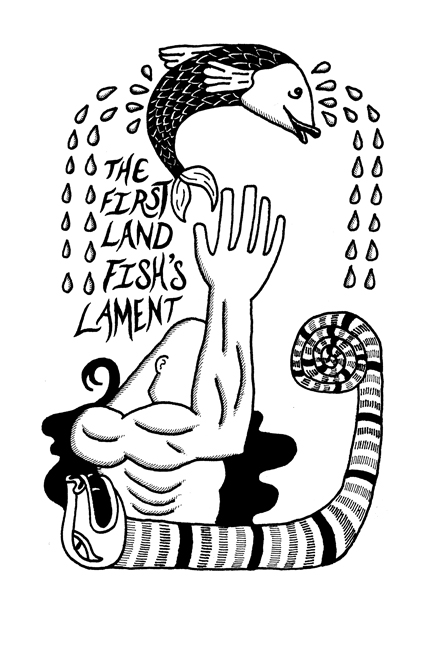
I've just read the first three stories in the collection Golden Gate and Other Stories (1982, Corroboree Press, signed copy, illustrated). I'm struck afresh with the profound commingling of deep joy and deep sorrow in Lafferty's fiction that I began to try to analyse previously here. These opening stories are wonderful specimens of consummate storytelling, each framed with certain types of narrational rhythmic repetitions characteristic especially of oral forms (which give his stories a 'live' and performative sort of feel - if you haven't done it yet, you must try reading some of his tales out loud to family or friends; it adds whole new levels to the experience).
The first story ('Golden Gate') takes place within a week's time, narrating several rollicking evenings of contemporary (1970s) working class folks having a high time at an 1890s style bar and pantomime venue. Each major scene is a ritual repetition of the build up to and then occurrence of a given weeknight's vaudeville-type melodrama, which is then capped by group singing to round out the night's rowdy fun.
The second story ('Mr. Hamadryad') takes place in semi-secret bars in Africa, North America, and Polynesia during short, apparently incidental, meetings between the narrator and the mysterious man of the title. Each major scene is a ritual repetition that recounts the bartender's making of the titular character's mixed drink (each one crowned by the cracked egg of a local exotic bird placed in the completed drink still in its shell and sprinkled with the local version of something like sesame seeds).
The third story ('This Boding Itch') takes place within, I think, less than two hours in a near-future America running at a hyper-productive speed similar to Lafferty's celebrated story 'Slow Tuesday Night' and the packed passage of time is marked by the ritual repetition of television news reports at 6:21, 6:41, 7:01, 7:31, 7:46 and so on.
Now, for me, it is its own pleasure just to notate these narrational framing devices. But they very much serve a purpose in - or rather, evince and exemplify a purpose underlying - all of Lafferty's writing, revealing of the existential wrestlings he performs in his art. The narrational significance can be seen when noticing and notating the theme of each of these stories.
Each one is about a grave loss to the human world. More and more I see how much so many of his stories are elegiacs and jeremiads. He wrote not only comic prophecies with cosmic laughter (jibing and joking as a means of calling his society to very sober choices and actions) but also wrote out-and-out lamentations, beautifully and heart-rendingly chronicling just what it is we've lost, what we've failed to choose, how we've failed to act - or indeed, how those of us who perhaps may have wanted to choose and act have been brutally denied this path by the powers that be.
'Golden Gate' is about an era's loss of a clear Villain or Devil. 'Mr. Hamadryad' is about an era's shift-change from the Monkeys ('scatterbrained, petty, inefficient and human') to the Cats ('clear and clean, and cool and cruel') - i.e. from being bumblingly human to being efficiently inhuman. 'This Boding Itch' is about the grotesquery of Thought Police acid-burning-off the maps of the future on the palms of our hands and the acid-burning-out of the third eyes on our foreheads that understand that map of the future - i.e. being bureaucratically and brutally severed from our own possibility of transcendence into fuller meaning, fuller humanity.
Loss, loss, loss. When you enter into sympathy with Lafferty's work, you really feel the deep sorrow and bereavement of these stories. The effect on the reader is a kind of reverse-Sensucht. (This was a term C. S. Lewis employed to describe our piercing sense of 'inconsolable longing' for 'another world'. So in Lafferty's counterpoise version it perhaps describes something like an 'inconsolable mourning' for a 'lost world' or better, an 'inconsolable stupefaction' due to a 'missed world' that we have somehow sidestepped and 'misplaced'. Possibly this is relevant to understanding Lafferty's oft-used term 'amnesia' to describe our contemporary cultural state).
But that's not all. That is not the entirety of the effect on the reader of these jeremiads. You had also been experiencing a deeply haunting joy intertwining the sadness as you read each story. Where does this strange ecstatic (I would say 'eucatastrophic') element come from if the theme is about a terrible loss - indeed, the loss of our humanity, or at least its severe diminishment? I suggest it comes from the storytelling itself: mainly the orally organised narration I've briefly described here, the richly (but raucously) poetic and polyvalent ( = multi-level meanings) language, and, of course, the unbounded imagination the author exercises - or rather, a very powerfully bound and bridled imagination that is thereby ferociously empowered to CREATE a kind of elemental fantasy writing that may well have no equal, a scarily deep level of creativity that is submitted to an infinitely wealthy spiritual orthodoxy which liberates and unleashes the artist into a truly primal and preternatural exercise of expression and craft.
Yet, to complete the incarnationally paradoxical sort of miracle that Lafferty's writing is (in the ballpark of the Divine Word becoming Human Flesh), the issuing forth of its nearly unspeakable wonders is never without a firm eye and ear on real people, usually 'salt of the earth' people, everyday folks. (There are a plenitude of 'tall' characters too, of course, but even they seem to be grown from the rich red clay beneath our feet.) Indeed, in this regard, Lafferty is probably the wildest, woolliest mixture of the canny and uncanny the world is going to see. This latter 'ordinary folks' sort of element is, in fact, where a lot of the fun, funny, joking quality comes in.
So, it is by means of these in-woven elements that a certain unspeakable elation seems to be infusing the stories, a pungent gladness that poignantly mixes with the sorrow and bewilderment the stories also exhibit.
(Look, I know that's wordy. Someday perhaps I'll hone my own writing craft to trim down much of this teetering verbosity. I do have a poet's free-association imagination and intuitive communicativity, so there is a lot of 'play' in my word-hurling, I admit. YET, please believe me that I am here combing through my words and trying to sculpt them until they really seem to fit the subject matter. I believe that if some thought and patience is given to the above paragraphs, it is at least a pseudo-noble, if pitiful, effort at apprehending this great man's craft and artistry. I mean for it to gain traction, to get purchase, on Lafferty's writing and truly help elucidate it.)
To try to sum it: there is a very piercing sorrow in many of Lafferty's tales at the level of the theme that the events narrate - namely, loss or diminishment of humanity in a socio-cultural era of the philosophical denial of the human person (following from the era's denial of the divine and/or divine revelation). And, at the exact same time in the reading experience, there wrestles with this sorrow a piercing joy at the level of the storytelling itself - a wild joy and mystery and even hope comes through in the very narration and events narrated, the mind-and-heart-expanding wonder of experiencing impossibilities tumbling out and over you in exquisite pungency and potency. (Indeed, I haven't even explored here the weird wonders these particular stories contain - a man in a crowd shooting and killing another man on a stage and only the two them know it has happened; a baboon-faced man with a giant invisible panther for a slave; thirty freshly severed left hands crawling out the windows of a room of thirty people to escape being eaten by dogs bred for the purpose - you get the idea.) This strange commingling of opposed elements makes the stories Laughing Lamentations it would seem, a fitting tag perhaps for the writer who took up Chesterton's mantle as merry maker of paradox and brought the practice to whole new levels.
Indeed, Lafferty has a constant 'double vision' in a variety of ways and themes, so this fits in with that. (And there's lots of academic literary terminology about 'twinning' and 'doubles' and so on that could be tapped into for theoretical equipment with which to analyse this central aspect of Lafferty.)
If you made it through to here - thank you and congratulations: you are undisputedly a lusty, robust, stamina-stacked, longsuffering reader!
I've just read the first three stories in the collection Golden Gate and Other Stories (1982, Corroboree Press, signed copy, illustrated). I'm struck afresh with the profound commingling of deep joy and deep sorrow in Lafferty's fiction that I began to try to analyse previously here. These opening stories are wonderful specimens of consummate storytelling, each framed with certain types of narrational rhythmic repetitions characteristic especially of oral forms (which give his stories a 'live' and performative sort of feel - if you haven't done it yet, you must try reading some of his tales out loud to family or friends; it adds whole new levels to the experience).
The first story ('Golden Gate') takes place within a week's time, narrating several rollicking evenings of contemporary (1970s) working class folks having a high time at an 1890s style bar and pantomime venue. Each major scene is a ritual repetition of the build up to and then occurrence of a given weeknight's vaudeville-type melodrama, which is then capped by group singing to round out the night's rowdy fun.
The second story ('Mr. Hamadryad') takes place in semi-secret bars in Africa, North America, and Polynesia during short, apparently incidental, meetings between the narrator and the mysterious man of the title. Each major scene is a ritual repetition that recounts the bartender's making of the titular character's mixed drink (each one crowned by the cracked egg of a local exotic bird placed in the completed drink still in its shell and sprinkled with the local version of something like sesame seeds).
The third story ('This Boding Itch') takes place within, I think, less than two hours in a near-future America running at a hyper-productive speed similar to Lafferty's celebrated story 'Slow Tuesday Night' and the packed passage of time is marked by the ritual repetition of television news reports at 6:21, 6:41, 7:01, 7:31, 7:46 and so on.
Now, for me, it is its own pleasure just to notate these narrational framing devices. But they very much serve a purpose in - or rather, evince and exemplify a purpose underlying - all of Lafferty's writing, revealing of the existential wrestlings he performs in his art. The narrational significance can be seen when noticing and notating the theme of each of these stories.
Each one is about a grave loss to the human world. More and more I see how much so many of his stories are elegiacs and jeremiads. He wrote not only comic prophecies with cosmic laughter (jibing and joking as a means of calling his society to very sober choices and actions) but also wrote out-and-out lamentations, beautifully and heart-rendingly chronicling just what it is we've lost, what we've failed to choose, how we've failed to act - or indeed, how those of us who perhaps may have wanted to choose and act have been brutally denied this path by the powers that be.
'Golden Gate' is about an era's loss of a clear Villain or Devil. 'Mr. Hamadryad' is about an era's shift-change from the Monkeys ('scatterbrained, petty, inefficient and human') to the Cats ('clear and clean, and cool and cruel') - i.e. from being bumblingly human to being efficiently inhuman. 'This Boding Itch' is about the grotesquery of Thought Police acid-burning-off the maps of the future on the palms of our hands and the acid-burning-out of the third eyes on our foreheads that understand that map of the future - i.e. being bureaucratically and brutally severed from our own possibility of transcendence into fuller meaning, fuller humanity.
Loss, loss, loss. When you enter into sympathy with Lafferty's work, you really feel the deep sorrow and bereavement of these stories. The effect on the reader is a kind of reverse-Sensucht. (This was a term C. S. Lewis employed to describe our piercing sense of 'inconsolable longing' for 'another world'. So in Lafferty's counterpoise version it perhaps describes something like an 'inconsolable mourning' for a 'lost world' or better, an 'inconsolable stupefaction' due to a 'missed world' that we have somehow sidestepped and 'misplaced'. Possibly this is relevant to understanding Lafferty's oft-used term 'amnesia' to describe our contemporary cultural state).
But that's not all. That is not the entirety of the effect on the reader of these jeremiads. You had also been experiencing a deeply haunting joy intertwining the sadness as you read each story. Where does this strange ecstatic (I would say 'eucatastrophic') element come from if the theme is about a terrible loss - indeed, the loss of our humanity, or at least its severe diminishment? I suggest it comes from the storytelling itself: mainly the orally organised narration I've briefly described here, the richly (but raucously) poetic and polyvalent ( = multi-level meanings) language, and, of course, the unbounded imagination the author exercises - or rather, a very powerfully bound and bridled imagination that is thereby ferociously empowered to CREATE a kind of elemental fantasy writing that may well have no equal, a scarily deep level of creativity that is submitted to an infinitely wealthy spiritual orthodoxy which liberates and unleashes the artist into a truly primal and preternatural exercise of expression and craft.
Yet, to complete the incarnationally paradoxical sort of miracle that Lafferty's writing is (in the ballpark of the Divine Word becoming Human Flesh), the issuing forth of its nearly unspeakable wonders is never without a firm eye and ear on real people, usually 'salt of the earth' people, everyday folks. (There are a plenitude of 'tall' characters too, of course, but even they seem to be grown from the rich red clay beneath our feet.) Indeed, in this regard, Lafferty is probably the wildest, woolliest mixture of the canny and uncanny the world is going to see. This latter 'ordinary folks' sort of element is, in fact, where a lot of the fun, funny, joking quality comes in.
So, it is by means of these in-woven elements that a certain unspeakable elation seems to be infusing the stories, a pungent gladness that poignantly mixes with the sorrow and bewilderment the stories also exhibit.
(Look, I know that's wordy. Someday perhaps I'll hone my own writing craft to trim down much of this teetering verbosity. I do have a poet's free-association imagination and intuitive communicativity, so there is a lot of 'play' in my word-hurling, I admit. YET, please believe me that I am here combing through my words and trying to sculpt them until they really seem to fit the subject matter. I believe that if some thought and patience is given to the above paragraphs, it is at least a pseudo-noble, if pitiful, effort at apprehending this great man's craft and artistry. I mean for it to gain traction, to get purchase, on Lafferty's writing and truly help elucidate it.)
To try to sum it: there is a very piercing sorrow in many of Lafferty's tales at the level of the theme that the events narrate - namely, loss or diminishment of humanity in a socio-cultural era of the philosophical denial of the human person (following from the era's denial of the divine and/or divine revelation). And, at the exact same time in the reading experience, there wrestles with this sorrow a piercing joy at the level of the storytelling itself - a wild joy and mystery and even hope comes through in the very narration and events narrated, the mind-and-heart-expanding wonder of experiencing impossibilities tumbling out and over you in exquisite pungency and potency. (Indeed, I haven't even explored here the weird wonders these particular stories contain - a man in a crowd shooting and killing another man on a stage and only the two them know it has happened; a baboon-faced man with a giant invisible panther for a slave; thirty freshly severed left hands crawling out the windows of a room of thirty people to escape being eaten by dogs bred for the purpose - you get the idea.) This strange commingling of opposed elements makes the stories Laughing Lamentations it would seem, a fitting tag perhaps for the writer who took up Chesterton's mantle as merry maker of paradox and brought the practice to whole new levels.
Indeed, Lafferty has a constant 'double vision' in a variety of ways and themes, so this fits in with that. (And there's lots of academic literary terminology about 'twinning' and 'doubles' and so on that could be tapped into for theoretical equipment with which to analyse this central aspect of Lafferty.)
If you made it through to here - thank you and congratulations: you are undisputedly a lusty, robust, stamina-stacked, longsuffering reader!
Subscribe to:
Posts (Atom)