Showing posts with label unreal world. Show all posts

Friday, August 19, 2011

The Rough Account of The Group of Twelve: 1. Hilary Ardri (excerpt from R. A. Lafferty's East of Laughter)

‘HILARY ARDRI, a rusty-coloured man, red-haired all over his body (an Esau man). He stood an even two meters tall and was very thick in the arms and shoulders and chest. Like an earlier hero, he was blue-eyed when he gazed out over the land, and he was green-eyed when he gazed over the ocean. He was only moderately intelligent, but he had great mental stamina: he could stay with an argument for thirty-six hours and tire out his opposition. He had, for a while, been in politics where this quality of mental stamina was important. His inquiring mind had one restriction on it, and this was his old family motto: When you have a good thing going, don’t ask questions. He had a remarkable memory for details, and this made up for his not quite remarkable intelligence. And he did have one good thing going, and he didn’t ask questions about it. He had stumbled onto it by accident.

‘Hilary had an enterprise on the shore of a recreational lake in eastern Oklahoma. This was the Computerized Lake-Fish Company. But Hilary did not have a Commercial Fisherman’s License to operate on Lake Tenkiller nor on any other lake, stream, river, pond, or reservoir in Oklahoma. Commercial Fisherman’s Licenses were quite rare and very hard to obtain. The only really good way to get such a license was to be born with it. And why should one bother? Those who did have commercial licenses seldom fished, for there were no longer any fish to be caught in the lakes, streams, rivers, ponds, or reservoirs of Oklahoma. Nevertheless, Hilary Ardri had become quite wealthy from his Computerized Lake-Fish Company. A man from the State Fish and Game Department spied on Hilary constantly to find out how it was all accomplished, but he could find out nothing at all. And the fact was that Hilary himself did not understand how he did it.

‘“I do not break any of your thousand-and-one regulations,” Hilary always insisted to that man from the State F&G Department. “I do not fish at all, not with hook or line or net or jug or dynamite or gaff or harpoon or fish-line or fish-bane. I do not poison the waters to kill the fish. There is no smell of fish on my shore (my own shoreline is only ten meters long), and there is no debris of fish. I have no factory or processing plant. Where is my fish works if I am accused of engaging in commercial fishing without a license?”

‘“I dunno, Ardri, where is it? That’s my own question,” said the man from the F&G Department.

‘“It’s right there, on my table there, taking up only half a square meter of space,” Hilary said in a moment of candor. “That computer, small and efficient and personalized, is all the fish business that I have, is all the business of any sort that I have.”

‘“You deliver packaged fish (excellent fish they are) to more than three thousand Oklahoma stores every morning,” said the man from the F&G Department (his name was Myron McMasters). “How and where do you get the fish, and how do you deliver them?”

‘“My computer there takes care of everything. It gets the fish without hook or crook, and it delivers them by driverless vehicles to the stores. It puts them in stock. It bills them and it collects for them. And it deposits all the profits (the profits are 100%) in my cash accounts and in my security accounts. Hey, these fish are good, are they not, Myron? They’re some of mine. The computer delivers them to me every morning too. And then it prepares and serves them however and whenever my whim desires it. And the driverless vehicle by which it delivers them, well, it isn’t anywhere when it isn’t in use. But I don’t know anything at all about fish.”

‘“What do you know about then, Hilary Ardri?” Myron McMasters from the State F&G Department asked. He had a touch of irritation in his voice, but not too much irritation, for he loved Ardri’s fish and he also believed that one shouldn’t ask too many questions about a good thing.

‘“Computers,” Hilary Ardri said. “I know about computers. I am not known as a big brain among the computer people, but I know a few things that the big brain people haven’t learned. One thing I know is that a happy computer can work wonders, and that a computer is most happy when it can indulge itself in a little bit of sociability. But computers don’t find the society of humans all that captivating. Some computer-owners stable a goat with each computer to keep it from getting lonesome. That’s the second best solution to the problem. But the best solution is to let the computer welcome the guest of its choice, and most computers are kept too clean and antiseptic by their owners to appeal to the special visitors. But I was never bothered by the fetish of cleanliness and over-maintenance. My computer has a poltergeist friend that lives in its maw and does not take up any physical space there. And my computer is happy by this circumstance. So it works wonders for me.”

‘“You’re kidding, of course,” Myron McMasters said. “I’ll solve your mystery yet, Hilary. I’ll solve it yet.”

‘There wasn’t much of a mystery to solve. Hilary Ardri did know about computers, and he knew about them by hard study as well as by sudden intuition. He studied things that other computer people didn’t bother about. He even studied a humorous chapter in an obscure computer operators’ manual, a chapter named Theoretical Things That Could be Effected by a Computer in the Ambient of an Unreal World.

‘“Might as well try some of them,” Hilary had said.

‘To take one example, the one that he did take, he learned that in an unreal world, the amount of fish that may be taken out of a lake has no connection with the amount of fish in the lake. The amount of fish to be taken out is related only to the amount of fish that the computer programs to be taken. It does not matter whether or not there are any fish at all in the lake. In an unreal world, the ambient is never restrictive. The fish will be processed as the computer programs them to be processed. They will be delivered, collected for, and deposited for as the computer programs them to be done. It is a little mental game that one may imagine for a computer. And it is safe, for it will work only in the ambient of an unreal world.

‘But it worked for Hilary Ardri. That wasn’t the first indication that Hilary had that the world was unreal, but it was one of the most telling indications. So Hilary Ardri learned, quite by accident, that the world in which he lived was unreal. And hardly anybody in the world knew that.

‘To be real is to be unique. To be unreal is to be common.

‘And the odds in favor of the world being unreal are prohibitive. There is only one chance in all infinity of it being real. But there are a billion billion and ongoing billions of chances of it being unreal.

‘And besides that, Hilary’s computer had an alter ego, or at least an inhabitant, who became a pleasant friend of all of them in the household.’

-R. A. Lafferty, East of Laughter (1988), pp.4-6

The Rough Account of The Group of Twelve: 2. Jane Chantal Ardri (excerpt from R. A. Lafferty's East of Laughter)

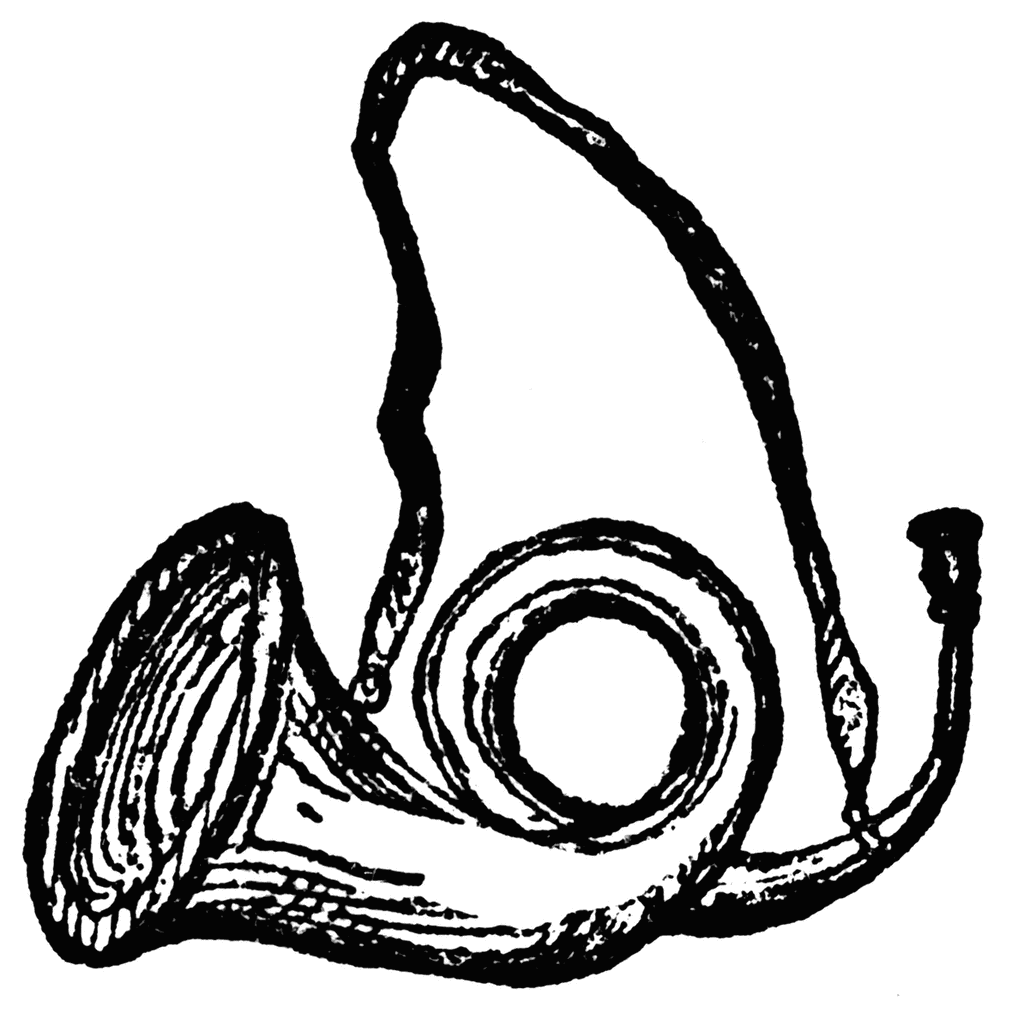
'JANE CHANTAL ARDRI was an artist of all the arts. But she denied that her art was completely computerized art. Her personal computer, in the family room of the Ardri home, was invisible, except to the eye of another artist. It was housed in a hunting-horn that hung on a rafter (a computer-hewn hickory rafter) in that pleasant room. But every artist who came there (and most of Jane’s friends outside the circle of Twelve were artists) would say at once, “Oh, how quaint, Jane Chantal, how cult! How could anybody not put her computer in her hunting-horn! How could anybody not have a hunting-horn! And does it still sound like a hunting-horn?”

‘And, in her programming voice, Jane Chantal would immediately order, “Sound, horn, sound, and mean it when you sound!” And lively and rousing (though computerized) hunting-horn tunes would immediately tumble out of the rafter-hung horn-computer. Jane was a huntress, of course, always and in everything, but she was a fuzzy and somewhat lazy huntress, one who was seldom in a hurry. She knew that her game would wait for her, that her prey would take only token (though colourful) flight. She was the huntress who was always in charge of the hunt.

‘But Jane Chantal always maintained, “I use the computer only for the tedious and difficult things in art, and in my hunting. Many of the things in art are hot and heavy, or they are cold and clammy, or they are back-breaking and finger-breaking. These things the computer does, but I do all the artistic parts, and all the really avid pursuits.”

‘Yes, certain aspects of bronze-casting are hot and heavy, as is the carrying-in of a full-grown elk on the shoulders and hanging and drawing it. Certain aspects of massive sculpture in travertine-marble-limestone are rockdust-breathing and arm-breaking and unpleasant. So also are aspects of stalking a prey by the belly-crawl through frozen grass on a winter pre-dawn. And the whole process of writing and regaling of Heavy Drama is nerve-jangling and emotion-wrenching. So let it be the computer whose nerves are jangled and whose emotions are wrenched. And it is the business of the computer to find rimes for unrimeable words and to devise new meters, just as it is the business of the computer to find new Canadian Geese to rise from the lake in the morning and to make their turn-back when a furlong in the air to receive the shot. And the computer can gaze directly into the sun (directly by remote-control) and then record the after-images that result form that encounter. Or the computer can go, not physically itself, but in its probing processes, down into the bottom of the deepest well or aquafer and there record the curious poetry of the blind brooks and the blind fish. And, whenever Jane Chantal returned from one of her frequent trips to other parts of the world, she would find that her artistic production had gone on unabated in her own absence. Her joyous computer (it was named Joyeuse Vice-Reine and it was a female computer) never failed her. Her newest productions were always in the newest style, whether Jane Chantal was physically present at their production or not.

‘Like the computer of her husband Hilary, that of Jane Chantal Ardri was also inhabited by a sprite that was kindred to a poltergeist, but less obtrusively adolescent. And the two sprites were excellent friends. The two people with their computers and with the two infestations of their computers all lived together in one happy household.

‘Hilary and Jane Chantal Ardri also had five children of their own flesh and blood, good, pleasant, smart children. They will be mentioned without hesitation if ever there is a reason to mention them again. The names of the children (they were named by the computers: neither Hilary nor Jane Chantal was good at naming children) were Hilary Henry, Jane Chanteclaire, Marie Rieuse, Anne Auclaire, and Urban Urchin. Urban Urchin, the squeaking wheel, got a certain amount of attention form them simply because he was the squeaking wheel. And the eldest of them, Hilary Henry, was their “man in New York” and so they maintained a sort of business relationship with him.

‘“If you ever meet a happy artist in any of the arts, fall back and regroup,” a brilliant critic in the late twentieth century has written. “Fall back and regroup, or back out of it any way you can, for you will have stumbled into an unreal world.”

‘But the fuzzily-beautiful and fuzzily-avid Jane Chantal Ardri was a happy artist in all the arts. This wasn’t the first or the second indication the Ardris had that they lived in an unreal world, without difficulty or complication. But it was another of those most telling indications.’

-R. A. Lafferty, East of Laughter (1988), pp. 6-8

'It was all strong talk with the horns and hooves still on it.'
(R. A. Lafferty, The Devil is Dead)