Friday, July 31, 2015

Short Story Review # 6: Narrow Valley (1966)

4.5/5

This story genuinely deserves to be included in anthologies of the American (USA) short story.  It is a regional yarn of post-colonial irony, highly amusing, its wonders deftly described, and a narrative richly layered with allusive material for class discussions and the writing of essays.  May the day speed on when we see this title listed next to stories by Flannery O'Connor, Mark Twain, Jack London, Charlotte Gilman, Shirley Jackson, Ray Bradbury, Langston Hughes, and so on.

I wrote a very short section about this story in my recent dissertation.  It was only in doing this that I properly realised just how many themes and elements Lafferty folded into this one short, seemingly light, tale.  In the dissertation, I could only talk a tiny bit about the land itself as a sort of character in the story.  It pained me not to even touch on the other elements.  If I could have done so, it would have strengthened even the discussion of the land because all the elements of the story reinforce each other (as well as leading off on individual tangents).

The story's three main themes that seem most central to me are:  1) the delightfully portrayed marvel of the valley's anomalous spatial-perceptual behaviour (with its political as well as ontological implications); 2) the wry lampooning of white reductionist views of Native Americans; 3) the equally wry lampooning of 'scientific' explanations and our modern psychological need for them in order to keep a mysterious universe at bay.

But these don't exhaust the story's charms and riches.  The dialogue, for example, is some of the funniest and sharpest in all of Lafferty's output.  One of my favourite instances is the exchange between the Rampart children and the Indian Clarence Little-Saddle when they're down in the valley together.  For example:
“Is there any wild Indians around here?” Fatty Rampart asked.
“No, not really. I go on a bender about every three months and get a little bit wild, and there's a couple Osage boys from Gray Horse that get noisy sometimes, but that's about all,” Clarence Little-Saddle said.
“You certainly don't intend to palm yourself off on us as an Indian,” Mary Mabel challenged. “You'll find us a little too knowledgeable for that.”
“Little girl, you might as well tell this cow there's no room for her to be a cow since you're so knowledgeable. She thinks she's a short-horn cow named Sweet Virginia; I think I'm a Pawnee Indian named Clarence. Break it to us real gentle if we're not.”
This badinage carries on, disabusing the children of their ethnic stereotypes.  Mary asks Clarence where his war bonnet is if he's a real Indian.  He in turn asks her why she's not wearing the Crown of Lombardy if she's supposed to be a real white girl.  After a little more back and forth, including asking where his bow and arrows are and him admitting he only did archery once and poorly at a range in T-Town, we get this:
“Hey, you old Indian, you lied!” Cecilia Rampart shrilled from the doorway of the shack. “You do have a war bonnet. Can I have it?” 
“I didn't mean to lie, I forgot about that thing,” Clarence Little-Saddle said. “My son Clarence Bare-Back sent that to me from Japan for a joke a long time ago. Sure, you can have it.”
An example of other elements buried in the story is the very occluded reference to the Rampart matriarch's own possible non-white ethnicity.  Her name is Nina, and she confesses to sometimes having an urge to disappear to Mexico forever.  This might be another reason why she and the children, unlike Robert Rampart the patriarch, are able to enter the fun and humour of the recalcitrant valley and thus 'play along' and experience its true dimensions.  At least for a little while.

I suppose that's a fourth central element:  humans having or lacking true dimensionality, which determines their ability to experience the true dimensionality of the world in which they exist (and the true dimensionality of one another, especially across racial lines).  Cue the concluding punny joke between Clarence and the ever-popular Lafferty stalwart, Willy McGilly the 'eminent scientist':
“Did we overdo it, Clarence?” Willy McGilly asked. “What did one flat-lander say to the other?”
“Dimension of us never got around,” Clarence said. “No, I don't think we overdid it, Willy.”
It's an all round great tale of magic, theory, repartee, and subversion of Manifest Destiny, supplying a variety of pleasures only truly appreciated on repeated readings.  It also, along with the other American Indian short stories Lafferty wrote, is deepened by (and deepens) a reading of Lafferty's historical novel of the Choctaw people Okla Hannali (1972).  There are various interesting resonances, but the poignancy only lightly implied in 'Narrow Valley' gets full voice in Okla, along with plenty more wonders and horrors and hilarities.

* Discussion of 'Narrow Valley' on Facebook

* 'Narrow Valley' on ralafferty.org (including many links to other blog reviews of this story)


'Narrow Valley' appeared in this anthology among several others, as well as being included in Lafferty's seminal short story collection Nine Hundred Grandmothers (1970)

Tuesday, June 23, 2015

'Ecomonstrous Environments in the Fiction of R. A. Lafferty and Cormac McCarthy' (dissertation uploaded!)

Here it is at last, folks:

https://www.academia.edu/13205984/Ecomonstrous_Environments_in_the_Fiction_of_R._A._Lafferty_and_Cormac_McCarthy

Feel free to tear it to shreds with incisive criticism.  It's definitely only the first stab at a longer project. I'm pleased to be able to say the dissertation received an 'A'.  It's just an undergraduate paper, but I hope it points in some helpful directions for seeing Lafferty's place in American and world literature as well as philosophy.  Works mentioned, either at length or briefly, are 'Narrow Valley', 'Smoe and the Implicit Clay', 'Snuffles', and Okla Hannali.  The only work by McCarthy engaged in the paper is Blood Meridian.  (The PhD research I hope to begin in October will delve into the rest of their respective bodies of work.)

The main theorists engaged in this paper are Timothy Morton ('dark ecology'), Graham Harman ('object-oriented ontology'), Alphonso Lingis ('imperatives in things'), and a bit of Lawrence Buell (pioneer of contemporary ecocriticism in literary studies).  Large swathes of the paper should be pretty readable even to those not familiar with any theory.  Other parts may seem a bit impenetrable! At any rate, the whole thing is only ten thousand words.  To those further down the academic road than me, all I can ask is your patience and charity!  (But don't hold back much-needed critique either!)

There's lots of other Lafferty stuff happening and I still plan to get back to reporting on that, so stay tuned!  (Here's a quickie:  Jeff Vandermeer is a huge Lafferty fan now, a recent convert, and he'll be including Lafferty's story 'Nine Hundred Grandmothers' in the forthcoming Big Book of SF he and his wife Ann Vandermeer are editing for Vintage Books.)

Wednesday, June 10, 2015

Short Story Review # 5: Parthen (1973)

4.5/5
'Peggy had put her tongue on the crux.'
This one is one of my faves and one of the first Lafferty stories I ever blogged about some six years ago.  All that I said in that earlier post still stands.  The story still strikes me as exquisitely taut in its prose and plot, it still tickles my funny bone, and the poetic passage describing the (probably projected) beauty of the alien women is still unique and brilliant.  I would add to what I originally wrote about reading it over and over in the early days that I also used to read it out loud to family and friends every chance I got, and I also photocopied it and thrust it into the hands of a number of people.  ('Configuration of the North Shore' is another one I've done that with frequently over the years, but usually just loaning the person Gardner Dozois's Modern Classics of Fantasy, which contains that story in a nicely printed format amidst good authorial company.  'Configuration' has won over a lot more people than 'Parthen' ever did.)

But I guess I also still have the same qualifications:  that this is potentially a great intro to Lafferty if someone's likely to be won over by a well-written, humorous, semi-twisty, lightly satirical Twilight Zone type of tale.  But it doesn't give a whole lot of indication of the depths, heights, and bizarrities to which Lafferty frequently rises. (His story 'The Six Fingers of Time' is similar in this respect to me - a great, funny, wowing piece of speculative fiction, but only hinting at the full Lafferty effect.)

Three things stuck out to me on this read:  one is the line quoted above, delivered by Peggy Ronsard, the wife of Roy the protagonist.  I feel as if I never even read that line before.  This time it leapt right off the page and enthralled my eyes.  What does it mean?  It seems suggestive, and in one of the comment threads on the discussion of this story on Facebook we got into some very graphic detail trying to spell this out!  Basically, it was suggested that this was a double entendre, which would fit with the subplot of the men no longer being sexually hungry or active because of the 'higher values' they have euphorically embraced.  And that diminishing of actual sexual activity is what is narrated after the arresting sentence.  'The goats among the men had become lambs and the wolves had turned into puppies.'  Such sexual goatiness and wolfishness is keenly missed by the wives of the men for they have not been visually seduced into the body-denying 'higher values' by the new beautiful women (aliens) in town.  Well, if this is a double entendre, there's also no doubt in my mind that Lafferty would not be unaware of the phrase's allusion to the Catholic practice of kissing the crucifix. (I'd love to hear from any of you theologically minded folks on this.)  That's quite risqué of Lafferty! And potentially a really complex move.

This leads me to the next thing that stuck out to me on this read, especially since we had just read 'Maybe Jones and the City' the week before (a yarn with an emphasis on a bawdy bodily afterlife): 'Parthen' is bitingly anti-gnostic.  I've always grasped that it was generally satirising 'higher ethics' that ignore or sublimate truly good actions.  But I hadn't quite as viscerally grasped how much the story portrays the cessation of conjugal physical affection and lovemaking as a grave and terminal social evil.  Parthenogenesis may be great for some biota, but not for humans, Lafferty seems to say.  This made me see that I'd missed the story's thematic connection to other of Lafferty's stories like 'Ishmael Into the Barrens', 'Try to Remember', and 'Heart Grow Fonder'.

Lastly, I was freshly struck that Peggy Ronsard is the real hero and centre of this story, even though she only features on a few pages of it.  (Then again, it's a very, very short tale).  She is the most truly drawn character of the story, bursting with vim and vigour, wit and wisdom, all of which is evinced with only a few masterful strokes from Lafferty.  (And this freshly confirms my impression that this is just such a tightly written story craftwise).  Indeed, Peggy's few lines have always stuck with me over the years, almost more than any other character in Lafferty's body of work - not only her incisively sarky comment that Jack the Ripper would be better than the sexless creatures their husbands had become, but also her lively lusty love of male attention, both her husband's and his friends!  (Lafferty's recurring theme of men sitting on women's laps is broached here.)  It's a cheeky tale to be sure.  A minor classic in his oeuvre.

* Discussion of 'Parthen' on Facebook

* A review of 'Parthen' on Yet Another Lafferty Blog

* Comment thread for 'Parthen' on ralafferty.org

Sunday, June 7, 2015

Short Story Review # 4: Maybe Jones and the City (1968)

3/5

This one gets a little richer and deeper every time I think about it.  It's easy to think it's merely an entertaining 'idea story' with some connections to other fuller explorations of similar themes elsewhere in Lafferty's works, but not much more.  Then you try to pick apart why this is so and it gets more complex as you do so.  In the East of Laughter Facebook group, the ratings ranged from 2 to 5, the broadest we've seen so far.  I think it's a typically Laffertian take on themes like Sensucht and the 'argument from desire'.  And 'typically Laffertian' here means that Lafferty has put so many tensions and carnivalisations into this embodiment of those ideas that the theology of it becomes downright confusing and perhaps disturbing.  It's definitely designed to be a story you have to wrestle with.  I'm thankful for that because, as I said, it's forcing me to get much more out of it the more I wrestle with it.

'Maybe Jones' is one of my favourite Lafferty names (out of probably a hundred more favourites - he is the king of character names).  It captures perfectly the essence of the story:  the ambivalent longings of the everyman.  Its theme of yearning specifically for the 'perfect place', which one has visited but forgotten the location of, connects it to other Lafferty stories such as 'Configuration of the North Shore' and 'Land of the Great Horses', which also explore themes of peoples and landscapes, psychogeography, the sense of a homeland, and so on.  The fact that these longings are focused on a long lost perfect city (rather than, say, an edenic pastoral setting) connects it to Lafferty's repeated explorations of utopia and his many excursions into competing ideals of the urban (e.g. Past Master, 'The Will as World and Wallpaper', 'Interurban Queen', etc.).

The more I think about it the more I think this story could be a brief Laffertian take on the whole Pilgrim's Progress type of narrative, but instead of the straightforwardly linear 'Pilgrim' or 'Christian' wending his dangerous way to the 'Celestial City', Lafferty gives us Maybe Jones searching and searching the universe for what he's lost, the perfect place with the perfect 'high old time'.  Bunyan's pilgrim struggles to be sure, and is waylaid and whatnot, but Lafferty's pilgrim is in a perpetual cycle of amnesia and ambiguity.  It's as if Lafferty felt spiritual pilgrimage had to be cast in these terms in modern/postmodern times.

Lafferty's idea of 'perfection' in this tale is what I found slightly troubling, mainly in that it involved a hefty dose of prostitution.  Lafferty wasn't at all down with the 'sexual revolution' into which his writing emerged in the 1960s and because of that it's easy to miss some of his very saucy references to sex scattered throughout his works.  Here he calls a brothel a 'bang-house' and calls his acquaintance Susie-Q 'the prettiest trick on Sad-Dog planet'.  Since it's a crucial element of the perfect place in this story, I can only assume that Lafferty is here taking prostitution in the carnivalesque way that he often takes binge eating and drinking, bloody brawling, and the like, using these 'vices' as grotesquely humorous ways to shock us awake to the wildness of the 'virtues'.  That's maybe a stretch, but it's the best I've got for now.  The Vaudeville, Music Hall, bawdy, rowdy ideal of a 'high time' in this story relates it to still more stories in Lafferty's oeuvre such as 'One At a Time' and 'Golden Gate'. The fact that it's set in a planet-hopping context put me in mind of Space Chantey also (and, as it turns out, it shares a few characters, including Maybe himself, with that novel).  Indeed, 'Maybe Jones and the City' feels like a bit of a run up to, or run off from, both Past Master and Space Chantey (both of which novels were published the same year as this short story).

Despite some potential confusions, this tale is definitely about false and true (or less true and more true) versions of perfection, paradise, afterlife, eternity, a blessed state, heaven, and so on.  An old friend of mine recently told me he couldn't imagine there being art in heaven since art requires struggle and heaven is the cessation of all struggle, the answering of all questions, and the like.  I did my best to tell him he had a flawed view of heaven, that it was a place not of instant, total, final knowing and consequently of flat static 'tranquility', but rather it was place and level of existence finally freed from the inhibiting chains of hubris and self-centredness so that one can quest forever in the ecstatic adventure of knowing the divine in ever rising alternations of dark and light as one moves into new unveilings, which are always dark at first sight, until one's eyes grow used to the glory - an existence that will most certainly require the struggle of art to experience it (hence all the praise in biblical visions of heaven - someone has to write those songs, make the instruments, etc.).  Something like that.  It's all just finite pictures of a reality that is unpictureable to mere mortals.  Lafferty in this story pictures it far, far better than I did, if equally oblique.  Lafferty confesses in this story that one person's idea of heaven is another's idea of hell, but he still thinks imagined eternities of mere 'peace' (in a bland, static sense) are not on the right track and that rowdy, bodily, and pleasure-filled pictures are more on the right track, more in keeping with that historical bodily resurrection which is the centre of his church's faith.  It's not a flawless eternity Lafferty pictures, but one for those with, as he puts it in this story, 'the golden flaw' - namely, the inability to settle for a sanctimonious idea of heaven.  Anything too 'peaceful' would become unbearably boring if it went on for all eternity. Heaven must be something so potent that we will quite literally never tire of it.  As the story says of the perfect place, in one of Lafferty's most memorable lines:  'At night they took the sky off just to give it more height.'

Another clue Lafferty gives us about how such an eternity could actually satisfy real flesh-and-blood humans is that, as with so much of his fiction, he breaks the fourth wall and calls upon the reader directly to participate in world-building.  'Hey, get in on this if you're going to. They're building it now!'  All we have to do, he informs us, is post our suggestions to the 'Bureau of Wonderful Cities. Old Earth.'  We are part of the making of heaven, if we're willing.  The story closes:  'That's all you need, but get with it. They're building our place now.'

* Discussion of 'Maybe Jones and the City' on Facebook

* 'Maybe Jones and the City' comment thread on ralafferty.org

Saturday, June 6, 2015

Short Story Review # 3: Through Other Eyes (1960)

4.5/5

I'm starting to see that Lafferty may have had two mega-themes throughout his work, from early to late:  Creating and Seeing.  Lafferty's critical-theory interpreter and biographer, Andrew Ferguson, is doing yeoman's work on the Creating front, performing ongoing in-depth analysis of Lafferty's creative world-building and how his works metafictionally invite readers to participate in that world-building, especially given our world's present conceptual non-status.  I guess my essays in the first two issues of Feast of Laughter have been taking first stabs at the Seeing theme, especially as regards Lafferty's ability to widen and deepen our gaze to take in the non-human environment, and maybe that's going to be the bulk of the contribution I make to Lafferty studies.  I guess there are probably other major, central themes in Lafferty's body of work, but these seem to be two of them.  (Any ideas on others? If I kept on the present-tense verb terminology, I might call his emphasis on 'ghostliness', i.e. spirituality, his mega-theme of Being, which, of course, is ontological and undergirds his themes of Seeing and Creating.)

I've also begun to notice that Lafferty signals most of his major themes right from the earliest part of his career, sometimes with stories that are as accomplished and profound and groundbreaking as any he would write in his mid and late career.  We are put on notice that Creating will be a mega-theme from the outset by his chilling but somehow also invigorating story 'Snuffles' (1960).  So also, in the same year, he sets out for us his mega-theme of Seeing in the story 'Through Other Eyes'.

I think in the past this story has not been one of my top personal favourites because I got a little put off by the introduction, or first panel, of the tale.  I typically don't love it when stories or novels start off with dialogue - I'm a sot for description and that's how I prefer any piece of fiction get going. Immerse me in either action, or, even better, setting, and I'm a very willing reader.  Start me in the middle of a conversation, with little or no imagery, and I'm just enduring it to get through to whenever the description of this world I've entered will finally begin.  I'm sure some readers are opposite, or appreciate both.  (And, of course, I know dialogue does tons of the work of building the setting and telling the story.)  Having said all that, the first line of this story is a cracker:  '"I don't think I can stand the dawn of another Great Day," said Smirnov.'

But the characters' subsequent discussion of time travel experiments feels like a very clunky way to get started. (I think discursively top-heavy intros are often the case with the Institute of Impure Sciences cycle of stories, of which this is the earliest.)  It is very, very erudite and witty - if you are familiar enough with the references.  First of all, I'm not a general history buff, so I'm just not that interested, even if I know the references, but secondly, I had to look several of them up, some of which research yielded a smile or chuckle at Lafferty's handling of the historical material (especially Nell Guinn).  The take on Tristram and Isolde (a reference I did readily recognise) was amusing, and the portrait of Lancelot was the best of the lot to my mind: that he 'spent more time on the rubbing table than any athlete I ever heard of', like a 'high-priced quarterback who was never ready to play'.  (Incidentally, Gene Wolfe compares medieval knights to American football players in his novel The Knight.)  And the reference to Aristotle's treatises on the Beard in Essential and Beard in Existential (pretend treatises, as far as I can tell, though A. did apparently write something or other about beards in some work or other) was funny, a joke whose relevance has come round again with our present bewhiskered hipster-mania.  As I say, as clever and amusing as all this is, it is a slow start to the tale for me and a seemingly irrelevant one to boot given that it is not a setup to a yarn about time travel! Yet I did 'get it' this time round.  This opening gambit supplies an instance of how our successes at peering into unknowns can sometimes shrink rather than expand our world.  The past didn't look as glorious as our handed down accounts when you could actually be there and witness it. And that's the setup:  a foreshadowing of the results of the real experiment at hand in this story (which will be complexly fulfilled, as the subsequent experience will end up being too successful and overly expanding).

Now, I will say that catching this structural element this time round made something else click for me about Lafferty's works.  I'm noticing more and more that his structures can be very, very odd, often in this kind of asymmetric triptych, or otherwise 'panelled' sort of way, where the movements or sections are each quite different from one another in mode or some other aspect of presentation or performance or content.  In some ways it's almost like the stories change styles as they change scenes or sections.  I'm not going to try to analyse it right now, but 'Land of the Great Horses' and 'Thieving Bear Planet' are an early and late story that strike me as instances of this structural phenomenon (the former without the numbered parts and the latter a numbered asymmetric diptych).  A lot of Lafferty's structures are actually beginning to put me in mind of the ornate stories of Jorge Luis Borges.  More consciously recognising the tripartite structure of 'Through Other Eyes' this time round enriched the reading for me.  Even though I don't love the first panel of this particular tale, I do appreciate how it adds to the structural elegance.

At the end of this opening, Smirnov proffers the opinion that 'One pair of eyes is enough.  I do not see any advantage at all except the novelty.'  This is the view Lafferty will never tire of knocking down for the rest of his career.  (Cf. the notion that 'A man misses so much if he uses only one set of eyes' in his 1969 novel Fourth Mansions.)  And this statement from Smirnov allows Cogsworth to state the thesis of the whole short story:  'I believe that what we regard as one may actually be several billion different universes, each made only for the eyes of the one who sees it.'

For me, even though section or panel 2 is where this story really starts to pay gigantic dividends, we still have to get through another page or so of story-stalling theory-speak before it does so. Nevertheless, having just read William James's seminal paper 'What is an Emotion?' (1884), and its subsequent responses in the philosophy of emotion, for a course this past semester, I found Lafferty's little discussion of brains and perception quite neatly fitting into that discourse.  So that was a bonus and something probably worth digging more into.

But it's when Cogsworth's initial thesis is elaborated upon that this tale blows up for me and goes full Laffertian.  He experiences the age-old subjective perception question as a boy, with a fairly commonplace example:  'It may be that I am the only one who sees the sky black at night and the stars white [...] and everybody else sees the sky white and the stars shining black. And I say the sky is black, and they say the sky is black; but when they say black they mean white.'  But, as Harlan Ellison recently noted, Lafferty 'could take a simple idea and say, well, wait a minute, look at it this way.'  True to this propensity, Cogsworth then delightfully and freakishly stacks up weirder and weirder examples, starting with wondering whether others see cows inside out and finishing with wondering whether, when a bird eats a worm, does the worm think 'that his outside is his inside, and that the bird's inside is his outside? And that he has eaten the bird instead of the bird eating him?' (See the whole wonderful passage here.)  We are notified here that when Lafferty talks about every single person seeing the world differently than every other, he really means it, radically.  The amazing thing is that he pays this out in the rest of the story.  Incredible stuff.

After an entertaining wee wander through the eyes of a great man, a wide man, a mathematical man, a fastidiously detailed man, an already-looking-back-at-you man, and a radically sceptical man, there is nothing left but to look through the eyes of a woman.  She is an exceptional woman to Charles Cogsworth (he's in love with her as becomes clear), but Gregory will later tell Cogsworth she's a pretty average gal. Apparently, however, looking at the world through the eyes of even an average woman is wilder, fuller, and more challenging than looking through the eyes of any or all of those diverse kinds of men combined.  Cogsworth says he has seen the world through the eyes 'of a giant, of a king, of a blind hermit, of a general, of a peeping tom, of a fool' and now he will see it through the eyes 'of an angel'.  The narrator has this to say about that:  'Valery Mok may or may not have been an angel. She was a beautiful woman, and angels, in the older and more authentic iconography, were rather stern men with shaggy pinions.'  The implication is that even if Cogsworth saw through the eyes of an angel, he might see a much shaggier world than he was expecting.  At any rate, he is utterly shell-shocked by seeing through Valery's eyes, so much so that he has to spend six weeks in a sanatorium.

Now comes the third and final panel of the story.  Cogsworth eventually chats with his friend Smirnov some more and is challenged that perhaps he just doesn't understand girls!  I won't go much into this final panel of the story as I dealt with it somewhat extensively at the close of my essay for Feast of Laughter issue 2.  Suffice it to say, the view of the world just gets beautifully weirder as we're treated to a description of Valery's universe, imaginatively sensual and mythically literal to a genuinely 'ecomonstrous' degree.  What I do want to note here is how this story contrasts with C. S. Lewis's similarly themed tale 'The Shoddy Lands' (first published in the February 1956 issue of The Magazine of Fantasy and Science Fiction).  The male protagonist of Lewis's tale also sees the world through the eyes of a woman, but he sees not a wildly hyper-sensuous world but a 'shoddy land' full of vague, shoddy flora and people and objects, with a few frivolous and vain exceptions.  I've always really liked Lewis's story for its imaginative premise rendered quite evocatively.  And I don't think it's necessarily damning that the protag of 'The Shoddy Lands' happens to look at the world through a particularly vapid and boring young lady's eyes, especially as Lewis published a whole novel that same year, Till We Have Faces, which is narrated by the fiercely intelligent and fascinating voice of a highly admirable female protagonist.  Nevertheless, it's fascinating and instructive that, in contrast to 'The Shoddy Lands', in 'Through Other Eyes' Lafferty's view through female eyes is gobsmacking, challenging, expanding - the polar opposite of 'shoddy'.  Indeed, it's Lafferty's male protag that comes in for criticism from Valery for his view of the world being too shoddy:
She burst in on him furiously one day.
“You are a stick. You are a stick with no blood in it. You are a pig made out of sticks. You live with dead people Charles. You make everything dead. You are abominable.”
After a bit of half-hearted argument from Charles Cogsworth, he is duly humbled (as is, to be fair, Lewis's protagonist at the end of 'The Shoddy Lands' when he shrinks from the thought that someone might well look at the world through his eyes and see a similarly shoddy landscape, just differently distributed based on his own parochial inclusions and exclusions).  This is a story of being shattered by being too-suddenly immersed in the viewpoint of the Other, and then slowly put back together by further humbled engagement with that same viewpoint (and other POVs as well - it's not unimportant that Cogsworth builds back up to understanding Valery by first seeing the world through other people and even various animals, all of these views surprising, challenging, and enlightening).

One last thing I noticed this time round, which was a delightful surprise, is that this is really a 'cute' romantic love story buried in philosophical rumination.  Charles and Valery are married by the time of the one novel in the Institute cycle, Arrive At Easterwine (1971).  As a man married to a woman whose visual and sensual view of the world is generally far greater than my own, and who must lovingly remonstrate with me about my 'dead stick' view from time to time, and whom I can't help but love for it, 'Especially when it becomes beautiful when angry', I can really resonate with the love story aspect of this tale.

* Discussion of 'Through Other Eyes' on Facebook

* 'Through Other Eyes' entry on Continued On Next Rock blog

* 'Through Other Eyes' comments on ralafferty.org 

Saturday, May 30, 2015

And what if the dog is right?

This idea of his—to enter into the mind of another, to peer from behind another's eyes into a world that could not be the same—this idea had been with him all his life. He recalled how it had first come down on him in all its strength when he was quite small.

“It may be that I am the only one who sees the sky black at night and the stars white,” he had said to himself, “and everybody else sees the sky white and the stars shining black. And I say the sky is black, and they say the sky is black; but when they say black they mean white.”

Or: “I may be the only one who can see the outside of a cow, and everybody else sees it inside out. And I say that it is the outside, and they say that it is the outside; but when they say outside they mean inside.”

Or: “It may be that all the boys I see look like girls to everyone else, and all the girls look like boys. And I say ‘That is a girl,’ and they say ‘That is a girl'; only when they say a girl they mean a boy.”

And then had come the terrifying thought: “What if I am a girl to everyone except me?”

This did not seem very intelligent to him even when he was small, and yet it became an obsession to him.

“What if to a dog all dogs look like men and all men look like dogs? And what if a dog looks at me and thinks that I am a dog and he is a boy?”

And this was followed once by the shattering afterthought: “And what if the dog is right?

“What if a fish looks up at a bird and a bird looks down at a fish? And the fish thinks that he is the bird and the bird is the fish, and that he is looking down on the bird that is really a fish, and the air is water and the water is air?”

“What if, when a bird eats a worm, the worm thinks he is the bird and the bird is the worm? And that his outside is his inside, and that the bird's inside is his outside? And that he has eaten the bird instead of the bird eating him?”

This was illogical. But how does one know that a worm is not illogical? He has much to make him illogical.

~R. A. Lafferty, 'Through Other Eyes' (1960)

Cover by Paul Orban

Tuesday, May 26, 2015

Short Story Review # 2: The Wooly World of Barnaby Sheen (1973)

Rating:  3/5

This has always been a minor favourite of mine.  I like other stories from this cycle (most of them collected in Through Elegant Eyes: Stories of Austro and the Men Who Know Everything) far better, but each one is crucial to the whole that they together build, and this one in particular is just fun to me.  It does get a little deeper with each reading.  It is overtly theological in theme, especially as regards creations and creators, but, as with Lafferty's similarly themed story 'Snuffles' (1960), it is rather baffling as to its theological point.  Yet fascinating.  This one feels quite light and playful though, just touching on the themes, getting you thinking in that direction, rather than fully immersing you in theological ruminations.  It is consequently not the masterwork that 'Snuffles' clearly is.  In addition to the theology, this is one of many stories that exhibit Lafferty's absolute delight in geology.  Indeed, Barnaby expresses that it is only to study some geological issues that he has created this two-ton, cubic meter chunk of world.  Laff paints a nice little picture of this odd creation with its periscopic microscopes protruding from its transparent dome.  The ghostly figure of Mary Mondo hovering over that little world issuing her various Latin fiats was more suggestive to me this time, adding some weight.  But it seems to me essentially a humorous little prank story, an entertaining diversion.  (It also pairs nicely with its companion story in this cycle, a yarn with very similar theme and tone:  'The Ungodly Mice of Doctor Drakos'.)

Interestingly, despite its title and premise, this story didn't strike me as being about 'world-building' all that much, which is generally the mega-/meta-theme of Lafferty's entire body of work.  I didn't really get the sense of being invited to participate in building new worlds that you often get from Lafferty.  We do, however, get the bang, the explosion, that so many stories in this cycle, and elsewhere, do include.  Indeed, it seems more about minor world-destruction than creation, but again in a merely playful way and not leading to 'new worlds from old'.  But I'm probably missing something.

* Discussion of 'The Wooly World of Barnaby Sheen' on Facebook

* Comments for 'The Wooly World of Barnaby Sheen' on ralafferty.org

(From Interior Art by Joe Staton for Through Elegant Eyes)

Monday, May 25, 2015

Short Story Review # 1: Phoenic' (1960)

The Facebook group East of Laughter: An Appreciation of R. A. Lafferty is now running a weekend reading club.  A story is selected and discussed there weekly.  I'm going to see if I can keep up with it and post my own thoughts on each story here, along with a rating out of 5 stars.  There's already been great discussion there and I'll continue to be a part of that.  But I want to keep a record of some of my own thoughts here as well.  For each story I review here, I'll include a link to the discussion of it in Facebook group and, when available, a link to Andrew Ferguson's review of the story on his Lafferty blog Continued On Next Rock, and a link to the story's comment thread on ralafferty.org as well, which I think is the most public, accessible, permanent place to keep a record of open, ongoing discussion of the stories.  (And perhaps occasionally I'll also link to reviews of the stories elsewhere on the web that I might have run into.)

Up first is one of the diminishing number of Lafferty's stories that I had never read before:  'Phoenic''.

Pheonic' (1960) 3/5

I think this is a delightful tale, definitely a new personal favourite in the Lafferty canon.  It is a redemptive sartorial retelling of the phoenix legend, stitching together Pagan, Jewish, and Christian mythos, even stitching together science fiction and fantasy.  It's fairly loose, not as tight and deep as some other tales from this earliest era of Lafferty's writing, such as 'Snuffles' (1960) and 'Through Other Eyes' (1960), but the prose is strong and the imagination unique (the brief mermaid yarn being one of my favourite moments in Lafferty).  It sits nicely alongside Lafferty's other seafaring/seaside tales such as 'Groaning Hinges of the World', 'Cliffs That Laughed', 'The Ugly Sea', and 'Configuration of the North Shore'.  The Phoenician main character could be another 'odd one' collected by Sour John (see the opening of Lafferty's short story 'One At a Time').  Its theme of renewal, both creative and spiritual, was genuinely poignant to me.  The only real criticism I have of it is that the clothing technology at the end seemed just a little - but only a little - cheesy and of its late 50s/early 60s time.  But even that impression was largely subsumed by the resurrection language for me and by feeling the resonance this ending achieved as regards renewed creative productivity.  There was an ambiguity or ambivalence about an aspect of this ending though:  the last line is 'Whence is this newness?' and I think Lafferty means it as a genuine question that the reader must get involved with.  Normally Lafferty uses fashion trends as foils for truth and beauty, trends to be lampooned and subverted (see, for example, 'About a Secret Crocodile', 'The Man With the Aura', Not To Mention Camels, etc.).  Either he hadn't yet decided that would be a major running theme or he introduces it here more ambiguously, calling on the reader to declare 'whence this newness' and thus either validate or invalidate the renewed lines of creative clothing as arising either from false or true springs.  Lafferty often deals in such ambiguous, participatory story-endings, so that would be no surprise.  Even so, I think there is a note of genuine spirituality here, even if it is wrestling with mere trendiness.  It's a theme very relevant to our present time of viral meme-think and hashtag wars and the like.


* Facebook discussion of Pheonic'

* Phoenic' entry at Continued On Next Rock blog

* Phoenic' comments at ralafferty.org


Saturday, May 9, 2015

a real one

“I took a live mermaid not far from here one morning,” said John Counts. And then he paused. “That pause, old Wiedervogel,” he said after a bit, “that pause was for you to say ‘Incredible!’ or something similarly apropos.”

“Consider it said. Was she real?”

“She said that she was. She seemed to be. She was ugly as sin, to use an old phrase. Her skin was green and rough, and perhaps it was scaled. She had a deformity of her feet and legs that turned them into serviceable flippers. She smelled like a mermaid, or at least like a fish. She was a diver, and it was as such that her husband made his living from her. Her hair would have been human hair, if the infestations that lived in it had been cleaned out.”

“What did you do with her?”

“I tried to sell her in England. There is a man there who goes in for such things. ‘But I already have a mermaid,’ this man said. ‘A real one?’ I asked him. ‘No, not a real one, but this is not the first real one that has been offered to me. What I have is better than a real one.’

“It was. What the man had was incomparably better than a real one. She was a beautiful human girl who happened to terminate in a fishtail. But she was no great whiz at swimming or deep diving. She wasn't a real mermaid. I gave my mermaid back to her husband on my return voyage and paid him for her service. We did not understand the same thing by the term, but she was a real mermaid.”

“I used to see them sometimes,” said Wiedervogel.

~R. A. Lafferty, 'Pheonic' (1960)


Monday, April 27, 2015

'Well then, this was something that did not explain itself at all'; Or, 'the grin of a tribal deity full of rogue power and eternal youth'

Overlark breathed out deeply, emptying chest and collapsing his whole upper body in the expelling. Then he plunged his head and neck and shoulders into the large bowl and began to breathe the water deeply.  If this was fakery it was good fakery,and it hadn't been rigged just to impress Freddy Foley.

The man, if he was a man, was breathing very deeply under water - if it was water.  His eyes were open and they had a new snap to them.  He grinned, a not altogether fish grin.  It was the grin of a tribal deity full of rogue power and eternal youth, one at home in all the elements.  Something false about both the power and the youth, though.

Fred Foley scooped water and tasted.  It was half salt - brackish, like tide-turning estuary water, or water from the sea very near the mouth of a great river.  Or it was like water from an ancient ocean, one with less salt in it than have the oceans now.  But why did Fred Foley think of that?

There were minute plants in the water, and small fish.  It was not tap water.  It was either drawn from a particular source, or carefully mixed.  Foley had a sudden belief that there might be an upwelling of that water in that room, even though it was an upper-floor room, just as there was an upwelling of water on Auclaire's mountain, though there were dry caves below.

Well then, this was something that did not explain itself at all.   Carmody Overlark had had his head under water for more than five minutes, and the water itself was in constant change or parade.  There were schools of small fish that passed through it laterally.  They did not follow around the curve of the bowl, they disappeared.  And other sorts of fish appeared, all traveling a parade in the same direction, coming out of the glass itself (for all that could be discerned of them), traveling across the bowl in a straight line and disappearing into the glass wall again.  There was optical illusion or there was strong current flowing through that bowl.

Was the underwater breathing of Overlark somehow the key to suspended animation?  It was a funny key; it didn't seem to fit any of the locks.  It was plain that an ordinary man would be dead, as it was now ten, now fifteen minutes that Overlark had his head and breathing below the surface.  It was plain that he was not an ordinary man.

Then the water went out of the bowl.  It could not be said that it drained out, for there was no drain. Air followed water in the current-parade across the inside of the bowl, and then the inside was dry. Overlark pulled his head out.  He was beaming and greatly refreshed.

"Wonderful, Foley, wonderful.  You should try it.  There's nothing like it to set a man up."


-R. A. Lafferty, Fourth Mansions (1969)


Sunday, April 19, 2015

Laffertian Muck-Monsters

The essay I hope to write for Feast of Laughter volume 3 (due to come out this autumn) is about monsters in Lafferty's fiction, one section of which will be on 'muck-monsters' specifically.  I want to drop a note or two about that here.

My family didn't have much money growing up, so I couldn't afford extensive comic book collections.  Thankfully, some family we knew had a son heading off to college who decided to bequeath to me two brown paper grocery sacks full of comics from the 60s to the early 80s.  Among these were a fairly random selection of Man-Thing and Swamp Thing issues, both of which series pleased me greatly.  I've recently reconnected to those series and discovered they are the flowering of an older type of creature known as the muck-monster, one of the origins of which is The Heap from the WWII era.  


One of the main things I connect with in these monsters is their sheer physiognomy.  I just love the green, goopy, swampy, leafy, muddy, mucky mess of their form.  Man-Thing, for me, trumps Swamp Thing in this regard, the former being of a much weirder bulk than the latter's rather elegantly anthropic bearing.  Nevertheless, Alan Moore's Saga of the Swamp Thing series is by far the greater literary achievement.  (But I've also been enjoying catching up with the whole multi-world nexus conceit of Steve Gerber's The Man-Thing, finding it fruitful for limning theoretical ideas of the muck-monstrous.)

L to R:  Swamp Thing, Man-Thing

I suppose muck-monsters emblematise the dream of humanity's visceral (and viscous) connection to and intermingling with the rankly copious flora that supports its carbon-based, oxygen-breathing biosphere.  Perhaps it reifies a longing for deep rootedness and earthiness, and reminds us of our ecological connection to slime.  And, of course, all this connects to my ongoing study of 'dark ecology' and my own developing theory of the 'ecomonstrous'.

Somewhat to my surprise, as soon as I gained renewed and newly informed interest in muck-monsters, I began to notice a muck-monstrous theme cropping up rather frequently in Lafferty's fiction.  Just off the cuff (rather than going and researching it all right now), I can name the following stories that seem to evince muck-monstrous resonances:  

'Boomer Flats' (bigfoot-type primordial peoples ritually bury themselves in muddy river banks for spiritual renewal)

'Happening at Chosky Bottoms' (same type of folks as in 'Boomer Flats', with some great descriptions of glowing muddy monster-men)

'Smoe and the Implicit Clay' (primordial people rising up out of the clay underfoot, inviting others to recede into said clay with them, again for purposes of renewal)

'Incased in Ancient Rind' (the whole earth becomes swampy and the people slow down and thicken, this time apparently to show the opposite of spiritual renewal)

'Entire and Perfect Chrysolite' (a deadly swamp dream, noting our need for a connection to swampy depths, but our present inability to make this connection without casualty)

'Dream' (also titled 'Dreamworld'; a very nasty version of swampy existence takes over our present world, this tale cautionary again of the dehumanising versions of muck-monstrousness)

'Scorner's Seat' (people working in sewers full of fungoid bioluminescence and which host a gigantic version of Beowulf's Grendel monster, this one explicitly called a 'sewer monster' - this story perhaps exemplifies the tensions between the humanising and dehumanising versions of the muck-monstrous)

As to Lafferty's novels, the 'feral strips' on the planet Astrobe in Past Master seem to connect to muck-monstrous themes.  Some of the anthropo-amphibious ontologies of certain characters in Fourth Mansions perhaps connect too.  There are probably Southern Gothic swampy connections in The Reefs of Earth and I wouldn't be surprised if re-reads show some relevant resonances in the rank ontic luxuriance of Annals of Klepsis and the theo-monstrous discourse of Aurelia. Tangentially connected are oceanic monster/people themes in Past Master, Fourth Mansions, Serpent's Egg, and East of Laughter.  No doubt more instances will arise.  Please, dear reader, let me know of any I missed.

It's really no surprise, I guess, that a writer as earthy as Lafferty would resonate with a study of slime and muck-monsters.  And Lafferty's all about recovering lost depths and roots and so on.  

So, Laffertian muck-monsters, here we come!

Saturday, April 18, 2015

Dissertation is in and Feast of Laughter 2 is out!

The dissertation is handed in.  I didn't get to take the argument as far down its arc as I'd hoped.  I knew the 10,000 word limitation couldn't contain what I wanted to say, but it contained even less than I predicted.  For example, my section on 'Snuffles' was reduced to a paragraph and I didn't get to include a discussion of 'Days of Grass, Days of Straw' at all!  Ai yi yi.  Guess that and some other overflow will be the next chapter in my exploration of the ecomonstrous in Cormac McCarthy and Lafferty.  But working on the section on 'Smoe and the Implicit Clay' was especially exciting and enlightening to me.  It will take much greater detail, tighter argument, and further wrestling with one of Lafferty's most richly layered and bizarre stories, but it felt like I was getting somewhere - especially in happening upon a resonance with a thinker called Alphonso Lingis who has argued for a metaphysics of upthrusting 'faces' in non-human things (a metaphor for the fact that all things are engaged in a task in response to an imperative), which is similar to Lafferty's imagery of faces rising up out of the clay in this tale.  I will upload the paper to my academia.edu site (and provide a link here) when I've received a mark on it and made a few adjustments based on that feedback.  It's only an undergraduate dissertation, but the paucity of academic writing on Lafferty available on the web perhaps justifies sharing it with the public.

Having said that, here's a feast of writing about Lafferty (academic and otherwise) that I've yet again been privileged to make contributions to:  that's right, Volume 2 of Feast of Laughter: An Appreciation of R. A. Lafferty is hot off the press!  This thing is more of a beast of a feast than volume one.  The quantity and quality of the content have only increased (as well as the inner layout and design of the text).  We're so surprised this thing is going from strength to strength - not because we think Lafferty fans aren't enthusiastic and talented, but because we just had no idea how many great people would make great contributions as a pure labour of love (there's no profit garnered from the books at this stage).  There are reports from Laffertians in Japan, UK, Netherlands, Germany, and Russia.  Truly fascinating stuff, trust me.  There are new essays on how Lafferty's fiction works and what it achieves, as well as some more excellent and obscure reprints (including an academic article from a Thomas More journal on Lafferty's Past Master), some in-depth elucidations of Lafferty's barely-read, but by all accounts masterful, Argo Mythos, and reviews of a number of Lafferty's books.  There are a variety of creative approaches in all this as well, from the highly academic to the utterly experimental, each enlightening and enthralling in its own way.  And, in fact, as I've been reading through it, I've been amazed to note that the essays form almost a Laffertian baton race, where each new article picks up certain threads from the others and further elaborates.  A big picture of the ethos and workings of Lafferty's cosmos is starting to emerge, I swear!  There are also creative contributions again:  songs, poems, stories, and art - including, again, Lissanne Lake as cover artist:  her lovely rendering of Lafferty's short story 'Sodom and Gomorrah, Texas'.  That story is also included in this volume, as well as an interview with Lafferty by Tom Jackson.  We also got another professional 'lafferty' (an attempt to write a story in Lafferty's signature style), this time by Howard Waldrop!

I know I haven't reviewed volume 1 yet, as I promised I would, but I will and then I'll review this one as well.  I want to briefly engage each and every piece in each volume, partly for the sake of each contributor getting at least that tiny bit of direct engagement with their work, but also just because each contribution is valuable and fascinating for its part played in the emergence of a Lafferty revival.  And for the record, there are, from time to time, certain interpretations and viewpoints that I strenuously disagree with in these contributions.  So it's not just a back-slapping club but a genuinely diverse and opinionated community.  But I'm profoundly grateful for those views that spark rebuttal in me:  iron sharpens iron and all that.

There's lots of other Lafferty news that I'd like to report on (like the induction of Lafferty into the Oklahoma Writers Hall of Fame and related events).  But it will all have to await another post.

Thursday, January 15, 2015

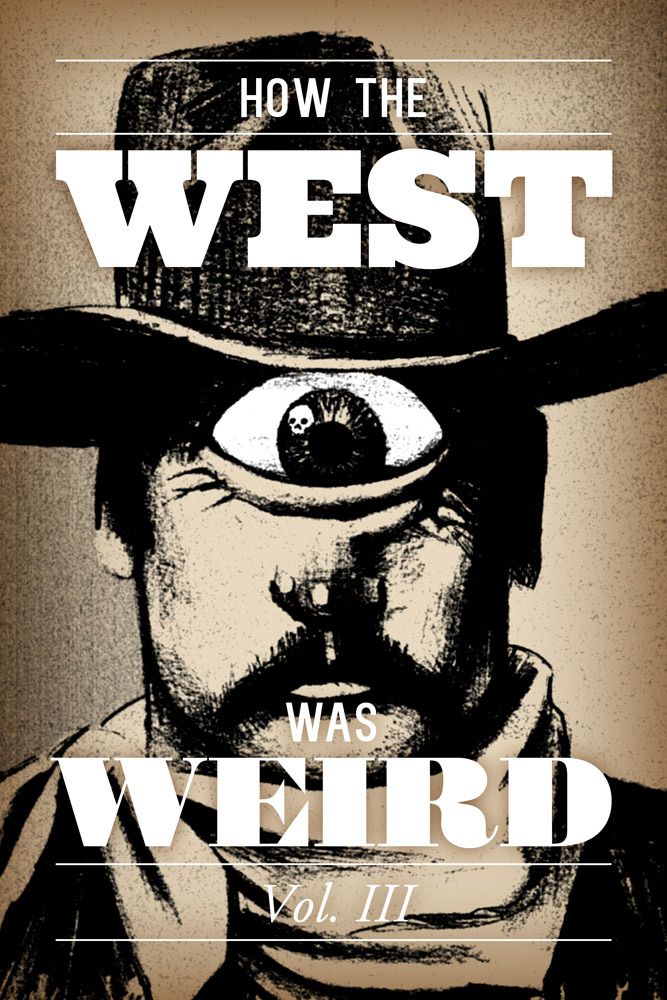
Again, Buffalopunk - Lafferty and Weird West

Okay, I'm going to try to keep more 'notes' here on my long-term project of interpreting Lafferty through the nexus-lens of:

* Monster Theory,
* Southwest Regional Writing,
* Environmental Writing,
* Ecocriticism (especially Dark Ecology),
* Theology (especially Ecotheology, Theology of Monsters, and Thomism),
* Metaphysics (especially Object-Oriented Ontology, Speculative Realism, Weird Realism, et. al.),
* and my own emerging (puling to be precise) theory of an 'Ecomonstrous' aesthetic.

Today I just want to scratch a few thoughts about Lafferty's fiction in relation to the Weird West subgenre.  Roughly, a 'weird west' tale tends to mix classic western genre motifs with the monsters and horror of Weird Fiction (ala Lovecraft if you're Old School and Vandermeer if you're New School [and Miss Jackson if you're Nasty]). 

It's kind of like Cowboys & Cthulhu.

Or Lovecraft meets L'Amour. 

(art by Jim Rugg)


To me, it's a plenty stretchy genre that can also include things like Space Westerns and Future Westerns (e.g. android gunslingers) and other such genre-blending permutations (in the far reaches there are comic books series such as Cowboy Ninja Viking and Six-Gun Gorilla).  And it can draw not only on roots of classic westerns but also American Indian lore and Weird Mexicana (e.g. Día de los Muertos).  It overlaps a little with Spaghetti Westerns and Gonzo Westerns and Anti-Westerns (Cormac McCarthy's Blood Meridian being the quintessential specimen of this last type) and even the Southern Gothic literature of the likes of Faulkner and Flannery O'Connor.  For me, it's a loose and suggestive conglomeration of tangentially related imagery and concepts.

Enter Lafferty.  He's never going to truly fit any genre.  He mutates everything he touches.  Such is the case here.  He overlaps with some of the territory of westerns because his settings are frequently those of his own lifelong Southwestern environs, mainly his native Oklahoma.  Though many of his Oklohaman settings, in both novels and short stories, are urban, many also feature the wider non-urban landscape.  (And even the tales set in a city - frequently Tulsa - tend to have an eye for regional features.)  Since Lafferty's fiction tends to have a hefty dose of American Indian influence as well as stylistic innovations that made him at home in 1960s/70s New Wave science fiction for a while, I call his excursions into western-y territory 'buffalopunk' (think 'cyberpunk', 'steampunk', etc.).

Indeed, buffalos themselves sometimes feature in his yarns (e.g. 'Days of Grass, Days of Straw', 'Inventions Bright and New') as well as their 'byproducts' (hides, horns, meat, etc.).  And just think of all the instances where some character, instead of crying bullshit, cries 'Oh, Buffalo Hokey!'    And so it is with all the other fauna, flora, landscape, and general ephemera of the Southwestern region, which show up in equal doses of focused attention, background assumption, offhanded asides, and enmeshed textural detail.  You may not have even noticed it, but once you're paying attention, you'll see it often:  mesquite, coyotes, mesas, cattle, mountains, mountain lions, plains, 'bottoms', 'flats', crayfish, kit foxes, bears, and much, much more.

Of course, all these regional elements are either themselves 'weirded' in some way or are attendant upon the joyfully bizarre Laffertian carnival we've all come to expect from his tales:  the weirdness may be in the form of magic, horror (both visceral and ghostly), mad science, aliens, monsters, extreme violence or gore, dystopia, and general metaphysical antics (doubled people, landscapes that won't behave properly, skies raining everything but cats and dogs, talking fauna, persons filled with sawdust or confetti, etc.).  Hence the '-punk' suffix. 

You can think of your own list of stories that feature strains of Lafferty's buffalopunk, but some that spring to my mind are (in addition to the few named above) 'Boomer Flats', 'Happening at Chosky Bottoms', 'Narrow Valley', 'And Walk Now Gently Through the Fire', 'Sodom and Gomorrah, Texas' and 'Oh Tell Me Will It Freeze Tonight'.  These all take place in the Southwest, but even in Lafferty's offworld stories there is often a noticeable element of buffalopunk:  e.g. 'Pig in a Pokey', 'Snuffles', 'Golden Trabant', 'Smoe and the Implicit Clay', etc.  (Also, a number of his earliest stories, which are only recently beginning to come to light to a wider audience, are quite regional, though some are perhaps a little lighter on overtly freakish 'punk' elements:  e.g. 'The Wagons', 'Rain Mountain', 'Ghost in the Corn Crib', etc.)

His novel most relevant to this theme is obviously his historical epic of the Choctaws Okla Hannali (1972), but The Reefs of Earth (1968) comes a close second as a science fiction novel in full Southwestern Gothic-Weird mode, with its backwoods setting, murderous alien children, lively Indian mounds and so on. 

But what provoked this whole meditation for me was that I ran smack into a whole chapter of buffalopunk (IV: 'Liar on the Mountain') in my now third re-reading of Fourth Mansions (1969).  I'd remembered that the landscape behaved strangely in this passage, but I didn't remember how repletely Weird West this chapter was, complete with a Texas-Mexico setting (the same territory as McCarthy's Blood Meridian).  There is a very western 'mesquite and sagebrush' landscape described, which is rolling like the sea (an image of western plains I've seen in sources as diverse as McCarthy and Zane Grey, but here rather more literalised) and taking on impossible dimensions the further into it they go.  There's a preternatural guardian, a short bloody boar hunt, a cave-cooked meal, and even a many-tentacled black monster in a fountain in this chapter.  A delightful excursion into weird western!

The rest of the novel is very Tulsa urban, and still evinces not a little of buffalopunk, but that Lafferty just went full western in this chapter kind of freshly hit me and reminded me how frequently recurring is his element of buffalopunk.  Now I'm going to be trying to catalogue all its appearances and allusions.  (What, me obsessive? Pshh.)

Monday, January 12, 2015

Lafferty News (Issue 3!)

Okay, it’s unfortunate I haven’t been able to keep up with this more regularly because there have been regular, sometimes weekly, developments.  Here’s what I can remember, starting with the newsworthy item most recent and biggest:

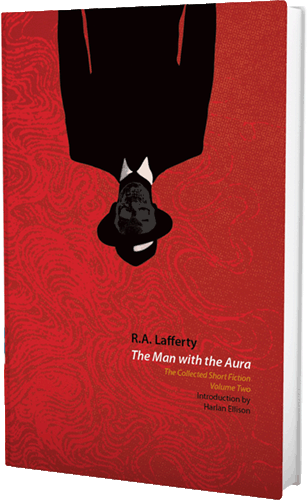
  • Centipede Press have announced the release of Volume 2 of their Lafferty Library:  The Man with the Aura (introduction by Harlan Ellison).


(I gotta say, I like this cover for the second volume a LOT better than the cover for the first.)

Interestingly, they've also announced a second limited run of Volume 1: The Man Who Made Models.  So if you're kicking yourself for not getting it the first time round, you've been granted a second chance:  http://www.centipedepress.com/home.html.


Says Kevin:
Deadlines:
  • Expression of Interest: Saturday, January 31, 2015
  • Content complete: Friday, February 20, 2015
  • Publication: Saturday, March 18, 2015
Contact:
Email editor@feastoflaughter.org with all your ideas, submissions, stories, daydreams of things you'd love to write about R. A. Lafferty, and even requests.

  • If you didn’t see Andrew’s photos of the Lafferty piece in This Land, you’ll wanna check those out.  I would love to see Lafferty more and more often in contemporary journalistic print like this.

  • Lafferty’s short story ‘What’s the Name of That Town?’ (1964) was mentioned last week on a WNPR news radio program summary:  ‘It's a brilliant story on a number of levels and one of those levels has to do with the impossibility of suppressing historical records.’  (The radio program was about ‘historical deletion’, a theme indeed dear to Lafferty.)

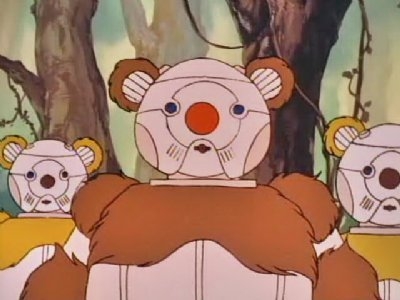
  • It was pretty exciting to see Lafferty’s lesser known story ‘Thieving Bear Planet’ included on the Electric Literature website in an article entitled ‘31 Fairly Obscure Literary Monsters’. (It was a Halloween piece, but I didn’t see it until after I’d posted Issue 2 of Lafferty News in November.)  It was also amusing to see that they used a picture of the ‘Ro-Bear Berbils’ from the Thundercats cartoon.  When I saw the Berbils on an episode of the new Thundercats series a few years ago, I was immediately put in mind of the creatures in Lafferty’s ‘Thieving Bear Planet’.  Seems I’m not the only one!
Thieving-Bears-Actually-Thundercats.jpg

  • Andrew Ferguson also announced that his article for the scholarly journal Science Fiction Studies went live in November.  This is only the second ever peer-reviewed academic essay on Lafferty, the last one from 1983.  Andrew’s fascinating article is entitled ‘R.A. Lafferty's Escape from Flatland; or, How to Build a World in Three Easy Steps’ and draws on the work of Paul Ricoeur.  I’ll do a full review of it at a later point.


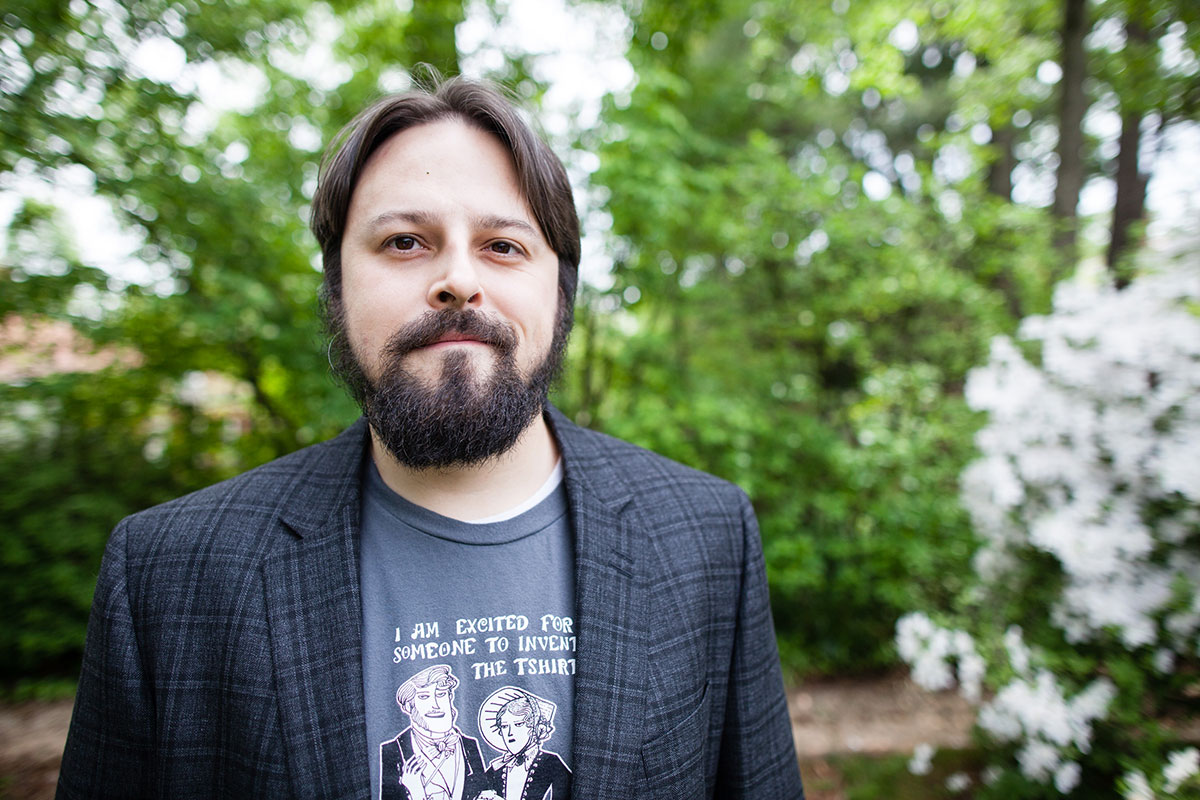
  • Andrew himself made Lafferty news by being included in the ‘Bright Young Collectors’ series in Fine Books Magazine for his extensive Lafferty collection, one to make the rest of us drool and contemplate burglary.  Mr. Ferguson even came out from behind the scholarly curtain to allow a fine photo portrait of his person to go public.

andrew ferguson photo.jpg

  • It’s worth noting that the indefatigible and skilled Rich Persaud is always updating and innovating the ralafferty.org website in a number of ways.  My favourite and most-used aspect of late is that now the title of every single published Lafferty story is listed in chronology of first publication, with the ability for anyone to comment on each story - a function I have availed myself of several times now and urge the rest of you to go and do likewise.  This is a very easy and permanent way for the Lafferty community to really get busy with the joy of discussing his works.  Every type of comment is welcome and appropriate, from simple exclamations of ‘this is one of my faves!’ or ‘I never liked this one’ to more in-depth commentary and analysis.

There is also a page that lists Lafferty’s own favourite stories, at least the ones he mentioned were personal favourites in interviews - with a few quotes from the man himself about this.  Very intriguing.  There’s a page devoted to listing out the books that Lafferty was known to have possessed in his personal library, usually with a comment or two from Lafferty about each book.  This is updated at intervals when new information on the matter is obtained.  And there’s a page with a working timeline of Lafferty’s life.  And there’s more, but you must explore!

  • In my own personal Lafferty-related news, I’m happy to report that I’ve received an offer from the University of Glasgow to start a PhD on Lafferty this October.  It will develop the topic of the Honours Dissertation that I’m writing this semester on the ‘ecomonstrous’ aesthetic in Lafferty and Cormac McCarthy.  Now to find some funding!  If any of you know of some Lafferty Studies scholarship that I’ve somehow overlooked, please let me know!  I’m sure they’d be happy to fund the first-ever doctoral thesis on Lafferty, right?

There have also been a number of Lafferty book and story reviews on various blogs in the past few months as well, but I’m going to do a separate blog post on those.  Please let me know of any news I missed!  (I’ll try to do these more frequently so they won’t end up as long and involved as this one.)
'It was all strong talk with the horns and hooves still on it.'
(R. A. Lafferty, The Devil is Dead)