Showing posts with label ecomonstrous. Show all posts

Tuesday, September 29, 2015

Excerpt from 'Boomer Flats'

I'm studying Lafferty's short story 'Boomer Flats' right now for my forthcoming essay for Feast of Laughter volume 3.  Just had to share the following excerpt.  Up to this point in the story, the style has been fairly plain (but Lafferty's prose at its plainest still tends to be graceful, taut, and often lyrical - even if the difficult concepts and narrative experimentations sometimes obscure his generally mellifluous style).  I suspect the sudden change in style here reflects the new and strange and heightened setting the characters have suddenly found themselves within, for they have entered a sort of 'shadow' town not shown on maps, in search of monsters. 

Dr. Velikof Vonk twinkled his deep eyes in their orbital caves: perhaps he cogitated his massive brain behind his massive orbital ridges: and he arrived, by sheer mentality, at the next step. 
“Have you a menu, young lady?” he asked. 
“No,” she answered simply, but it wasn't simple at all. Her voice didn't go with her prettiness. It was much more intricate than her appearance, even in that one syllable. It was powerful, not really harsh, deep and resonant as caverns, full and timeless. The girl was big-boned beneath her prettiness, with heavy brindled hair and complex eyes. 

“We would like something to eat,” Arpad Arkabaranan ventured. “What do you have?” 

“They're fixing it for you now,” the girl said. “I'll bring it after a while.” 

There was a rich river smell about the whole place, and the room was badly lit. 

“Her voice is an odd one,” Arpad whispered in curious admiration. “Like rocks rolled around by water, but it also has a touch of springtime in it, springtime of a very peculiar quality.” 

“Not just a springtime; it's an interstadial time,” Willy McGilly stated accurately. “I've noticed that about them in other places. It's old green season in their voices, green season between the ice.” 

The room was lit only by hanging lamps. They had a flicker to them. They were not electric. 

“There's a lot of the gas-light era in this place,” Arpad gave the opinion, “but the lights aren't gas lights either.” 

“No, they're hanging oil lamps,” Velikof said. “An amusing fancy just went through my head that they might be old whale-oil lamps.”

“Girl, what do you burn in the hanging lamps?” Willy McGilly asked her. 

“Catfish oil,” she said in the resonant voice that had a touch of the green interstadial time in it. And catfish oil burns with a clay-colored flame. 

“Can you bring us drinks while we wait?” Velikof of the massive head asked. 

“They're fixing them for you now,” the girl said. “I'll bring them after a while.” 

Meanwhile on the old pool table the Comet was beating the hairy man at rotation. Nobody could beat the Comet at rotation. 

“We came here looking for strange creatures,” Arpad said in the direction of the girl. “Do you know anything about strange creatures or people, or where they can be found?” 

“You are the only strange people who have come here lately,” she told them. Then she brought their drinks to them, three great sloshing clay cups or bulbous stems that smelled strongly of river, perhaps of interstadial river. She set them in front of the eminents with something like a twinkle in her eyes; something like, but much more. It was laughing lightning flashing from under the ridges of that pretty head. She was awaiting their reaction.

Velikof cocked a big deep eye at his drink. This itself was a feat. Other men hadn't such eyes, or such brows above them, as had Velikof Vonk. They took a bit of cocking, and it wasn't done lightly. And Velikof grinned out of deep folk memory as he began to drink.
~R. A. Lafferty, 'Boomer Flats' (1971) 

I think it's a pretty good example of Lafferty's odd yet robust prose when he really lets it out of its cage (though he can wax even richer and wilder than this).  The dialogue sparkles, humour abounds, yet the language becomes injected with imagery of the huge and redolent, hinting at a dark, green, muddy, deep vitality beneath the effervescent chatter.

This exchange between the 'eminent scientists' and Crayola Catfish (the waitress) is followed by plenty more fearful wonders and laughing horrors in 'Boomer Flats', but the high-ish prose style here starts to crack and recede, probably to reflect one of the characters' stubborn unbelief in the redemptively monstrous nature of the place and people they've encountered (and which they discover is in themselves as well).

The description of Velikof's eyes here also reminds me of some passages in Cormac McCarthy's Blood Meridian where men's eyes are described similarly, as caves and the like, but I'm not going to go hunt up the exact references right now.  Here too the woman's voice is said to call forth deep geological time, green spring times between ice ages - deep geology being another theme dear to McCarthy also, especially in Blood Meridian.  Both McCarthy and Lafferty share a tendency to describe human features - soulish as well as bodily - in the imagery of landscapes (as well as other aspects of ecology).  Another example from Lafferty that springs to mind is the enthralling description of a man's large and contoured hand at the opening of his short story 'Hands of the Man' (1970).  

Here in 'Boomer Flats' you can see the clear connection Lafferty is making between ecology and people, between the non-human and human, troubling a complete disjunction, re-enfolding subjects into objects. Notably in this story, outside of the excerpt above, Lafferty folds regional fauna and humanity together as well, especially catfish and bears.  These kinds of anthropo-eco boundary blurrings and hybridities are part of what I mean by the  'ecomonstrous' and what I'm researching in Lafferty's writing.  (The PhD is now 100% funded by the way, thanks to the generosity of a lot of kind and supportive folks out there.)


('Boomer Flats' was first published in IF magazine, then the collection Does Anyone Else Have Something Further To Add?; but I'm obviously not the first to see the story's eco implications as it was also later included in this 1994 anthology)


Tuesday, August 18, 2015

Ecomonstrous Lafferty/McCarthy PhD on Indiegogo

Ok, folks, I'm stepping out from behind the blog and showing my face to introduce my forthcoming PhD and the crowdfunding campaign we've launched for it.  I share it here because I genuinely think that some Lafferty fans may want to get behind the academic study of his work.  I believe that is one more crucial way that awareness and appreciation of Lafferty's art and thought can find traction and permanence in the world.  It comes first from readers, then readers enthusing with fellow readers, then popular forums and writings, then academic study - and through that last step the cycle begins again and in an ever widening radius as culture begins to be impacted by both critical and popular engagement with an artist.  It's not that neat and tidy, of course, but that's a rough sketch of what I hope will happen and what I do actually believe is already happening as the likes of Andrew Ferguson do professional theoretical work on Lafferty, and bloggers like me, Kevin, and John blog about him, and the Facebook Lafferty group discusses him, and the folks contributing to Feast of Laughter write about his work, and so on.  It's happening!

'This is beginning, this is happening!  Let no least part of it ever forget the primordial tumble that is the beginning!'
-R. A. Lafferty, 'Symposium' (1973)

Neil Gaiman kindly retweeted about the campaign already (see below video) and it's about 23% funded as I write this.   A great start for which we're thankful.

So, thanks for taking a look at the video below (don't worry, there are plenty of images too, not just my talking head!), and I hope you'll have a wee gander at the perks on the Indiegogo site as well. (You can follow the campaign on Twitter and Facebook as well.)


Tuesday, June 23, 2015

'Ecomonstrous Environments in the Fiction of R. A. Lafferty and Cormac McCarthy' (dissertation uploaded!)

Here it is at last, folks:

https://www.academia.edu/13205984/Ecomonstrous_Environments_in_the_Fiction_of_R._A._Lafferty_and_Cormac_McCarthy

Feel free to tear it to shreds with incisive criticism.  It's definitely only the first stab at a longer project. I'm pleased to be able to say the dissertation received an 'A'.  It's just an undergraduate paper, but I hope it points in some helpful directions for seeing Lafferty's place in American and world literature as well as philosophy.  Works mentioned, either at length or briefly, are 'Narrow Valley', 'Smoe and the Implicit Clay', 'Snuffles', and Okla Hannali.  The only work by McCarthy engaged in the paper is Blood Meridian.  (The PhD research I hope to begin in October will delve into the rest of their respective bodies of work.)

The main theorists engaged in this paper are Timothy Morton ('dark ecology'), Graham Harman ('object-oriented ontology'), Alphonso Lingis ('imperatives in things'), and a bit of Lawrence Buell (pioneer of contemporary ecocriticism in literary studies).  Large swathes of the paper should be pretty readable even to those not familiar with any theory.  Other parts may seem a bit impenetrable! At any rate, the whole thing is only ten thousand words.  To those further down the academic road than me, all I can ask is your patience and charity!  (But don't hold back much-needed critique either!)

There's lots of other Lafferty stuff happening and I still plan to get back to reporting on that, so stay tuned!  (Here's a quickie:  Jeff Vandermeer is a huge Lafferty fan now, a recent convert, and he'll be including Lafferty's story 'Nine Hundred Grandmothers' in the forthcoming Big Book of SF he and his wife Ann Vandermeer are editing for Vintage Books.)

Sunday, April 19, 2015

Laffertian Muck-Monsters

The essay I hope to write for Feast of Laughter volume 3 (due to come out this autumn) is about monsters in Lafferty's fiction, one section of which will be on 'muck-monsters' specifically.  I want to drop a note or two about that here.

My family didn't have much money growing up, so I couldn't afford extensive comic book collections.  Thankfully, some family we knew had a son heading off to college who decided to bequeath to me two brown paper grocery sacks full of comics from the 60s to the early 80s.  Among these were a fairly random selection of Man-Thing and Swamp Thing issues, both of which series pleased me greatly.  I've recently reconnected to those series and discovered they are the flowering of an older type of creature known as the muck-monster, one of the origins of which is The Heap from the WWII era.  


One of the main things I connect with in these monsters is their sheer physiognomy.  I just love the green, goopy, swampy, leafy, muddy, mucky mess of their form.  Man-Thing, for me, trumps Swamp Thing in this regard, the former being of a much weirder bulk than the latter's rather elegantly anthropic bearing.  Nevertheless, Alan Moore's Saga of the Swamp Thing series is by far the greater literary achievement.  (But I've also been enjoying catching up with the whole multi-world nexus conceit of Steve Gerber's The Man-Thing, finding it fruitful for limning theoretical ideas of the muck-monstrous.)

L to R:  Swamp Thing, Man-Thing

I suppose muck-monsters emblematise the dream of humanity's visceral (and viscous) connection to and intermingling with the rankly copious flora that supports its carbon-based, oxygen-breathing biosphere.  Perhaps it reifies a longing for deep rootedness and earthiness, and reminds us of our ecological connection to slime.  And, of course, all this connects to my ongoing study of 'dark ecology' and my own developing theory of the 'ecomonstrous'.

Somewhat to my surprise, as soon as I gained renewed and newly informed interest in muck-monsters, I began to notice a muck-monstrous theme cropping up rather frequently in Lafferty's fiction.  Just off the cuff (rather than going and researching it all right now), I can name the following stories that seem to evince muck-monstrous resonances:  

'Boomer Flats' (bigfoot-type primordial peoples ritually bury themselves in muddy river banks for spiritual renewal)

'Happening at Chosky Bottoms' (same type of folks as in 'Boomer Flats', with some great descriptions of glowing muddy monster-men)

'Smoe and the Implicit Clay' (primordial people rising up out of the clay underfoot, inviting others to recede into said clay with them, again for purposes of renewal)

'Incased in Ancient Rind' (the whole earth becomes swampy and the people slow down and thicken, this time apparently to show the opposite of spiritual renewal)

'Entire and Perfect Chrysolite' (a deadly swamp dream, noting our need for a connection to swampy depths, but our present inability to make this connection without casualty)

'Dream' (also titled 'Dreamworld'; a very nasty version of swampy existence takes over our present world, this tale cautionary again of the dehumanising versions of muck-monstrousness)

'Scorner's Seat' (people working in sewers full of fungoid bioluminescence and which host a gigantic version of Beowulf's Grendel monster, this one explicitly called a 'sewer monster' - this story perhaps exemplifies the tensions between the humanising and dehumanising versions of the muck-monstrous)

As to Lafferty's novels, the 'feral strips' on the planet Astrobe in Past Master seem to connect to muck-monstrous themes.  Some of the anthropo-amphibious ontologies of certain characters in Fourth Mansions perhaps connect too.  There are probably Southern Gothic swampy connections in The Reefs of Earth and I wouldn't be surprised if re-reads show some relevant resonances in the rank ontic luxuriance of Annals of Klepsis and the theo-monstrous discourse of Aurelia. Tangentially connected are oceanic monster/people themes in Past Master, Fourth Mansions, Serpent's Egg, and East of Laughter.  No doubt more instances will arise.  Please, dear reader, let me know of any I missed.

It's really no surprise, I guess, that a writer as earthy as Lafferty would resonate with a study of slime and muck-monsters.  And Lafferty's all about recovering lost depths and roots and so on.  

So, Laffertian muck-monsters, here we come!

Saturday, April 18, 2015

Dissertation is in and Feast of Laughter 2 is out!

The dissertation is handed in.  I didn't get to take the argument as far down its arc as I'd hoped.  I knew the 10,000 word limitation couldn't contain what I wanted to say, but it contained even less than I predicted.  For example, my section on 'Snuffles' was reduced to a paragraph and I didn't get to include a discussion of 'Days of Grass, Days of Straw' at all!  Ai yi yi.  Guess that and some other overflow will be the next chapter in my exploration of the ecomonstrous in Cormac McCarthy and Lafferty.  But working on the section on 'Smoe and the Implicit Clay' was especially exciting and enlightening to me.  It will take much greater detail, tighter argument, and further wrestling with one of Lafferty's most richly layered and bizarre stories, but it felt like I was getting somewhere - especially in happening upon a resonance with a thinker called Alphonso Lingis who has argued for a metaphysics of upthrusting 'faces' in non-human things (a metaphor for the fact that all things are engaged in a task in response to an imperative), which is similar to Lafferty's imagery of faces rising up out of the clay in this tale.  I will upload the paper to my academia.edu site (and provide a link here) when I've received a mark on it and made a few adjustments based on that feedback.  It's only an undergraduate dissertation, but the paucity of academic writing on Lafferty available on the web perhaps justifies sharing it with the public.

Having said that, here's a feast of writing about Lafferty (academic and otherwise) that I've yet again been privileged to make contributions to:  that's right, Volume 2 of Feast of Laughter: An Appreciation of R. A. Lafferty is hot off the press!  This thing is more of a beast of a feast than volume one.  The quantity and quality of the content have only increased (as well as the inner layout and design of the text).  We're so surprised this thing is going from strength to strength - not because we think Lafferty fans aren't enthusiastic and talented, but because we just had no idea how many great people would make great contributions as a pure labour of love (there's no profit garnered from the books at this stage).  There are reports from Laffertians in Japan, UK, Netherlands, Germany, and Russia.  Truly fascinating stuff, trust me.  There are new essays on how Lafferty's fiction works and what it achieves, as well as some more excellent and obscure reprints (including an academic article from a Thomas More journal on Lafferty's Past Master), some in-depth elucidations of Lafferty's barely-read, but by all accounts masterful, Argo Mythos, and reviews of a number of Lafferty's books.  There are a variety of creative approaches in all this as well, from the highly academic to the utterly experimental, each enlightening and enthralling in its own way.  And, in fact, as I've been reading through it, I've been amazed to note that the essays form almost a Laffertian baton race, where each new article picks up certain threads from the others and further elaborates.  A big picture of the ethos and workings of Lafferty's cosmos is starting to emerge, I swear!  There are also creative contributions again:  songs, poems, stories, and art - including, again, Lissanne Lake as cover artist:  her lovely rendering of Lafferty's short story 'Sodom and Gomorrah, Texas'.  That story is also included in this volume, as well as an interview with Lafferty by Tom Jackson.  We also got another professional 'lafferty' (an attempt to write a story in Lafferty's signature style), this time by Howard Waldrop!

I know I haven't reviewed volume 1 yet, as I promised I would, but I will and then I'll review this one as well.  I want to briefly engage each and every piece in each volume, partly for the sake of each contributor getting at least that tiny bit of direct engagement with their work, but also just because each contribution is valuable and fascinating for its part played in the emergence of a Lafferty revival.  And for the record, there are, from time to time, certain interpretations and viewpoints that I strenuously disagree with in these contributions.  So it's not just a back-slapping club but a genuinely diverse and opinionated community.  But I'm profoundly grateful for those views that spark rebuttal in me:  iron sharpens iron and all that.

There's lots of other Lafferty news that I'd like to report on (like the induction of Lafferty into the Oklahoma Writers Hall of Fame and related events).  But it will all have to await another post.

Thursday, January 15, 2015

Again, Buffalopunk - Lafferty and Weird West

Okay, I'm going to try to keep more 'notes' here on my long-term project of interpreting Lafferty through the nexus-lens of:

* Monster Theory,
* Southwest Regional Writing,
* Environmental Writing,
* Ecocriticism (especially Dark Ecology),
* Theology (especially Ecotheology, Theology of Monsters, and Thomism),
* Metaphysics (especially Object-Oriented Ontology, Speculative Realism, Weird Realism, et. al.),
* and my own emerging (puling to be precise) theory of an 'Ecomonstrous' aesthetic.

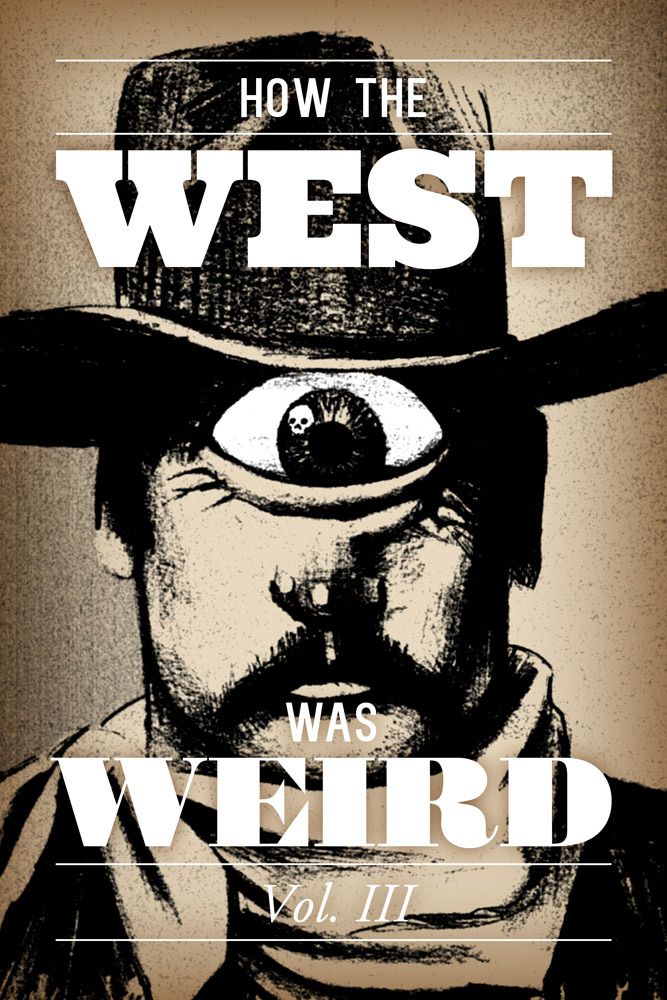
Today I just want to scratch a few thoughts about Lafferty's fiction in relation to the Weird West subgenre.  Roughly, a 'weird west' tale tends to mix classic western genre motifs with the monsters and horror of Weird Fiction (ala Lovecraft if you're Old School and Vandermeer if you're New School [and Miss Jackson if you're Nasty]). 

It's kind of like Cowboys & Cthulhu.

Or Lovecraft meets L'Amour. 

(art by Jim Rugg)


To me, it's a plenty stretchy genre that can also include things like Space Westerns and Future Westerns (e.g. android gunslingers) and other such genre-blending permutations (in the far reaches there are comic books series such as Cowboy Ninja Viking and Six-Gun Gorilla).  And it can draw not only on roots of classic westerns but also American Indian lore and Weird Mexicana (e.g. Día de los Muertos).  It overlaps a little with Spaghetti Westerns and Gonzo Westerns and Anti-Westerns (Cormac McCarthy's Blood Meridian being the quintessential specimen of this last type) and even the Southern Gothic literature of the likes of Faulkner and Flannery O'Connor.  For me, it's a loose and suggestive conglomeration of tangentially related imagery and concepts.

Enter Lafferty.  He's never going to truly fit any genre.  He mutates everything he touches.  Such is the case here.  He overlaps with some of the territory of westerns because his settings are frequently those of his own lifelong Southwestern environs, mainly his native Oklahoma.  Though many of his Oklohaman settings, in both novels and short stories, are urban, many also feature the wider non-urban landscape.  (And even the tales set in a city - frequently Tulsa - tend to have an eye for regional features.)  Since Lafferty's fiction tends to have a hefty dose of American Indian influence as well as stylistic innovations that made him at home in 1960s/70s New Wave science fiction for a while, I call his excursions into western-y territory 'buffalopunk' (think 'cyberpunk', 'steampunk', etc.).

Indeed, buffalos themselves sometimes feature in his yarns (e.g. 'Days of Grass, Days of Straw', 'Inventions Bright and New') as well as their 'byproducts' (hides, horns, meat, etc.).  And just think of all the instances where some character, instead of crying bullshit, cries 'Oh, Buffalo Hokey!'    And so it is with all the other fauna, flora, landscape, and general ephemera of the Southwestern region, which show up in equal doses of focused attention, background assumption, offhanded asides, and enmeshed textural detail.  You may not have even noticed it, but once you're paying attention, you'll see it often:  mesquite, coyotes, mesas, cattle, mountains, mountain lions, plains, 'bottoms', 'flats', crayfish, kit foxes, bears, and much, much more.

Of course, all these regional elements are either themselves 'weirded' in some way or are attendant upon the joyfully bizarre Laffertian carnival we've all come to expect from his tales:  the weirdness may be in the form of magic, horror (both visceral and ghostly), mad science, aliens, monsters, extreme violence or gore, dystopia, and general metaphysical antics (doubled people, landscapes that won't behave properly, skies raining everything but cats and dogs, talking fauna, persons filled with sawdust or confetti, etc.).  Hence the '-punk' suffix. 

You can think of your own list of stories that feature strains of Lafferty's buffalopunk, but some that spring to my mind are (in addition to the few named above) 'Boomer Flats', 'Happening at Chosky Bottoms', 'Narrow Valley', 'And Walk Now Gently Through the Fire', 'Sodom and Gomorrah, Texas' and 'Oh Tell Me Will It Freeze Tonight'.  These all take place in the Southwest, but even in Lafferty's offworld stories there is often a noticeable element of buffalopunk:  e.g. 'Pig in a Pokey', 'Snuffles', 'Golden Trabant', 'Smoe and the Implicit Clay', etc.  (Also, a number of his earliest stories, which are only recently beginning to come to light to a wider audience, are quite regional, though some are perhaps a little lighter on overtly freakish 'punk' elements:  e.g. 'The Wagons', 'Rain Mountain', 'Ghost in the Corn Crib', etc.)

His novel most relevant to this theme is obviously his historical epic of the Choctaws Okla Hannali (1972), but The Reefs of Earth (1968) comes a close second as a science fiction novel in full Southwestern Gothic-Weird mode, with its backwoods setting, murderous alien children, lively Indian mounds and so on. 

But what provoked this whole meditation for me was that I ran smack into a whole chapter of buffalopunk (IV: 'Liar on the Mountain') in my now third re-reading of Fourth Mansions (1969).  I'd remembered that the landscape behaved strangely in this passage, but I didn't remember how repletely Weird West this chapter was, complete with a Texas-Mexico setting (the same territory as McCarthy's Blood Meridian).  There is a very western 'mesquite and sagebrush' landscape described, which is rolling like the sea (an image of western plains I've seen in sources as diverse as McCarthy and Zane Grey, but here rather more literalised) and taking on impossible dimensions the further into it they go.  There's a preternatural guardian, a short bloody boar hunt, a cave-cooked meal, and even a many-tentacled black monster in a fountain in this chapter.  A delightful excursion into weird western!

The rest of the novel is very Tulsa urban, and still evinces not a little of buffalopunk, but that Lafferty just went full western in this chapter kind of freshly hit me and reminded me how frequently recurring is his element of buffalopunk.  Now I'm going to be trying to catalogue all its appearances and allusions.  (What, me obsessive? Pshh.)

Friday, October 3, 2014

Eco-Monstrosity in Cormac McCarthy and R. A. Lafferty (my dissertation proposal - approved!)

For those who may not have picked up on it yet, I'm a 'mature student' (40 years old and just now getting round to obtaining a proper education).  I am, at last, in my final year of a joint-honours degree in Philosophy and English Literature at the University of Glasgow.  The following is the rough starting point of what I'll be writing this year for my final dissertation in the English Literature half of the degree.  I was relieved when the department approved it and found a supervisor for me (haven't talked to him yet, so I have no idea if he has any familiarity at all with Lafferty). 

After prematurely claiming (over three years ago) that I was going to write a chapter on Lafferty as a Chestertonian theological storyteller for a book of Lafferty essays, it is gratifying to see that something along those lines is finally coming to fruition, even if only for degree work.  Better late than never.  (The editor of the proposed book of essays on Lafferty, our beloved Andrew Ferguson, has since been sidetracked by the noble and even more exciting task of writing Lafferty's biography - with which, I recently heard, he is nearly finished.) 

I was not then really up to writing an essay on Lafferty, as I fairly quickly discovered.  I'm still not, but at least I have some theoretical tools and preoccupations to throw at it now.  Below is the dissertation proposal essentially as given to my department.  Please don't be too distracted by technical jargon with which you may not be familiar.  I had a word-limit that precluded much elucidation of the terminologies.  I hope some reasonably clear conception of what I'm attempting will still come through. 

As it reaches completion (in April), the paper will become both clearer and different.  I'm not sure how it will change, but I know it will to one degree or another.  Unfortunately, it's only a 10,000 word paper and I'm covering two authors, so it's not going to be able to cover as much ground as I'd like.  But I think putting Lafferty in conversation with a recognised 'great writer' is worth it and will provide its own fascinating illuminations.  Please let me know your questions and criticisms of the proposal and suggestions for further theoretical materials and for other elements or works of Lafferty's fiction to consider as regards the topic.  (Please do tell me if you see any egregious errors based on any expert knowledge you have!)


Dissertation proposal:

The primary texts the dissertation will consider are Cormac McCarthy’s ‘anti-western’ novel Blood Meridian (1985) and R. A. Lafferty’s historical Choctaw novel Okla Hannali (1972) as well as Lafferty’s short stories ‘Narrow Valley’, ‘Smoe and the Implicit Clay’, and ‘Days of Grass, Days of Straw’[1].  The question the dissertation asks is:  can the iterations of eco-monstrosity[2]  exemplified in these two Southwestern American regional writers be grounded in and yet transmogrify theological readings of ‘nature’?  I.e. do these texts show ‘dark ecology’ and theological ecology to be mutually exclusive or do they open the way for some sort of harmony or hybridity?  I argue the latter.  Evocations of monstrosity in these texts make room for comic rather than tragic (or nihilistic) ecologies, undergirded by ‘dark’ or ‘weird’ theologies.

Lafferty is well known as a ‘funny’ writer, though his ‘tall tales’ are often grotesque and even gory.  It is also well known that Lafferty’s devout Roman Catholic beliefs infused all his work.  So it is no surprise that his ecology is ultimately theological and comic.  But it is not always appreciated that Lafferty’s fiction only achieves this ‘theo-comedy’ (to borrow a term from the theologian Thomas Oden) by way of much ambiguity and carnivalised horror.  McCarthy’s harrowing and hyper-violent novels, on the other hand, are often thought to be eloquent tracts for an unflinchingly bleak nihilism.  It is often argued that Blood Meridian in particular subverts theological readings of the world, but I will argue that it subverts only theologies that cannot embrace ‘dark’ ecology and thereby clears the way for more adequate theologies.

It is arguably rare that the disciplines of ecology, theology, and monster theory all three intersect in one study.  Certainly the proposed texts of this dissertation do not appear to have received this triangulated critical reading.  Both authors are, in any case, far from over-subscribed by academics and are thus ripe for more theoretical work.  McCarthy studies are now numerous but by no means enormous.  Lafferty studies are nearly non-existent[3] and as this obscure author is being slowly rediscovered[4], critical work is needed.  More generally, the worldwide growth in cultural awareness of both ecological and religious debates gives urgency to a cross-discipline study such as this.

The main critical tools the dissertation employs consist of Timothy Morton’s dark ecology[5], Graham Harman’s object-oriented ontology (‘weird realism’)[6], and Timothy Beal’s theology of monsters[7].  The foci of the reading will be the emphases the primary texts place on monstrous (usually grotesque or gigantic) evocations of flora, fauna, and landscape, and the place of humans therein that religious worldviews purport to provide.  With these tools I aim to show that the texts under consideration evince a theologically pertinent eco-monstrosity that serves to situate and orient readers within a dangerous but genuinely all-inclusive ontology.  The monsters here are not ‘off the map’ – the monsters are the map.  Further, the texts evince no easy disjunction between a so-called ‘post-human’ eco-centricity and the theo-comic ecology of, for example, Roman Catholic doctrine. Rather, the monstrous ecologies of the texts—in their strange grotesqueries and violences and in their characters’ lengthy theological declamations—tend to agitate for a ‘dark’ and ‘weird’ hybridisation of theological ecology and dark ecology:  a conceptual space in which humans are decentralised in certain respects (radically contextualised by the non-human environment) even as they bear the divine image.


[1] Possibly also drawing from the stories ‘Snuffles’, ‘And Walk Now Gently Through the Fire’, and ‘All Pieces of a River Shore’.
[2] This can be considered a particular artistic iteration of eco-centric or post-human or post-equilibrium ecocritical theories.
[3] Andrew Ferguson’s master’s dissertation ‘Lafferty and His World’ is the only ‘official’ academic work I know of on Lafferty so far, but a handful of critical reviews and comments can also be dug up - e.g. brief but insightful critical comments on Lafferty’s writing can be found from the likes of Ursula Le Guin, Brian Aldiss, John Clute, and Neil Gaiman.  Ferguson in his paper utilises Mikhail Bakhtin’s ideas on carnival and grotesque and Walter J. Ong’s ideas on orality to read Lafferty’s body of work:  http://www.academia.edu/329007/Lafferty_and_His_World.  Ferguson, a doctoral candidate at the University of Virginia, is currently writing the first biography of Lafferty.
[4] The Locus Science Fiction Foundation has recently acquired the rights to Lafferty’s works and through them Centipede Press have published the first of what is projected to be twelve volumes collecting the complete short stories by Lafferty:  The Man Who Made Models: The Collected Short Fiction Volume One (2013), Centipede Press, Lakewood.
[5] E.g. Ecology Without Nature: Rethinking Environmental Aesthetics (2007), Harvard University Press, Cambridge.
[6] E.g. Guerrilla Metaphysics: Phenomenology and the Carpentry of Things (2005), Open Court Publishing, Peru; Weird Realism: Lovecraft and Philosophy (2012), John Hunt Publishing, Alresford.
[7] Religion and Its Monsters (2002), Routledge, London.


The Dissertation Reading Stack!
'It was all strong talk with the horns and hooves still on it.'
(R. A. Lafferty, The Devil is Dead)