Showing posts with label monsters. Show all posts

Saturday, December 24, 2016

"I always break them," said the monstrous face.

There was the morning that Dana saw the whole fair landscape from horizon to horizon and realized that it was all on the inside of one very large soap-bubble. He saw then, beyond and dwarfing it all, the pipe that was blowing the whole bubble, and the face that was blowing the pipe. The wide world was quite small in comparison to that face. It was the face of a rather lack-eyed monster, somehow like an old Irish bummer, a little like that of one of the Other People who live under the hills. "Be careful, you'll break it if you puff any more into it." "I always break them," said the monstrous face. "I wish I could keep one of them sometime."

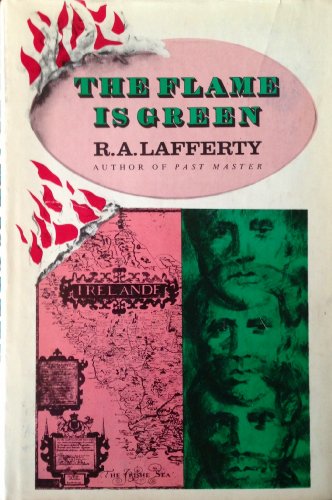
R. A. Lafferty, The Flame is Green (1971), p. 224

Almost finished with this sometimes incredible, sometimes baffling, novel, the first in the Coscuin Chronicles. (Pseudo) review forthcoming!

Have a happy Christmas Eve.
Tuesday, September 29, 2015

Excerpt from 'Boomer Flats'

I'm studying Lafferty's short story 'Boomer Flats' right now for my forthcoming essay for Feast of Laughter volume 3.  Just had to share the following excerpt.  Up to this point in the story, the style has been fairly plain (but Lafferty's prose at its plainest still tends to be graceful, taut, and often lyrical - even if the difficult concepts and narrative experimentations sometimes obscure his generally mellifluous style).  I suspect the sudden change in style here reflects the new and strange and heightened setting the characters have suddenly found themselves within, for they have entered a sort of 'shadow' town not shown on maps, in search of monsters. 

Dr. Velikof Vonk twinkled his deep eyes in their orbital caves: perhaps he cogitated his massive brain behind his massive orbital ridges: and he arrived, by sheer mentality, at the next step. 
“Have you a menu, young lady?” he asked. 
“No,” she answered simply, but it wasn't simple at all. Her voice didn't go with her prettiness. It was much more intricate than her appearance, even in that one syllable. It was powerful, not really harsh, deep and resonant as caverns, full and timeless. The girl was big-boned beneath her prettiness, with heavy brindled hair and complex eyes. 

“We would like something to eat,” Arpad Arkabaranan ventured. “What do you have?” 

“They're fixing it for you now,” the girl said. “I'll bring it after a while.” 

There was a rich river smell about the whole place, and the room was badly lit. 

“Her voice is an odd one,” Arpad whispered in curious admiration. “Like rocks rolled around by water, but it also has a touch of springtime in it, springtime of a very peculiar quality.” 

“Not just a springtime; it's an interstadial time,” Willy McGilly stated accurately. “I've noticed that about them in other places. It's old green season in their voices, green season between the ice.” 

The room was lit only by hanging lamps. They had a flicker to them. They were not electric. 

“There's a lot of the gas-light era in this place,” Arpad gave the opinion, “but the lights aren't gas lights either.” 

“No, they're hanging oil lamps,” Velikof said. “An amusing fancy just went through my head that they might be old whale-oil lamps.”

“Girl, what do you burn in the hanging lamps?” Willy McGilly asked her. 

“Catfish oil,” she said in the resonant voice that had a touch of the green interstadial time in it. And catfish oil burns with a clay-colored flame. 

“Can you bring us drinks while we wait?” Velikof of the massive head asked. 

“They're fixing them for you now,” the girl said. “I'll bring them after a while.” 

Meanwhile on the old pool table the Comet was beating the hairy man at rotation. Nobody could beat the Comet at rotation. 

“We came here looking for strange creatures,” Arpad said in the direction of the girl. “Do you know anything about strange creatures or people, or where they can be found?” 

“You are the only strange people who have come here lately,” she told them. Then she brought their drinks to them, three great sloshing clay cups or bulbous stems that smelled strongly of river, perhaps of interstadial river. She set them in front of the eminents with something like a twinkle in her eyes; something like, but much more. It was laughing lightning flashing from under the ridges of that pretty head. She was awaiting their reaction.

Velikof cocked a big deep eye at his drink. This itself was a feat. Other men hadn't such eyes, or such brows above them, as had Velikof Vonk. They took a bit of cocking, and it wasn't done lightly. And Velikof grinned out of deep folk memory as he began to drink.
~R. A. Lafferty, 'Boomer Flats' (1971) 

I think it's a pretty good example of Lafferty's odd yet robust prose when he really lets it out of its cage (though he can wax even richer and wilder than this).  The dialogue sparkles, humour abounds, yet the language becomes injected with imagery of the huge and redolent, hinting at a dark, green, muddy, deep vitality beneath the effervescent chatter.

This exchange between the 'eminent scientists' and Crayola Catfish (the waitress) is followed by plenty more fearful wonders and laughing horrors in 'Boomer Flats', but the high-ish prose style here starts to crack and recede, probably to reflect one of the characters' stubborn unbelief in the redemptively monstrous nature of the place and people they've encountered (and which they discover is in themselves as well).

The description of Velikof's eyes here also reminds me of some passages in Cormac McCarthy's Blood Meridian where men's eyes are described similarly, as caves and the like, but I'm not going to go hunt up the exact references right now.  Here too the woman's voice is said to call forth deep geological time, green spring times between ice ages - deep geology being another theme dear to McCarthy also, especially in Blood Meridian.  Both McCarthy and Lafferty share a tendency to describe human features - soulish as well as bodily - in the imagery of landscapes (as well as other aspects of ecology).  Another example from Lafferty that springs to mind is the enthralling description of a man's large and contoured hand at the opening of his short story 'Hands of the Man' (1970).  

Here in 'Boomer Flats' you can see the clear connection Lafferty is making between ecology and people, between the non-human and human, troubling a complete disjunction, re-enfolding subjects into objects. Notably in this story, outside of the excerpt above, Lafferty folds regional fauna and humanity together as well, especially catfish and bears.  These kinds of anthropo-eco boundary blurrings and hybridities are part of what I mean by the  'ecomonstrous' and what I'm researching in Lafferty's writing.  (The PhD is now 100% funded by the way, thanks to the generosity of a lot of kind and supportive folks out there.)


('Boomer Flats' was first published in IF magazine, then the collection Does Anyone Else Have Something Further To Add?; but I'm obviously not the first to see the story's eco implications as it was also later included in this 1994 anthology)


Sunday, April 19, 2015

Laffertian Muck-Monsters

The essay I hope to write for Feast of Laughter volume 3 (due to come out this autumn) is about monsters in Lafferty's fiction, one section of which will be on 'muck-monsters' specifically.  I want to drop a note or two about that here.

My family didn't have much money growing up, so I couldn't afford extensive comic book collections.  Thankfully, some family we knew had a son heading off to college who decided to bequeath to me two brown paper grocery sacks full of comics from the 60s to the early 80s.  Among these were a fairly random selection of Man-Thing and Swamp Thing issues, both of which series pleased me greatly.  I've recently reconnected to those series and discovered they are the flowering of an older type of creature known as the muck-monster, one of the origins of which is The Heap from the WWII era.  


One of the main things I connect with in these monsters is their sheer physiognomy.  I just love the green, goopy, swampy, leafy, muddy, mucky mess of their form.  Man-Thing, for me, trumps Swamp Thing in this regard, the former being of a much weirder bulk than the latter's rather elegantly anthropic bearing.  Nevertheless, Alan Moore's Saga of the Swamp Thing series is by far the greater literary achievement.  (But I've also been enjoying catching up with the whole multi-world nexus conceit of Steve Gerber's The Man-Thing, finding it fruitful for limning theoretical ideas of the muck-monstrous.)

L to R:  Swamp Thing, Man-Thing

I suppose muck-monsters emblematise the dream of humanity's visceral (and viscous) connection to and intermingling with the rankly copious flora that supports its carbon-based, oxygen-breathing biosphere.  Perhaps it reifies a longing for deep rootedness and earthiness, and reminds us of our ecological connection to slime.  And, of course, all this connects to my ongoing study of 'dark ecology' and my own developing theory of the 'ecomonstrous'.

Somewhat to my surprise, as soon as I gained renewed and newly informed interest in muck-monsters, I began to notice a muck-monstrous theme cropping up rather frequently in Lafferty's fiction.  Just off the cuff (rather than going and researching it all right now), I can name the following stories that seem to evince muck-monstrous resonances:  

'Boomer Flats' (bigfoot-type primordial peoples ritually bury themselves in muddy river banks for spiritual renewal)

'Happening at Chosky Bottoms' (same type of folks as in 'Boomer Flats', with some great descriptions of glowing muddy monster-men)

'Smoe and the Implicit Clay' (primordial people rising up out of the clay underfoot, inviting others to recede into said clay with them, again for purposes of renewal)

'Incased in Ancient Rind' (the whole earth becomes swampy and the people slow down and thicken, this time apparently to show the opposite of spiritual renewal)

'Entire and Perfect Chrysolite' (a deadly swamp dream, noting our need for a connection to swampy depths, but our present inability to make this connection without casualty)

'Dream' (also titled 'Dreamworld'; a very nasty version of swampy existence takes over our present world, this tale cautionary again of the dehumanising versions of muck-monstrousness)

'Scorner's Seat' (people working in sewers full of fungoid bioluminescence and which host a gigantic version of Beowulf's Grendel monster, this one explicitly called a 'sewer monster' - this story perhaps exemplifies the tensions between the humanising and dehumanising versions of the muck-monstrous)

As to Lafferty's novels, the 'feral strips' on the planet Astrobe in Past Master seem to connect to muck-monstrous themes.  Some of the anthropo-amphibious ontologies of certain characters in Fourth Mansions perhaps connect too.  There are probably Southern Gothic swampy connections in The Reefs of Earth and I wouldn't be surprised if re-reads show some relevant resonances in the rank ontic luxuriance of Annals of Klepsis and the theo-monstrous discourse of Aurelia. Tangentially connected are oceanic monster/people themes in Past Master, Fourth Mansions, Serpent's Egg, and East of Laughter.  No doubt more instances will arise.  Please, dear reader, let me know of any I missed.

It's really no surprise, I guess, that a writer as earthy as Lafferty would resonate with a study of slime and muck-monsters.  And Lafferty's all about recovering lost depths and roots and so on.  

So, Laffertian muck-monsters, here we come!

Wednesday, December 10, 2014

'Entire and Perfect Chrysolite' (1970) - brief short story review

Cross-posted from here:  http://www.ralafferty.org/works/stories/entire-and-perfect-chrysolite/


'Entire and Perfect Chrysolite' (first appeared in Orbit 6, 1970)
3/5 stars. It's interesting to see that this story was a Hugo and Nebula award nominee. I've always been intrigued by it, but never certain what I thought of it artistically. Still not sure. It's perhaps Lafferty's most overt 'dip' (pun intended) into the idea-space of the Jungian unconscious.
It's fascinating too in its depiction of white and black relations and of Europe/North America to Africa:
“Oh, white people, white people, this is real and this is death,” the black man moaned in agony.
[...]
“Oh, white people on dope, I cannot do this,” the black man moaned. “She is dead. And you joke and drink Green Bird and Bomb, and hoot like demented children in a dream.”
There are some great eco-psychotropic passages, especially of archetypal fauna:
"Now everybody conjure the animals that are compounded out of grisly humor, the giraffe with a neck alone that is longer than a horse, and the zebra which is a horse in a clown suit."
[...]
“Conjure the third of the large monkeys that is dog-faced and purple of arse.”
“We conjure it, we conjure it, but it belongs in a comic strip.”
“Conjure the gentle monster, the okapi that is made out of pieces of the antelope and camel and contingent giraffe, and which likewise wears a clown suit.”
“We conjure it, we conjure it.”
The story is pretty funny too in a brutal sort of way. It's philosophically rich as regards False Perfection (the 'Ecumene' as Laff calls it in this story) and our need for Monstrous Depths to be fully human - but also the danger of those depths if we approach them as shallow modern/postmodern selves pursuing mere pastime:
“That we go no more hungering after strange geographies that are not of proper world! That we seal off the unsettling things inside us!”
“We seal them off, we seal them off,” they chanted.
It's a small thematic coda to some of Lafferty's novels in this regard, such as Past Master, Fourth Mansions, and Serpent's Egg. It would also probably be pretty fascinating to comparatively study alongside Joseph Conrad's Heart of Darkness and some of his African short stories and also in relation to African authors like Chinua Achebe, Ben Okri, and Amos Tutuola.
I like the story more every time I read it.

[For what it's worth, the only other two reviews I could find of the story on the web are not at all favourable:  The R. A. Lafferty Devotional Page rated it 'lame'  and said:  'People on a ship conjure up a forgotten land -er- Afrika actually. This was actually nominated for some award. Go figure.'  And The PorPor SF & Fantasy Books Blog said:  'another overly artsy title. This story deals with recreational hallucinations and their unpleasant side effects. Lafferty had quite a bit of stature during the New Wave era, but his stories all have aged quite poorly.']


Saturday, December 6, 2014

Fourth Mansions again: it's like a vintage animated cartoon made of words, w/ slapstick & monsters; it's also the weirdest theological treatise ever written

Inspired by a couple of recent excellent blog posts on Fourth Mansions (1969) by John Owen HERE and HERE, and by the excellent page dedicated to it on the Lafferty website, and by browsing Amazon reviews, today I wrote my own off the cuff Amazon review.

I'm cross-posting it here:


4/5 stars

It's really a five star book. Very much so. In some ways, it might be Lafferty's masterpiece - in terms of his novels. But I'm trying to be realistic here and not come across as too fanboy-ish, as lacking any critical distance. The truth is, as a HUGE Lafferty fan (I've been writing a whole blog dedicated to his works since 2009), this is not actually my very favourite of Lafferty's novels. I prefer Past Master, Space Chantey, The Reefs of Earth, Arrive At Easterwine, Aurelia, Annals of Klepsis, and East of Laughter and I'd recommend you read several of them in addition to Fourth Mansions to really get the measure of this author.

But I'm not sure any of those other novels quite match the linguistic opulence and descriptive verve of Fourth Mansions. (That's how I feel about Gene Wolfe's Solar Cycle: my favourite is the last trilogy, Book of the Short Sun, but I can't deny that the first tetralogy, Book of the New Sun, is probably Wolfe's masterpiece and surely the richest in language and prose.)

Lafferty's voice in Fourth Mansions is like Charles Williams refracted through Raymond Chandler. Or Chesterton refracted through Black Elk. Or Flannery O'Connor refracted through George Orwell. Or Mark Twain refracted through Lovecraft. Or Colson Whitehead refracted through Kafka. Or Chaucer refracted through Walker Percy. Or the converse of any of those. Probably the nexus of all of them.

That's the main thing I want to say that hasn't been much mentioned by the other reviews here. That this is a delicious volume of prose style. Not in any way you might expect, though. Lafferty doesn't write like other humans. The narrative flow admittedly seems to bumble sometimes, but it's usually doing something deep at the moment it appears to be faltering a bit. And you'll probably only find that out on re-reads. But mostly the narration sings and sizzles and coruscates. It's a bit like a vintage animated cartoon made of words. Sentences seem to leap off the page and dance about in that mixture of fluidity and juddering jumpiness that early cartoons have. And it's also like old cartoons in that mixture of really silly slapstickery and really quite terrifying monstrosity they often evince in the impossible physical peregrinations they take the viewer through - where both bodies and landscape refuse to follow any known physics, yet cohere madly according to their own laws. It's very funny and very disturbing. That's Fourth Mansions.

One reviewer complained that the characters in this novel aren't developed, nor are they distinguishable from one another. I need to re-read it to see what I think about that. I've only read it one and half times so far (gave up half way through the first time, so I can sympathise with those who don't initially like it), but I've also dipped back into many passages many times over. What I will say is that the characters are drawn extremely richly in the 'cartoonish' mode I have just described. They are sketched in an incredibly vivid manner - Chesterton especially comes to mind in this connection - that makes them quite colourful, if of uncertain depth or distinction. It's worth noting that I have thought Lafferty characters weren't too 3D in some of his short stories, only to find on re-reads how incredibly wrong I was. They were rendered in a way I hadn't encountered before, so that I missed how incredibly solid and rich they were actually given to the reader, already fully formed. That may be the case in this novel, I'm not sure yet.

What makes the mad, terrifying, hilarious quality of the prose the more remarkable is that it is the vehicle of a deeply theological meditation, which many somewhat forgivably miss on a first read. Indeed, this book might be the funniest, wildest, weirdest theological treatise ever written. It's kind of about God making 'monsters' an indispensable but dangerous element of our inner and outer ecologies, that we must learn to integrate or be devoured by. Doesn't sound like anything you ever heard in Sunday School or 'Christian movies' or the like, right? Well, Lafferty is schooling believers as much as unbelievers in this book, calling everybody who will hear to a more fun and ferocious faith than we are wont to imagine Christianity is really all about. And he's trying to put readers in touch with ancient traditions that were really all about this kind of wild faith all along. According to Lafferty, modern religion has lost its way and needs to reconnect to its rich roots in order to evolve to its true potential. That's why the book is titled after a chapter in St. Teresa of Ávila's The Interior Castle and why some of the main biblical imagery it cryptically draws on is that of the prophet Ezekiel's terrifying Cherubim (angelic beings with four-faces - Ox, Lion, Eagle, Man - which attend the throne of God). Much of modern faith is too tame, suppressing holy monstrosity and thereby fostering unholy monstrosity. That seems to be a central aspect of the 'message' of this novel. And, admittedly, it is a sort of 'preachy' or 'lecturing' novel (there are long segments of actual lecturing and preaching late in the book!), but in a way that, if you ever experienced such in a church or university seminar room, you'd be on the edge of your seat - if not cowering behind it (trembling with laughter as much as terror).

For what it's worth, I first wrote about this book some three years ago here. That post has some great comments from other insightful Lafferty fans as well.

Tuesday, October 29, 2013

Cosmic Horror vs. Cosmic Laughter (Lovecraft vs. Lafferty)

Finally!  I've written something new on Lafferty over at my Ride the Nightmare blog as part of a '30 Days of Halloween' series:

Day 24: Cosmic Laughter vs. Cosmic Horror (Lafferty vs. Lovecraft)

I recall that we discussed a 'theology of monsters' in Fourth Mansions in the comments of a past post.  I think horror and monsters in Lafferty need to be explored again and again, deeper and deeper.  Considering he said his whole body of work was an unfinished novel called 'A Ghost Story', the category of horror is obviously a crucial way to grapple with what Lafferty was doing.  (It's fascinating too that quite a few of his stories in the 60s and 70s were first published in horror magazines and horror anthologies.)

I welcome your thoughts!

(And Happy Halloween!)
(image found HERE)

(contains Lafferty's story 'The Ultimate Creature' - image found HERE)

(contains Lafferty's story 'The Man Who Never Was' - image found HERE)

(contains Lafferty's story 'The Ghost in the Corn Crib' - image found HERE)

(contians Lafferty's story 'The Man With the Aura' - image found HERE)

(contains Lafferty's story 'Splinters' - image found HERE)

(contains Lafferty's story 'Oh Tell Me Will It Freeze Tonight' - image found HERE)

(contains Lafferty's story 'The Funny Face Murders' - image found HERE)

Saturday, March 3, 2012

"Hang in there, Gaea guys! Some of us are on your side.'


'The glob came upon them and swallowed them in its fetid breath.  It was sharp with teeth in it, and these were quickly identified as belonging to aerial snakes.  The glob brought with it a saturating mental and emotional depression, a stark consternation, an unbearable fearfulness and unpleasantness.  It brought dread.  It brought hallucination and contradiction and fear of falling, and fear of ultimate fire.  It brought flying foxes that fastened onto throats with hollow and life-draining teeth.  It brought violent small creatures who sometimes seemed to be human children and sometimes tearing monsters.
'But a voice came from one of the small and possibly human monsters.  It was a boy's voice speaking in Demotic or Low Galactic:
'"Hang in there, Gaea guys!  Some of us are on your side.  Don't let this whip you.  It's only a little psychic storm."
'What sort of stuff was that?'

-R. A. Lafferty, 'Quiz Ship Loose' (1978)


Tuesday, February 28, 2012

'The whole thing was a churning soup-bowl of death-dealing monsters.'

'The firm land "island" that they were on was hardly big enough for the five of them to stand on even with extreme crowding; and the snouts and serrate mouths that broke the surface of the quicksand were murderous. The whole thing was a churning soup-bowl of death-dealing monsters.'

-R. A. Lafferty, 'Quiz Ship Loose' (1978)

Saturday, February 25, 2012

'seeing the other nine-tenths of the world'

'The new experience or discovery was a wider range of seeing and sensing.  It was the quick cognition of animations and people and off-people and pantograms and joyous beasts and monsters that had heretofore been invisible.  It was seeing the other nine-tenths of the world in its racing brightness, and the realizing that the one-tenth of the world that had always been visible was comparatively a little bit sub-par.  It was - well, it was the sensual pleroma the fulfillment, the actualization, all this laced with the excited "Hey, where have you guys been!" motif.'

-R. A. Lafferty, 'Make Sure the Eyes Are Big Enough' (1982)
'It was all strong talk with the horns and hooves still on it.'
(R. A. Lafferty, The Devil is Dead)