Showing posts with label regional. Show all posts

Friday, July 31, 2015

Short Story Review # 6: Narrow Valley (1966)

4.5/5

This story genuinely deserves to be included in anthologies of the American (USA) short story.  It is a regional yarn of post-colonial irony, highly amusing, its wonders deftly described, and a narrative richly layered with allusive material for class discussions and the writing of essays.  May the day speed on when we see this title listed next to stories by Flannery O'Connor, Mark Twain, Jack London, Charlotte Gilman, Shirley Jackson, Ray Bradbury, Langston Hughes, and so on.

I wrote a very short section about this story in my recent dissertation.  It was only in doing this that I properly realised just how many themes and elements Lafferty folded into this one short, seemingly light, tale.  In the dissertation, I could only talk a tiny bit about the land itself as a sort of character in the story.  It pained me not to even touch on the other elements.  If I could have done so, it would have strengthened even the discussion of the land because all the elements of the story reinforce each other (as well as leading off on individual tangents).

The story's three main themes that seem most central to me are:  1) the delightfully portrayed marvel of the valley's anomalous spatial-perceptual behaviour (with its political as well as ontological implications); 2) the wry lampooning of white reductionist views of Native Americans; 3) the equally wry lampooning of 'scientific' explanations and our modern psychological need for them in order to keep a mysterious universe at bay.

But these don't exhaust the story's charms and riches.  The dialogue, for example, is some of the funniest and sharpest in all of Lafferty's output.  One of my favourite instances is the exchange between the Rampart children and the Indian Clarence Little-Saddle when they're down in the valley together.  For example:
“Is there any wild Indians around here?” Fatty Rampart asked.
“No, not really. I go on a bender about every three months and get a little bit wild, and there's a couple Osage boys from Gray Horse that get noisy sometimes, but that's about all,” Clarence Little-Saddle said.
“You certainly don't intend to palm yourself off on us as an Indian,” Mary Mabel challenged. “You'll find us a little too knowledgeable for that.”
“Little girl, you might as well tell this cow there's no room for her to be a cow since you're so knowledgeable. She thinks she's a short-horn cow named Sweet Virginia; I think I'm a Pawnee Indian named Clarence. Break it to us real gentle if we're not.”
This badinage carries on, disabusing the children of their ethnic stereotypes.  Mary asks Clarence where his war bonnet is if he's a real Indian.  He in turn asks her why she's not wearing the Crown of Lombardy if she's supposed to be a real white girl.  After a little more back and forth, including asking where his bow and arrows are and him admitting he only did archery once and poorly at a range in T-Town, we get this:
“Hey, you old Indian, you lied!” Cecilia Rampart shrilled from the doorway of the shack. “You do have a war bonnet. Can I have it?” 
“I didn't mean to lie, I forgot about that thing,” Clarence Little-Saddle said. “My son Clarence Bare-Back sent that to me from Japan for a joke a long time ago. Sure, you can have it.”
An example of other elements buried in the story is the very occluded reference to the Rampart matriarch's own possible non-white ethnicity.  Her name is Nina, and she confesses to sometimes having an urge to disappear to Mexico forever.  This might be another reason why she and the children, unlike Robert Rampart the patriarch, are able to enter the fun and humour of the recalcitrant valley and thus 'play along' and experience its true dimensions.  At least for a little while.

I suppose that's a fourth central element:  humans having or lacking true dimensionality, which determines their ability to experience the true dimensionality of the world in which they exist (and the true dimensionality of one another, especially across racial lines).  Cue the concluding punny joke between Clarence and the ever-popular Lafferty stalwart, Willy McGilly the 'eminent scientist':
“Did we overdo it, Clarence?” Willy McGilly asked. “What did one flat-lander say to the other?”
“Dimension of us never got around,” Clarence said. “No, I don't think we overdid it, Willy.”
It's an all round great tale of magic, theory, repartee, and subversion of Manifest Destiny, supplying a variety of pleasures only truly appreciated on repeated readings.  It also, along with the other American Indian short stories Lafferty wrote, is deepened by (and deepens) a reading of Lafferty's historical novel of the Choctaw people Okla Hannali (1972).  There are various interesting resonances, but the poignancy only lightly implied in 'Narrow Valley' gets full voice in Okla, along with plenty more wonders and horrors and hilarities.

* Discussion of 'Narrow Valley' on Facebook

* 'Narrow Valley' on ralafferty.org (including many links to other blog reviews of this story)


'Narrow Valley' appeared in this anthology among several others, as well as being included in Lafferty's seminal short story collection Nine Hundred Grandmothers (1970)

Thursday, January 15, 2015

Again, Buffalopunk - Lafferty and Weird West

Okay, I'm going to try to keep more 'notes' here on my long-term project of interpreting Lafferty through the nexus-lens of:

* Monster Theory,
* Southwest Regional Writing,
* Environmental Writing,
* Ecocriticism (especially Dark Ecology),
* Theology (especially Ecotheology, Theology of Monsters, and Thomism),
* Metaphysics (especially Object-Oriented Ontology, Speculative Realism, Weird Realism, et. al.),
* and my own emerging (puling to be precise) theory of an 'Ecomonstrous' aesthetic.

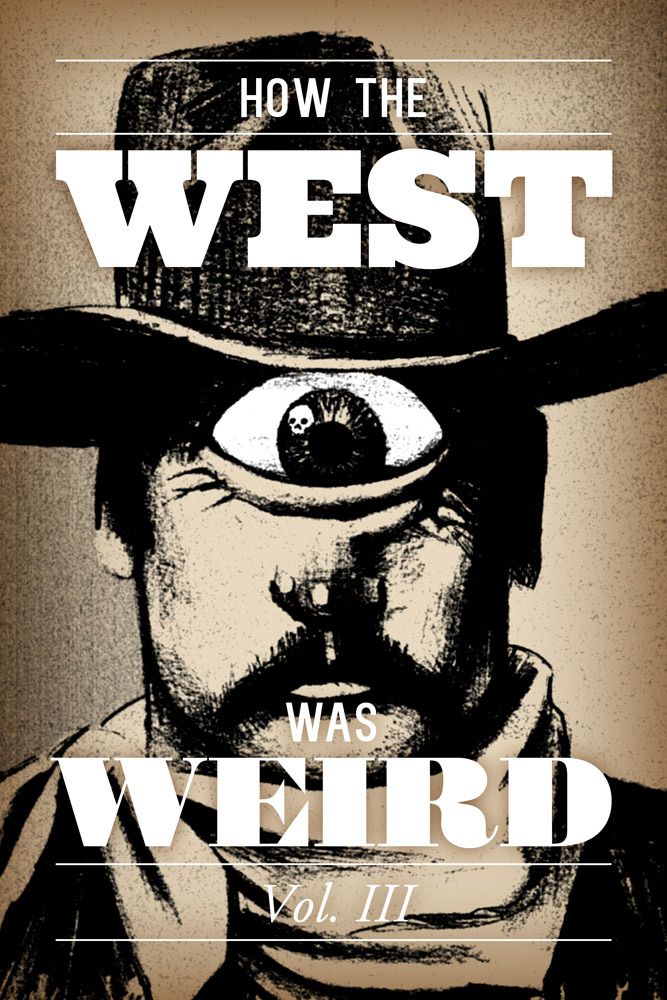
Today I just want to scratch a few thoughts about Lafferty's fiction in relation to the Weird West subgenre.  Roughly, a 'weird west' tale tends to mix classic western genre motifs with the monsters and horror of Weird Fiction (ala Lovecraft if you're Old School and Vandermeer if you're New School [and Miss Jackson if you're Nasty]). 

It's kind of like Cowboys & Cthulhu.

Or Lovecraft meets L'Amour. 

(art by Jim Rugg)


To me, it's a plenty stretchy genre that can also include things like Space Westerns and Future Westerns (e.g. android gunslingers) and other such genre-blending permutations (in the far reaches there are comic books series such as Cowboy Ninja Viking and Six-Gun Gorilla).  And it can draw not only on roots of classic westerns but also American Indian lore and Weird Mexicana (e.g. Día de los Muertos).  It overlaps a little with Spaghetti Westerns and Gonzo Westerns and Anti-Westerns (Cormac McCarthy's Blood Meridian being the quintessential specimen of this last type) and even the Southern Gothic literature of the likes of Faulkner and Flannery O'Connor.  For me, it's a loose and suggestive conglomeration of tangentially related imagery and concepts.

Enter Lafferty.  He's never going to truly fit any genre.  He mutates everything he touches.  Such is the case here.  He overlaps with some of the territory of westerns because his settings are frequently those of his own lifelong Southwestern environs, mainly his native Oklahoma.  Though many of his Oklohaman settings, in both novels and short stories, are urban, many also feature the wider non-urban landscape.  (And even the tales set in a city - frequently Tulsa - tend to have an eye for regional features.)  Since Lafferty's fiction tends to have a hefty dose of American Indian influence as well as stylistic innovations that made him at home in 1960s/70s New Wave science fiction for a while, I call his excursions into western-y territory 'buffalopunk' (think 'cyberpunk', 'steampunk', etc.).

Indeed, buffalos themselves sometimes feature in his yarns (e.g. 'Days of Grass, Days of Straw', 'Inventions Bright and New') as well as their 'byproducts' (hides, horns, meat, etc.).  And just think of all the instances where some character, instead of crying bullshit, cries 'Oh, Buffalo Hokey!'    And so it is with all the other fauna, flora, landscape, and general ephemera of the Southwestern region, which show up in equal doses of focused attention, background assumption, offhanded asides, and enmeshed textural detail.  You may not have even noticed it, but once you're paying attention, you'll see it often:  mesquite, coyotes, mesas, cattle, mountains, mountain lions, plains, 'bottoms', 'flats', crayfish, kit foxes, bears, and much, much more.

Of course, all these regional elements are either themselves 'weirded' in some way or are attendant upon the joyfully bizarre Laffertian carnival we've all come to expect from his tales:  the weirdness may be in the form of magic, horror (both visceral and ghostly), mad science, aliens, monsters, extreme violence or gore, dystopia, and general metaphysical antics (doubled people, landscapes that won't behave properly, skies raining everything but cats and dogs, talking fauna, persons filled with sawdust or confetti, etc.).  Hence the '-punk' suffix. 

You can think of your own list of stories that feature strains of Lafferty's buffalopunk, but some that spring to my mind are (in addition to the few named above) 'Boomer Flats', 'Happening at Chosky Bottoms', 'Narrow Valley', 'And Walk Now Gently Through the Fire', 'Sodom and Gomorrah, Texas' and 'Oh Tell Me Will It Freeze Tonight'.  These all take place in the Southwest, but even in Lafferty's offworld stories there is often a noticeable element of buffalopunk:  e.g. 'Pig in a Pokey', 'Snuffles', 'Golden Trabant', 'Smoe and the Implicit Clay', etc.  (Also, a number of his earliest stories, which are only recently beginning to come to light to a wider audience, are quite regional, though some are perhaps a little lighter on overtly freakish 'punk' elements:  e.g. 'The Wagons', 'Rain Mountain', 'Ghost in the Corn Crib', etc.)

His novel most relevant to this theme is obviously his historical epic of the Choctaws Okla Hannali (1972), but The Reefs of Earth (1968) comes a close second as a science fiction novel in full Southwestern Gothic-Weird mode, with its backwoods setting, murderous alien children, lively Indian mounds and so on. 

But what provoked this whole meditation for me was that I ran smack into a whole chapter of buffalopunk (IV: 'Liar on the Mountain') in my now third re-reading of Fourth Mansions (1969).  I'd remembered that the landscape behaved strangely in this passage, but I didn't remember how repletely Weird West this chapter was, complete with a Texas-Mexico setting (the same territory as McCarthy's Blood Meridian).  There is a very western 'mesquite and sagebrush' landscape described, which is rolling like the sea (an image of western plains I've seen in sources as diverse as McCarthy and Zane Grey, but here rather more literalised) and taking on impossible dimensions the further into it they go.  There's a preternatural guardian, a short bloody boar hunt, a cave-cooked meal, and even a many-tentacled black monster in a fountain in this chapter.  A delightful excursion into weird western!

The rest of the novel is very Tulsa urban, and still evinces not a little of buffalopunk, but that Lafferty just went full western in this chapter kind of freshly hit me and reminded me how frequently recurring is his element of buffalopunk.  Now I'm going to be trying to catalogue all its appearances and allusions.  (What, me obsessive? Pshh.)

Friday, October 3, 2014

Eco-Monstrosity in Cormac McCarthy and R. A. Lafferty (my dissertation proposal - approved!)

For those who may not have picked up on it yet, I'm a 'mature student' (40 years old and just now getting round to obtaining a proper education).  I am, at last, in my final year of a joint-honours degree in Philosophy and English Literature at the University of Glasgow.  The following is the rough starting point of what I'll be writing this year for my final dissertation in the English Literature half of the degree.  I was relieved when the department approved it and found a supervisor for me (haven't talked to him yet, so I have no idea if he has any familiarity at all with Lafferty). 

After prematurely claiming (over three years ago) that I was going to write a chapter on Lafferty as a Chestertonian theological storyteller for a book of Lafferty essays, it is gratifying to see that something along those lines is finally coming to fruition, even if only for degree work.  Better late than never.  (The editor of the proposed book of essays on Lafferty, our beloved Andrew Ferguson, has since been sidetracked by the noble and even more exciting task of writing Lafferty's biography - with which, I recently heard, he is nearly finished.) 

I was not then really up to writing an essay on Lafferty, as I fairly quickly discovered.  I'm still not, but at least I have some theoretical tools and preoccupations to throw at it now.  Below is the dissertation proposal essentially as given to my department.  Please don't be too distracted by technical jargon with which you may not be familiar.  I had a word-limit that precluded much elucidation of the terminologies.  I hope some reasonably clear conception of what I'm attempting will still come through. 

As it reaches completion (in April), the paper will become both clearer and different.  I'm not sure how it will change, but I know it will to one degree or another.  Unfortunately, it's only a 10,000 word paper and I'm covering two authors, so it's not going to be able to cover as much ground as I'd like.  But I think putting Lafferty in conversation with a recognised 'great writer' is worth it and will provide its own fascinating illuminations.  Please let me know your questions and criticisms of the proposal and suggestions for further theoretical materials and for other elements or works of Lafferty's fiction to consider as regards the topic.  (Please do tell me if you see any egregious errors based on any expert knowledge you have!)


Dissertation proposal:

The primary texts the dissertation will consider are Cormac McCarthy’s ‘anti-western’ novel Blood Meridian (1985) and R. A. Lafferty’s historical Choctaw novel Okla Hannali (1972) as well as Lafferty’s short stories ‘Narrow Valley’, ‘Smoe and the Implicit Clay’, and ‘Days of Grass, Days of Straw’[1].  The question the dissertation asks is:  can the iterations of eco-monstrosity[2]  exemplified in these two Southwestern American regional writers be grounded in and yet transmogrify theological readings of ‘nature’?  I.e. do these texts show ‘dark ecology’ and theological ecology to be mutually exclusive or do they open the way for some sort of harmony or hybridity?  I argue the latter.  Evocations of monstrosity in these texts make room for comic rather than tragic (or nihilistic) ecologies, undergirded by ‘dark’ or ‘weird’ theologies.

Lafferty is well known as a ‘funny’ writer, though his ‘tall tales’ are often grotesque and even gory.  It is also well known that Lafferty’s devout Roman Catholic beliefs infused all his work.  So it is no surprise that his ecology is ultimately theological and comic.  But it is not always appreciated that Lafferty’s fiction only achieves this ‘theo-comedy’ (to borrow a term from the theologian Thomas Oden) by way of much ambiguity and carnivalised horror.  McCarthy’s harrowing and hyper-violent novels, on the other hand, are often thought to be eloquent tracts for an unflinchingly bleak nihilism.  It is often argued that Blood Meridian in particular subverts theological readings of the world, but I will argue that it subverts only theologies that cannot embrace ‘dark’ ecology and thereby clears the way for more adequate theologies.

It is arguably rare that the disciplines of ecology, theology, and monster theory all three intersect in one study.  Certainly the proposed texts of this dissertation do not appear to have received this triangulated critical reading.  Both authors are, in any case, far from over-subscribed by academics and are thus ripe for more theoretical work.  McCarthy studies are now numerous but by no means enormous.  Lafferty studies are nearly non-existent[3] and as this obscure author is being slowly rediscovered[4], critical work is needed.  More generally, the worldwide growth in cultural awareness of both ecological and religious debates gives urgency to a cross-discipline study such as this.

The main critical tools the dissertation employs consist of Timothy Morton’s dark ecology[5], Graham Harman’s object-oriented ontology (‘weird realism’)[6], and Timothy Beal’s theology of monsters[7].  The foci of the reading will be the emphases the primary texts place on monstrous (usually grotesque or gigantic) evocations of flora, fauna, and landscape, and the place of humans therein that religious worldviews purport to provide.  With these tools I aim to show that the texts under consideration evince a theologically pertinent eco-monstrosity that serves to situate and orient readers within a dangerous but genuinely all-inclusive ontology.  The monsters here are not ‘off the map’ – the monsters are the map.  Further, the texts evince no easy disjunction between a so-called ‘post-human’ eco-centricity and the theo-comic ecology of, for example, Roman Catholic doctrine. Rather, the monstrous ecologies of the texts—in their strange grotesqueries and violences and in their characters’ lengthy theological declamations—tend to agitate for a ‘dark’ and ‘weird’ hybridisation of theological ecology and dark ecology:  a conceptual space in which humans are decentralised in certain respects (radically contextualised by the non-human environment) even as they bear the divine image.


[1] Possibly also drawing from the stories ‘Snuffles’, ‘And Walk Now Gently Through the Fire’, and ‘All Pieces of a River Shore’.
[2] This can be considered a particular artistic iteration of eco-centric or post-human or post-equilibrium ecocritical theories.
[3] Andrew Ferguson’s master’s dissertation ‘Lafferty and His World’ is the only ‘official’ academic work I know of on Lafferty so far, but a handful of critical reviews and comments can also be dug up - e.g. brief but insightful critical comments on Lafferty’s writing can be found from the likes of Ursula Le Guin, Brian Aldiss, John Clute, and Neil Gaiman.  Ferguson in his paper utilises Mikhail Bakhtin’s ideas on carnival and grotesque and Walter J. Ong’s ideas on orality to read Lafferty’s body of work:  http://www.academia.edu/329007/Lafferty_and_His_World.  Ferguson, a doctoral candidate at the University of Virginia, is currently writing the first biography of Lafferty.
[4] The Locus Science Fiction Foundation has recently acquired the rights to Lafferty’s works and through them Centipede Press have published the first of what is projected to be twelve volumes collecting the complete short stories by Lafferty:  The Man Who Made Models: The Collected Short Fiction Volume One (2013), Centipede Press, Lakewood.
[5] E.g. Ecology Without Nature: Rethinking Environmental Aesthetics (2007), Harvard University Press, Cambridge.
[6] E.g. Guerrilla Metaphysics: Phenomenology and the Carpentry of Things (2005), Open Court Publishing, Peru; Weird Realism: Lovecraft and Philosophy (2012), John Hunt Publishing, Alresford.
[7] Religion and Its Monsters (2002), Routledge, London.


The Dissertation Reading Stack!

Thursday, August 21, 2014

R. A. Lafferty writes like no one else, inventively strange and characterful and sparkling with deadpan wit

The astonishing emergence of R. A. Lafferty on the horror and science fiction scene over the last dozen years is a subject of much discussion and a Hugo Award.  Appreciated by both those who favor the more traditional story and those inclined to prefer the most offbeat and experimental, he has been a favorite of the best anthologists: Robert Silverberg, Harlan Ellison, and Damon Knight.  And while best known for his inimitable short stories, he has also turned out fine novels of science fiction, as well as Okla Hannali, which deals with the American Indians.  All this from a writer who has published most of his work past age fifty. But readers should not confuse Mr. Lafferty's chronology with an identifiable style of writing.  R. A. Lafferty writes like no one else, inventively strange and characterful and sparkling with deadpan wit.  Like this bit of regionalistic myth-lore, set in his native Oklahoma.

-from Frights: Stories of Suspense and Supernatural Terror (1976), edited by Kirby McCauley, featuring Lafferty's story 'Oh Tell Me Will It Freeze Tonight'.

Tuesday, June 14, 2011

A New Introduction to R. A. Lafferty


R. A. Lafferty (1914-2002) is truly my all-time favourite author of fiction, a huge inspiration on my own writing and thinking. Here is a fresh attempt at introducing him to my small world:

Dostoevsky meets Chesterton
Let’s start with a hefty dose of a few Old World masters of moral-spiritual fiction: Dostoevsky and Chesterton. Think of the deep, dark, and tenacious quest for God in a post-theistic world in the former mixed with the biting, satirical, joyous exuberance, wit, whimsy, farce, fancy, and wildness of the latter. (And, in terms of being predecessors to Lafferty, it is no coincidence that both of these great authors were creative adherents to Christian Orthodoxy.)


American Tall Tale meets Native American Folklore
Does this sound a bit serious and weighty? Well, Lafferty was such. But he is also constantly called ‘mad’, ‘insane’, ‘zany’, and the like. And he has the reputation of making the reader laugh aloud. So much so that the weightiness of his art has not often been appreciated. Chesterton’s influence can certainly account for some of the ‘lunacy’ and laughter. But for his unconventional qualities we must now also mix in the ingredients of American tall tales and Native American myth and folklore: Paul Bunyan meets Coyote the Trickster as it were. Think of the larger than life, hilarious, and gigantesque frontier exaggeration of the former mixed with the sly, wry, tribal, traditional, spiritual, ancient magic and mystery of the latter.

With these two major streams of Old World authors and New World folklore (you might call them ‘high’ and ‘low’ respectively, in terms of ‘register’) you can already see how Lafferty’s is going to be fiction that doesn’t easily fit moulds and that needs very large, wide-open spaces of thought and imagination to breathe and move and play and preach and fight and astound. But we’re far from through concocting this utterly strange brew.


Vaudeville meets Carnival
Keeping in the register of ‘Cowboys and Indians’, bring in the Vaudeville variety show and the Carnival barker. It’s the comedic, popular fun and 'burlesque' (as in absurd parody and exaggeration: there's no striptease in Lafferty's stories) of the former mixed with the freakish grotesquery and weird wonder of the latter—and the call for the audience to participate in both. There's song and dance and feasting and drinking and brawling and bragging a plenty in Lafferty's tales.
Irish meets Greco-Roman
Now let’s reach back to the much older Old World for influences before we finally charge into the latter 20th century context of when Lafferty was actually writing. Lafferty the Oklahoman was of Irish Catholic descent and it shows. The Irish storyteller is in him and he’s often been compared to both Flan O’Brien and James Joyce. You can also hear resonances in the contemporary playwright, Martin McDonagh. There is often even an Irish lilt or brogue to Lafferty’s cadence, syntax, and word choice.

In terms of wording and style and content we must also look back to ancient Greco-Roman sources of all varieties—plays, myths, philosophers, church fathers, politicians, treatises, epics, satires, ‘histories’ and so on. Thoughts and ideas from these ancient sources abound in Lafferty as well as everything else we’ve mentioned up to this point. The Bible and Medieval literature also make their influences felt, adding both a Hebrew and European flavour. And it’s worth mentioning here that there is some Arabic influence to be found also, perhaps mainly from the Thousand and One Arabian Nights and from Muslim culture of the Charlemagne era. From these Old World sources too I think comes Lafferty’s great interest in languages (partly by a working knowledge of which he re-invented the language and syntax of English Literature fiction to suit his own purposes).

American New Wave Science Fiction meets Southwest Regional Fiction
Lastly, we mention not so much influences as context—but a context that very much shaped the contours of Lafferty’s fiction. Lafferty’s fiction emerged mostly in the science fiction magazines of the 1960s among a constellation of ‘New Wave’ writers who were experimenting with new directions in the genre, focusing more on the ‘soft sciences’ of language, psychology, and anthropology rather than the traditional ground of science fiction in the ‘hard sciences’ of physics, technology, and so on. Harlan Ellison and the authors that populated his Dangerous Visions anthologies such as Roger Zelazny and Samuel R. Delany warmly welcomed Lafferty into their midst and praised him almost without qualification and with some genuine awe at the raw potency of his imagination and originality.

Many of these New Wave s.f. authors have a strong feel of the Beat Generation stylisings of the likes of William Burroughs and Jack Kerouac—and you often hear echoes of beatnik and jazz talk in Lafferty, but it is mostly just played with; his real roots are in the aforementioned, which arguably enabled him to out-jazz the ‘cool’ set at their own game.

But ‘cool’ Lafferty was not. He might be mistaken for such at a glance, but he was actually quite a bit older than most of his fellow writers of the time and really was doing something that was strange in a truly bizarre and pungent mode, not just a bit zany in a ‘hip’ sort of way. His experimentation, frankly, went far deeper and was more truly radical and structural, not least by being rooted in and nourished by potent traditions rather than attempting any kind of clean break with the past into a ‘new age’ or ‘summer of love’ or what have you. He was searching for bigger, muskier, shaggier, bloodier, spookier, gladder, subtler game.

One way he wasn’t as ‘hip’ as his contemporaries was by being far more of a ‘regional’ writer, particularly of his native Oklahoma and Southwest region. The open feel of the plains and prairies, of cattle and horses and horns and hooves, of fishing and hunting and living under the open sky, of saloons and ropes and saddles, of bucks and buffalos and bears, of Native Americans and ranch hands and cowpokes and so on, all permeate his fiction. Indeed, I felt so many tactile resonances with Lafferty’s fiction when recently reading Cormac McCarthy’s anti-western novel Blood Meridian. That was really when my eyes were fully opened to Lafferty as a regional writer of the Southwest. This places him, with all his other associations, loosely alongside some of his fellow Catholics who were Southern regional writers like Flannery O’Connor and Walker Percy.


A Ferocious, Generous, Joyous Storyteller
Does all this sound like perhaps a little too much broiling and roiling inside one man, too much for one artistic output? Well, frankly, sometimes it is! Lafferty at his very best (usually in his short stories) has a gemlike quality of concentrated power that swiftly and furiously, but smoothly, weaves and blends and infuses all or most of these streams of influence into an exquisitely coherent piece of art. It is truly awe-inspiring when it comes off. Really. But often his fiction is over-full, bristling, and careening with this background and all his feral genius firing and flailing.

Lafferty's world is one that feels like absolutely anything can happen, and yet it has an underlying coherence and solidity – it’s not a drugged up, tripped out psychedelic fantasia. It’s meaty, earthy, punchy, mythic, transcendent, wry, jokey, gruesome, funny, wily, ornery, amiable, farcical, grave, gritty, grotesque, delightful, magical, realistic, wild, noble, uncanny and canny all rolled into one. Indeed, this makes it something of a minor miracle that he can write an almost-mediocre story now and again (though there’s almost always a memorable wonder in there somewhere). His short story collections are the best place to start before moving on to the usually less cohesive, but equally wonder-filled, novels.

Lafferty can make you laugh harder and think harder than you’re used to, and also amaze your imagination and sense of wonder like few ever will. He called himself ‘the cranky old man from Tulsa’ and yet he fought hard to imbue the world with highly creative and inventive hope for a spiritually renewed present and future, calling all who would hear to join in world-up-building with all their powers and faculties on full throttle. He was a ferocious and generous and exuberantly joyous storyteller who spun out whopping tales at breakneck speed in a tumbling torrent of wild and glad and angry urgency and ecstasy. We are truly blessed to have had him. We must make the most of what we can get hold of.


‘Come on, y’all, this is awesome’
In closing, I want to mention that contemporary giants of ‘alternative’ dark fantasy such as Gene Wolfe and Neil Gaiman have cited Lafferty as a hero and influence. Both Wolfe and Gaiman have attempted to write stories in the ‘Lafferty genre’ (he really did essentially invent his own genre – in many ways he is the Captain Beefheart of American literature).


A few years ago, the New York Times asked the Saturday Night Live comedy actor, Bill Hader (a fellow Oklahoman), what books he recommended and he started his list with R. A. Lafferty’s collection of short stories entitle 900 Grandmothers. I’ll leave you with his apropos words trying to describe the experience of reading Lafferty:

‘It’s hilarious, incredibly funny and at the same time it’s insanely dark… You get such a sense of joy and boundless imagination in every sentence – even if the story doesn’t totally cohere, you feel like it’s about something. It’s so incredibly Tulsa. You get that feeling when you see a Flaming Lips show. It’s not like we’re dark and hurt and twisted. It’s like, “I’ve got blood on my face – come on, y’all, this is awesome.”’


'It was all strong talk with the horns and hooves still on it.'
(R. A. Lafferty, The Devil is Dead)