Showing posts with label worldview. Show all posts

Saturday, December 24, 2016

"I always break them," said the monstrous face.

There was the morning that Dana saw the whole fair landscape from horizon to horizon and realized that it was all on the inside of one very large soap-bubble. He saw then, beyond and dwarfing it all, the pipe that was blowing the whole bubble, and the face that was blowing the pipe. The wide world was quite small in comparison to that face. It was the face of a rather lack-eyed monster, somehow like an old Irish bummer, a little like that of one of the Other People who live under the hills. "Be careful, you'll break it if you puff any more into it." "I always break them," said the monstrous face. "I wish I could keep one of them sometime."

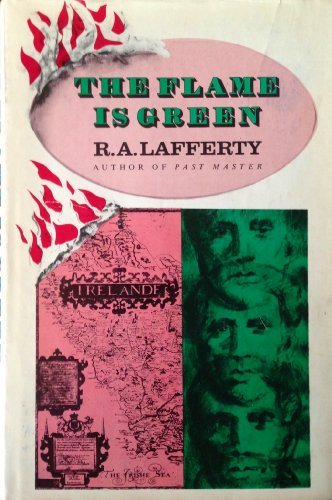
R. A. Lafferty, The Flame is Green (1971), p. 224

Almost finished with this sometimes incredible, sometimes baffling, novel, the first in the Coscuin Chronicles. (Pseudo) review forthcoming!

Have a happy Christmas Eve.

Saturday, June 6, 2015

Short Story Review # 3: Through Other Eyes (1960)

4.5/5

I'm starting to see that Lafferty may have had two mega-themes throughout his work, from early to late:  Creating and Seeing.  Lafferty's critical-theory interpreter and biographer, Andrew Ferguson, is doing yeoman's work on the Creating front, performing ongoing in-depth analysis of Lafferty's creative world-building and how his works metafictionally invite readers to participate in that world-building, especially given our world's present conceptual non-status.  I guess my essays in the first two issues of Feast of Laughter have been taking first stabs at the Seeing theme, especially as regards Lafferty's ability to widen and deepen our gaze to take in the non-human environment, and maybe that's going to be the bulk of the contribution I make to Lafferty studies.  I guess there are probably other major, central themes in Lafferty's body of work, but these seem to be two of them.  (Any ideas on others? If I kept on the present-tense verb terminology, I might call his emphasis on 'ghostliness', i.e. spirituality, his mega-theme of Being, which, of course, is ontological and undergirds his themes of Seeing and Creating.)

I've also begun to notice that Lafferty signals most of his major themes right from the earliest part of his career, sometimes with stories that are as accomplished and profound and groundbreaking as any he would write in his mid and late career.  We are put on notice that Creating will be a mega-theme from the outset by his chilling but somehow also invigorating story 'Snuffles' (1960).  So also, in the same year, he sets out for us his mega-theme of Seeing in the story 'Through Other Eyes'.

I think in the past this story has not been one of my top personal favourites because I got a little put off by the introduction, or first panel, of the tale.  I typically don't love it when stories or novels start off with dialogue - I'm a sot for description and that's how I prefer any piece of fiction get going. Immerse me in either action, or, even better, setting, and I'm a very willing reader.  Start me in the middle of a conversation, with little or no imagery, and I'm just enduring it to get through to whenever the description of this world I've entered will finally begin.  I'm sure some readers are opposite, or appreciate both.  (And, of course, I know dialogue does tons of the work of building the setting and telling the story.)  Having said all that, the first line of this story is a cracker:  '"I don't think I can stand the dawn of another Great Day," said Smirnov.'

But the characters' subsequent discussion of time travel experiments feels like a very clunky way to get started. (I think discursively top-heavy intros are often the case with the Institute of Impure Sciences cycle of stories, of which this is the earliest.)  It is very, very erudite and witty - if you are familiar enough with the references.  First of all, I'm not a general history buff, so I'm just not that interested, even if I know the references, but secondly, I had to look several of them up, some of which research yielded a smile or chuckle at Lafferty's handling of the historical material (especially Nell Guinn).  The take on Tristram and Isolde (a reference I did readily recognise) was amusing, and the portrait of Lancelot was the best of the lot to my mind: that he 'spent more time on the rubbing table than any athlete I ever heard of', like a 'high-priced quarterback who was never ready to play'.  (Incidentally, Gene Wolfe compares medieval knights to American football players in his novel The Knight.)  And the reference to Aristotle's treatises on the Beard in Essential and Beard in Existential (pretend treatises, as far as I can tell, though A. did apparently write something or other about beards in some work or other) was funny, a joke whose relevance has come round again with our present bewhiskered hipster-mania.  As I say, as clever and amusing as all this is, it is a slow start to the tale for me and a seemingly irrelevant one to boot given that it is not a setup to a yarn about time travel! Yet I did 'get it' this time round.  This opening gambit supplies an instance of how our successes at peering into unknowns can sometimes shrink rather than expand our world.  The past didn't look as glorious as our handed down accounts when you could actually be there and witness it. And that's the setup:  a foreshadowing of the results of the real experiment at hand in this story (which will be complexly fulfilled, as the subsequent experience will end up being too successful and overly expanding).

Now, I will say that catching this structural element this time round made something else click for me about Lafferty's works.  I'm noticing more and more that his structures can be very, very odd, often in this kind of asymmetric triptych, or otherwise 'panelled' sort of way, where the movements or sections are each quite different from one another in mode or some other aspect of presentation or performance or content.  In some ways it's almost like the stories change styles as they change scenes or sections.  I'm not going to try to analyse it right now, but 'Land of the Great Horses' and 'Thieving Bear Planet' are an early and late story that strike me as instances of this structural phenomenon (the former without the numbered parts and the latter a numbered asymmetric diptych).  A lot of Lafferty's structures are actually beginning to put me in mind of the ornate stories of Jorge Luis Borges.  More consciously recognising the tripartite structure of 'Through Other Eyes' this time round enriched the reading for me.  Even though I don't love the first panel of this particular tale, I do appreciate how it adds to the structural elegance.

At the end of this opening, Smirnov proffers the opinion that 'One pair of eyes is enough.  I do not see any advantage at all except the novelty.'  This is the view Lafferty will never tire of knocking down for the rest of his career.  (Cf. the notion that 'A man misses so much if he uses only one set of eyes' in his 1969 novel Fourth Mansions.)  And this statement from Smirnov allows Cogsworth to state the thesis of the whole short story:  'I believe that what we regard as one may actually be several billion different universes, each made only for the eyes of the one who sees it.'

For me, even though section or panel 2 is where this story really starts to pay gigantic dividends, we still have to get through another page or so of story-stalling theory-speak before it does so. Nevertheless, having just read William James's seminal paper 'What is an Emotion?' (1884), and its subsequent responses in the philosophy of emotion, for a course this past semester, I found Lafferty's little discussion of brains and perception quite neatly fitting into that discourse.  So that was a bonus and something probably worth digging more into.

But it's when Cogsworth's initial thesis is elaborated upon that this tale blows up for me and goes full Laffertian.  He experiences the age-old subjective perception question as a boy, with a fairly commonplace example:  'It may be that I am the only one who sees the sky black at night and the stars white [...] and everybody else sees the sky white and the stars shining black. And I say the sky is black, and they say the sky is black; but when they say black they mean white.'  But, as Harlan Ellison recently noted, Lafferty 'could take a simple idea and say, well, wait a minute, look at it this way.'  True to this propensity, Cogsworth then delightfully and freakishly stacks up weirder and weirder examples, starting with wondering whether others see cows inside out and finishing with wondering whether, when a bird eats a worm, does the worm think 'that his outside is his inside, and that the bird's inside is his outside? And that he has eaten the bird instead of the bird eating him?' (See the whole wonderful passage here.)  We are notified here that when Lafferty talks about every single person seeing the world differently than every other, he really means it, radically.  The amazing thing is that he pays this out in the rest of the story.  Incredible stuff.

After an entertaining wee wander through the eyes of a great man, a wide man, a mathematical man, a fastidiously detailed man, an already-looking-back-at-you man, and a radically sceptical man, there is nothing left but to look through the eyes of a woman.  She is an exceptional woman to Charles Cogsworth (he's in love with her as becomes clear), but Gregory will later tell Cogsworth she's a pretty average gal. Apparently, however, looking at the world through the eyes of even an average woman is wilder, fuller, and more challenging than looking through the eyes of any or all of those diverse kinds of men combined.  Cogsworth says he has seen the world through the eyes 'of a giant, of a king, of a blind hermit, of a general, of a peeping tom, of a fool' and now he will see it through the eyes 'of an angel'.  The narrator has this to say about that:  'Valery Mok may or may not have been an angel. She was a beautiful woman, and angels, in the older and more authentic iconography, were rather stern men with shaggy pinions.'  The implication is that even if Cogsworth saw through the eyes of an angel, he might see a much shaggier world than he was expecting.  At any rate, he is utterly shell-shocked by seeing through Valery's eyes, so much so that he has to spend six weeks in a sanatorium.

Now comes the third and final panel of the story.  Cogsworth eventually chats with his friend Smirnov some more and is challenged that perhaps he just doesn't understand girls!  I won't go much into this final panel of the story as I dealt with it somewhat extensively at the close of my essay for Feast of Laughter issue 2.  Suffice it to say, the view of the world just gets beautifully weirder as we're treated to a description of Valery's universe, imaginatively sensual and mythically literal to a genuinely 'ecomonstrous' degree.  What I do want to note here is how this story contrasts with C. S. Lewis's similarly themed tale 'The Shoddy Lands' (first published in the February 1956 issue of The Magazine of Fantasy and Science Fiction).  The male protagonist of Lewis's tale also sees the world through the eyes of a woman, but he sees not a wildly hyper-sensuous world but a 'shoddy land' full of vague, shoddy flora and people and objects, with a few frivolous and vain exceptions.  I've always really liked Lewis's story for its imaginative premise rendered quite evocatively.  And I don't think it's necessarily damning that the protag of 'The Shoddy Lands' happens to look at the world through a particularly vapid and boring young lady's eyes, especially as Lewis published a whole novel that same year, Till We Have Faces, which is narrated by the fiercely intelligent and fascinating voice of a highly admirable female protagonist.  Nevertheless, it's fascinating and instructive that, in contrast to 'The Shoddy Lands', in 'Through Other Eyes' Lafferty's view through female eyes is gobsmacking, challenging, expanding - the polar opposite of 'shoddy'.  Indeed, it's Lafferty's male protag that comes in for criticism from Valery for his view of the world being too shoddy:
She burst in on him furiously one day.
“You are a stick. You are a stick with no blood in it. You are a pig made out of sticks. You live with dead people Charles. You make everything dead. You are abominable.”
After a bit of half-hearted argument from Charles Cogsworth, he is duly humbled (as is, to be fair, Lewis's protagonist at the end of 'The Shoddy Lands' when he shrinks from the thought that someone might well look at the world through his eyes and see a similarly shoddy landscape, just differently distributed based on his own parochial inclusions and exclusions).  This is a story of being shattered by being too-suddenly immersed in the viewpoint of the Other, and then slowly put back together by further humbled engagement with that same viewpoint (and other POVs as well - it's not unimportant that Cogsworth builds back up to understanding Valery by first seeing the world through other people and even various animals, all of these views surprising, challenging, and enlightening).

One last thing I noticed this time round, which was a delightful surprise, is that this is really a 'cute' romantic love story buried in philosophical rumination.  Charles and Valery are married by the time of the one novel in the Institute cycle, Arrive At Easterwine (1971).  As a man married to a woman whose visual and sensual view of the world is generally far greater than my own, and who must lovingly remonstrate with me about my 'dead stick' view from time to time, and whom I can't help but love for it, 'Especially when it becomes beautiful when angry', I can really resonate with the love story aspect of this tale.

* Discussion of 'Through Other Eyes' on Facebook

* 'Through Other Eyes' entry on Continued On Next Rock blog

* 'Through Other Eyes' comments on ralafferty.org 
Saturday, May 30, 2015

And what if the dog is right?

This idea of his—to enter into the mind of another, to peer from behind another's eyes into a world that could not be the same—this idea had been with him all his life. He recalled how it had first come down on him in all its strength when he was quite small.

“It may be that I am the only one who sees the sky black at night and the stars white,” he had said to himself, “and everybody else sees the sky white and the stars shining black. And I say the sky is black, and they say the sky is black; but when they say black they mean white.”

Or: “I may be the only one who can see the outside of a cow, and everybody else sees it inside out. And I say that it is the outside, and they say that it is the outside; but when they say outside they mean inside.”

Or: “It may be that all the boys I see look like girls to everyone else, and all the girls look like boys. And I say ‘That is a girl,’ and they say ‘That is a girl'; only when they say a girl they mean a boy.”

And then had come the terrifying thought: “What if I am a girl to everyone except me?”

This did not seem very intelligent to him even when he was small, and yet it became an obsession to him.

“What if to a dog all dogs look like men and all men look like dogs? And what if a dog looks at me and thinks that I am a dog and he is a boy?”

And this was followed once by the shattering afterthought: “And what if the dog is right?

“What if a fish looks up at a bird and a bird looks down at a fish? And the fish thinks that he is the bird and the bird is the fish, and that he is looking down on the bird that is really a fish, and the air is water and the water is air?”

“What if, when a bird eats a worm, the worm thinks he is the bird and the bird is the worm? And that his outside is his inside, and that the bird's inside is his outside? And that he has eaten the bird instead of the bird eating him?”

This was illogical. But how does one know that a worm is not illogical? He has much to make him illogical.

~R. A. Lafferty, 'Through Other Eyes' (1960)

Cover by Paul Orban

Saturday, March 8, 2014

Serpent's Egg (1987) - 'That wonderful, that blessed, that hope-of-the-world thing'

Meet the Twelve Children of the Experiments, each one hyper-intelligent, each one a Mega-Person, each one under suspicion and surveillance as a potential Serpent's Egg to be crushed in the shell:

The Lynn-Randal Experiment:  Ruddy Lord Randall, the young male human; Inneall, the young female ambulatory computer; Axel, the young male Golden Ape (or Blue-Eyed Ape or Gargoyle, a member of the Unfallen People or Second Humanity).

The Wintergreen-Luna Experiment:  Marino the young male seal ('his mind and his personality and his outgoing spirit gleamed as his hide gleamed with its wetness in the sun when he came out of the water'); Luas the young male angel (who wouldn't be greatly missed in heaven - 'he was of one of the lower classes of the highest of creatures'); Henryetta, the young female human (flame-haired, flame-tempered, and flame-powered, gifted with pyro-kinesis).

The Dorantes-Saleh Experiment:  Lutin, the young female python (a prophetess); Dubu, the young female bear (whom all the other children called Little Mother); Schimp, the young male chimpanzee (erudite, degreed with a doctorate, he regularly wore an academic cap and gown).

The Gruenbaum-McGregor Experiment:  Gajah the unborn female Indian elephant (in the tenth and final year of her gestation in the womb of her mother, an Empress elephant; she communicates by telepathy as well as by means of a percussion language on a tiny drum inside her mother's belly); Carcajou, the young male wolverine (half animal, half devil); Popugai, the young male parrot (from New Zealand, big enough to kill and eat a sheep; with perfect recall and understanding and pronunciation, 'he knew the basic vocabularies of six hundred human languages, and of many thousands of insect, reptile, animal, and bird languages').

The location is only barely named, but this is one of Lafferty's many Oklahoma stories.  It is the end of summer in the year 2035, specifically the Last Three Days of Summerset.

Each set of three 'children' grew up together and now all twelve have been brought together as each approaches his or her tenth birthday.  Their project has been to find 'new ways of looking at the world, but not too cockeyed new'. But it looks like they have indeed been 'too cockeyed new' in their shining intelligence and vision and thus the Dolophonoi, the knife-wielding assassins, are drawing near to put an end to it before it really gets started.
Serpent's Egg is another of Lafferty's many apocalypses and shares themes (e.g. 'is this world an Egg that will shortly birth a new world?') strongly in common with Past Master (1968), Arrive At Easterwine (1971), and Annals of Klepsis (1983).  The novel also shares, in a more minor key, the theme of 'is any of this real or are we just dreaming?' with Where Have You Been, Sandaliotis? and The Three Armageddons of Enniscorthy Sweeney (these two short novels are collected together in Apocalypses, 1977) and East of Laughter (1988).  The novel's satiric dystopian quality (e.g. a Kangaroo Court rules the Global Village) resonates with works like Lafferty's novella Ishmael Into the Barrens (1971) and his short story 'And Walk Now Gently Through the Fire' (1972).  The characters are said to be living on the Floating World and this critique of modern society's lack of depth frequently recurs in Lafferty's fiction - e.g. Fourth Mansions (1969), 'Encased in Ancient Rind' (1971), From the Thunder Colt's Mouth, (1975),  and 'Bequest of Wings' (1978).

From the above thematically associative list it's easy to believe Lafferty's own claim that his body of work really added up to one long unfinished novel (which he called A Ghost Story).

The prose in Serpent's Egg is perhaps not as dense or as lyrical as the likes of Fourth Mansions, Past Master, Annals of Klepsis, or The Devil Is Dead (1971) or indeed of many of Lafferty's most famous short stories (the 1970 collection Nine Hundred Grandmothers contains many prime examples).  The poetry seems to mostly have been externalised into the very characters and events of the novel more than in the language that describes them.  The above cast is a shining example and various scenes in the novel sing out in sheer conveyance of the happenings.  Examples of the latter are that Inneall the little girl computer is making a New Ocean right there in the town and Heart's Desire Cove springs up round it as a local carnival or fair, the description of which is classic Lafferty 'high time' fun, full of outrageously oddball activities and elements:

Hearts Desire had become a great entertainment center, all within a week... A feature there was 'Computer Enhanced Music', and all sorts of music lovers came there.  The birds also were faithful listeners and participants.  Human music alone had never touched them much, but the enhanced music struck a chord with them.  Sometimes there were whole choruses of larks and catbirds and mockingbirds and of the multi-songed cardinals.  There was even the mightiness of ten-thousand voice crow-calls.  And the swifts and swallows and even the evil shrikes did air dances when the people and the 'people' danced.

And the fast-lunch and fast-drink places were attractions for old and young... Where else could one get Hot Coon Sandwiches?  Where else Ocean Catfish garnished with Crayfish tails?   Where else Persimmon Wine?  Where else Choc Beer as Mother Used to Make It?


[...]


At night there were the bonfires on Ocean Shore.  They were built out of folk memory... Oh the Campfire Songs that the people and the 'people' sang and entoned [sic] on the rocky shores of the Cove on those chilly End-of-Summer-Nights!  They sang 'Star People' and 'Skokemchuck Rag', 'Bandicot Blues' and 'World Village Medley', 'Ambulatory Ambles' and 'The Socsollabcomdem Party Potlatch', 'New Directions Ramble', 'Charisma Concerto', 'The We-Owe-A-Lot-To-Otto-Wotto Hootnanny', 'The Sixth Dream of Molly Mechanicus', 'New Entity Rock', 'Oh New Rice Feeds the Far-flung World!', 'Interspecies Intermezzo', 'Inneall's Ocean Hallelujah'.


[...]


Every night, some of the Computers sang 'Moon People Vaunt', a song that always caused at least a small amount of friction.  Only computers lived in the Moon Colonies.  Humans couldn't live on the Moon without elaborate support systems.  But Computers could live anywhere, even on the blistering hot surface of Venus or on the killingly cold surface of Jupiter... But everybody could enjoy such sing-a-longs as the 'Excitements Hot and Cold Suite' and 'It's the Crustacean in Me', a song of aeons-spanning nostalgia; and 'Going Home Over The Star Bridge'.


(pp. 57-60)

Or take the antic images that fizz and sparkle in your mind after hearing a series of little wisdom tall tales related by Dubu:

"I have a notion," said the young female bear Dubu, "that the answer to all the hard questions are written on the inside of one single Acorn somewhere.  This particular acorn, if placed in lye-water, will swell to a billion times its original size, and then it will burst open.  And whole mountains-full of writing will come tumbling out of it.  Then everyone can come and read it and enjoy it and know everything.  The only difficulty is knowing which acorn in the world is the right one.  I believe that there are clues pointing directly to the right acorn, but we do not notice them because they are so big and so plain and so close to our noses."

[...]


"Many bears in their natural state know everything.  Go down into the Winding Stair Mountains and walk out on the bear tracks.  When you meet another bear, if he is one of the bears who know everything, he will give you the 'All-Knowing Wink'.  No animal except the bear can give the 'All-Knowing Wink'.  The face muscles of other animals simply aren't adequate for it."


[...]


"I have a notion that turtles have uncanny and cryptic information written in the groove on the bottom side of their tongues.  The turtles themselves do not know about this, nor do the chelonologists.  But the people who work in turtle-soup factories are so very smart because they know about this hiding place.  They  read the turtles' tongues like Chinese fortune cookies, and what they read is total knowledge."


(pp. 74-75)

Lafferty's weaving together of folkloric, anthropological, and ecological tropes is both bewildering and awe-inspiring.  That, I suppose is part of the point of this novel.  It is a search (as is most of his work in one way or another) for how we can obtain an adequate view of the world that doesn't leave anything out and also Ties It All Together in some satisfactory and even salvific coherence - a coherence, we may be assured from the above quotes, that is comedic and carnival, not static and 'tidy'.  Indeed, it was the putting forward of two contrary views about this vision-casting that prompted Dubu's reflections:

"As to why we are here, Satrap, and what we are supposed to be doing here," Felix Snake-and-Dove got on the track again, "we are here to weave the seamless garment of our individual lives, and of the lives of those around us, of the neighborhood, of the countryside, of all the creatures down to the smallest, of all realms and continents and oceans. We are here to weave the seamless garment that will be highly detailed from the subatomic particles to the galaxy clusters. It must include all minds and ideas and inklings, all joys and all immediacies. There can never be enough weavers, there can never be enough brilliant details in the seamless garment known as 'The Life Affair'. And we can never be finished with it, for it continues to grow seamlessly."

"Weaving is outmoded, Felix," said Livius Secundus the history-writing Computer.  "Fabrics are no longer woven.  Now they are extruded by extruding machines.  Personal groups, landscapes, worlds, galaxies, all are extruded by a simple extruding machine which you could make yourself."


(pp. 73-74)

As always in Lafferty, there is a deadly urgency to these philosophical debates, as the presence of the aforementioned assassins attests (reminding one of the mechanical killers in Past Master and the nothoi-hunters in Ishmael Into the Barrens).  The Powers That Be in this tale are not only perpetrating socio-massive thought-control (another theme dear to Lafferty who repeatedly bemoaned catch-phrases and slogans and how the masses were made into 'sheep' by being 'fed' on them), but also death-dealing population control.

As to the former - thought-control - Lafferty describes a scenario very much like our 21st century internet planet:

It became a world in which everything and nothing was public.  It became a world with very little superstructure.  It became a world in which ideas and notions were transmitted instantly to every part of it.  But could such a world work? (p. 80)

He's asking the question honestly.  It is evident from his body of work that Lafferty loved technology and the sciences and he longed for humanity to truly stretch out and mature in itself, spiritually and intellectually, and in harmony with the natural environment.  Lafferty believed in the 'Fulfilment and Enlargement of the World' (p. 94), but his works dramatise how competing visions of what this is and how to bring it about collide. Wrong-headed utopias, Lafferty averred, would only make the bottom drop out on such maturing processes. The Kangaroo that Rules the World, as the elite social engineers in this tale are called, had backed the 'leveller movement':

One used to thinking of levelling as trimming the top off something into a semblance of evenness. But these 'levellers' trimmed the bottoms off of humanity and computerdom and the world itself. (pp. 80-81)

This was tragically not only the cutting out of our psychological and spiritual depths through reductionist philosophies and worldviews, but also the cutting out of our population depths:

The lower classes of everything were terminated without particular ado, without much apparent suffering, without any great quantity of visible bloodshed.  The bereft families did not ask where their inept members had gone because most of the families that had inept members went with them. Persons seldom asked where their neighbors had disappeared to, because usually it was entire neighborhoods that disappeared. The 'Don't make a big thing out of it' mentality was rife in the world, so a big thing was not made of the disappearance of eighty-seven percent of the persons in the world.  After all, that eighty-seven percent of the persons in the world had made ninety-seven percent of the trouble in the world.  In all logic there was much to be said for the 'removals'.

This is skin-crawling stuff.  The wisdom of Dubu the young female bear had earlier countered this pogrom programme:

"Oh, Oh, Oh, what will we do, Dubu, with all those countless billions of unwashed commoners?  I wonder whether they're necessary at all."

"Yes, they are necessary," Dubu answered in that 'ruf-ruf' voice that bears use for human talk. "We are the tree.  You are only the top leaf on the tree.  It's the one that quakes and moves in the wind as though it were an aspen leaf, the first one to fall when the inclement weather comes.  And I'm unwashed myself.  I don't use water.  I use a curry comb instead.  Curry combs are too good for horses, but they're just right for bears."


(p. 63)

If you read Lafferty long enough, you'll notice what might amount to a paranoia about this possibility of mass extermination of those who don't 'fit in' to certain versions of utopia.  But then again, his was a century that included literal secret police, travesties of trials, public executions, and dicatatorial mass exterminations of millions of people who didn't fit in to certain social visions.  (Not just Hitler and Nazism, of course, but also Stalin and Pol Pot and others.)

At any rate, though Lafferty was self-professedly 'cranky' and certainly had a dark turn of imagination, I can't in good conscience call his body of work pessimistic.  His themes of hope and of new birth on the far side of tragedy persist from the earliest to the latest novels and stories and Serpent's Egg is no exception.  The wonderful later chapters of this novel with their depictions of whales and sea lice building profound monuments on the ocean floor give vivid form to Lafferty's hopeful vision.  Chapter twelve in particular immerses the reader in an 'Oceanic Hyper-Active Dream State', which provides 'new eyes and new ways of looking at the world' full of creativity and possibility.  Our dream guide is a man who is one of the 'metamorphic creatures who can turn into Deep Ocean Denizens'.  Such a man is an 'Ocean Obscenity or Monster' for 'All Ocean Creatures are obscene, in the nicest sense of that word'.  Thus he is 'in his beautiful oceanic-ugliness-monsterness as we saw him and loved him today' (p. 144).  Lafferty is always very comfortable with placing grotesquery and monstrosity in the category of beauty and virtue.  With these phantasmagorical goggles on we see:

And the whales were making giant crypts and cenotaphs and menhirs from the blocks and shafts and trabants of marble.  It was utterly strange down there at Whale Town, and completely homey also.  A sign which the whales had put up proclaimed to all visitors "We're Glad You're Here".

[...]


The Temple-City that the Whales were building was certainly prodigious and entirely wonderful.


[...]


The beautiful pink, lilac, tan, orange, and mauve-tinted marble of the Whales' Constructions had also on it happy blotches and gouts of the greenest green ever.  It was a color so green that no language of Earth except only Malay has a word for the color.  Malay does have a twelve-syllable name for the color, a name that might be translated as 'The Green of Swarming, Ocean-floor etching, deep-sea lice'.  Yes, that vivid green was a living color, and one beautiful blotch of it, festooning the caput of a pillar, might contain a million of the small ocean-floor sculpturing Lice. They were quite small.


The small ocean-lice were etching figures and faces into the big marble and granite stone-pillars. Though not one, and not ten thousand of the little lice had enough scope and reach to comprehend what they were sculpting, to know what the statuary was all about, yet the lice were receiving and obeying orders from somebody, and likely from the whales.  The portraiture art, cut in high-and-bas relief out of the giant stone pillars and walls and lintels, had to be the Art of the Whales.


Mostly the faces and forms were those of famous whales of yore.  But there were also distinguished-looking animal faces, human faces, god faces, even strange computer faces, all emerging from the big stones that the sea-lice were sculpting for the whales.  And whenever they finished one of the great and distinguished faces, the sea-lice covered it over with a beautiful and thin plaiting of nacre or mother-of-pearl.


(pp. 137-138)

By the novel's end this dream of a coalescing vision of life has not yet saved the day.  It is still an underground thing. It is the resistance movement that stubbornly refuses to be stamped out.  It is the 'egg' of promise and new beginnings.

Indeed, one of the surviving Children of the Experiments, Lutin the young female python, who had become pregnant earlier in the narrative, appears to have given birth to a giant egg:

"Lo! - and Behold It!"

"That thing!" Inneall cried out aghast.

"Yes, that thing with the beautiful golden and blue light pulsating about it!"  Lutin spoke out of her mood of rapture.  "That wonderful, that blessed, that hope-of-the-world thing." 

(p. 154)

Dubu the wise young female bear says that 'a couple of odd fellows' gigglingly informed her about the egg:

"It is the joke by which the World will be saved and transformed". (p. 155)

And this too resonates with one of Lafferty's consistent themes.  In his early story 'Nine Hundred Grandmothers' (1966), when a space explorer asks "How Did It All Begin?" of those who purportedly can tell him the answer, those who were actually there at the Beginning, he is met with giggling and laughter and told: '"Oh, it was so funny how it began.  So joke! So fool, so clown, so grotesque thing!" [...] And they laughed. And laughed.  And went on laughing...' Storming off angry, thinking he hasn't received an answer, the explorer misses that he has.  He misses that he is being told that the universe is rooted in Cosmic Laughter.  In the short story 'And Walk Now Gently Through the Fire' (1972), the scattered disciples of Christ are the only hope left for rebuilding a post-catastrophe world and one of them informs another that sometimes 'the Lord... jests, He jokes, and we be the point of His most pointed jokes.'  And so here in Serpent's Egg also, Cosmic Laughter is the creative power for the New Beginning as much as the Beginning. We are not told what is inside the egg, but only given clues and hints and an 'Epilog by a Sea Louse'.

This novel is one of the more coherently structured and executed of Lafferty's notoriously difficult novels.  It meanders a bit in the third quarter, but the majority of it is packed with Laffertian wit and wisdom and weird wonders.  It is perhaps not quite the feast that, say, Annals of Klepsis or Fourth Mansions or Past Master or Arrive At Easterwine are, but I would definitely call it unmissable.

Friday, February 17, 2012

'A world that believes in open things is at least fertile...'

'What things a man or a world believes or disbelieves will permeate every corner and shadow and detail of life and style, will give a shape to every person and personifact and plant of that world.  They will form or they will disorder, they will open or close.  A world that believes in open things is at least fertile to every sort of adventure or disaster.  A world that believes in a closed way will shrivel and raven and sputter out in frosty cruelty.'

                                                                                                   Audifax O'Hanlon


(R. A. Lafferty, 'Ishmael Into the Barrens', originally published in Four Futures, 1971)

'It was all strong talk with the horns and hooves still on it.'
(R. A. Lafferty, The Devil is Dead)